
Professional Shingle Roof Installation in Central Florida
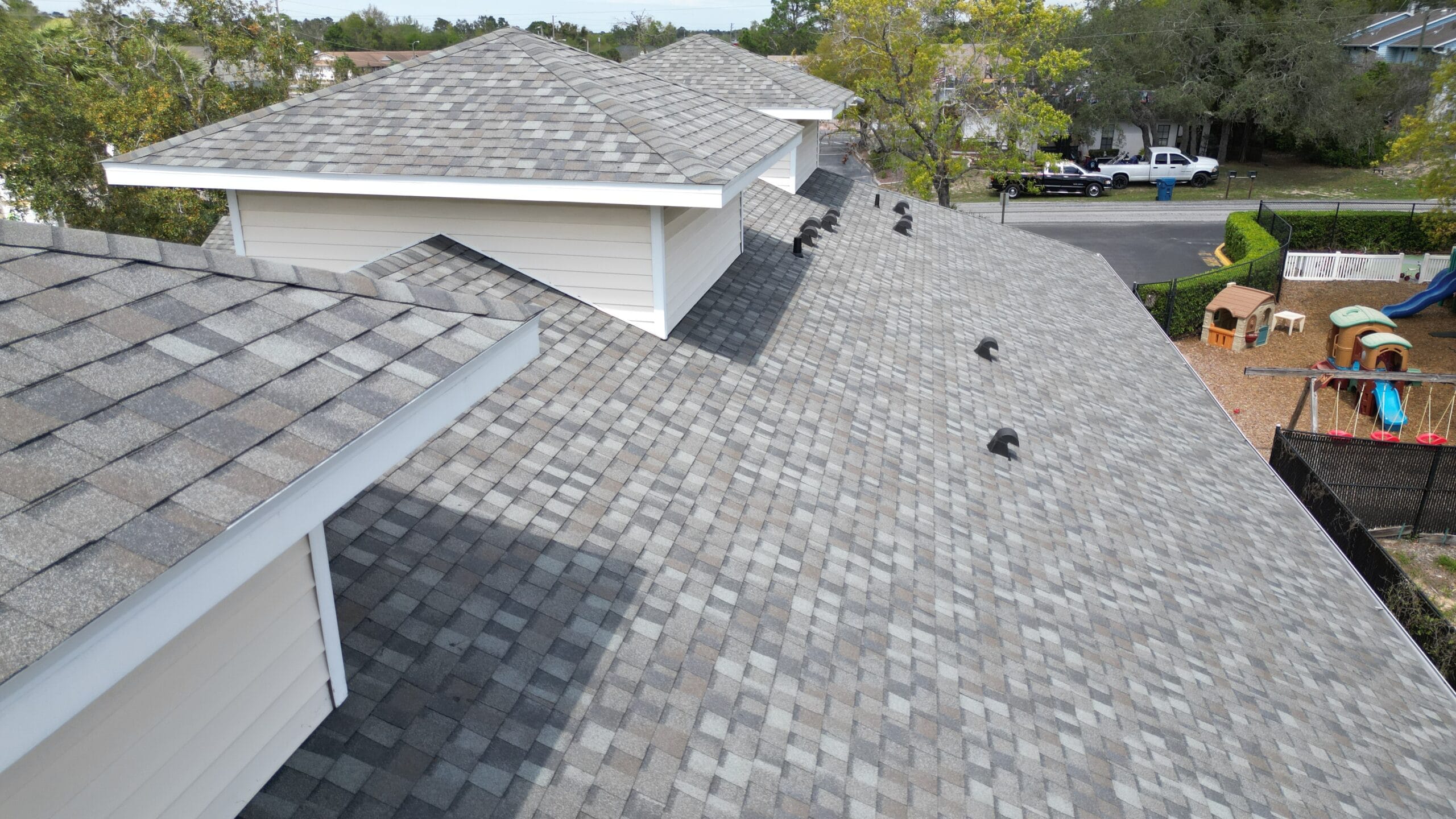
GAF, Owens Corning, and CertainTeed: How the Big Three Compare in Florida
There are dozens of shingle manufacturers in North America, but three companies dominate the Florida market for good reason. GAF, Owens Corning, and CertainTeed each bring different strengths to the table, and understanding those differences matters when you are investing $15,000 to $30,000 in a new roof.
GAF Timberline HDZ has become something of an industry standard in Central Florida. The HDZ line features a patented StrikeZone nailing area that makes proper fastener placement more consistent, which matters enormously in a high-wind zone. What sets GAF apart in Florida is their wind warranty: the Timberline HDZ carries a 15-year unlimited wind speed warranty right out of the box. That is not a typo. While competitors cap their standard wind coverage at 110 mph, GAF backs their HDZ shingle against any wind speed for a decade and a half. Installed costs for the Timberline HDZ in our service area run $4.50 to $6.50 per square foot in 2026, depending on roof complexity, access, and whether we are doing a tear-off or overlay.
Owens Corning Duration shingles compete directly with the HDZ and bring their own advantages. The Duration line uses Owens Corning’s SureNail technology, a woven strip embedded in the nailing zone that gives each fastener a stronger grip on the shingle. Standard wind coverage is 110 mph, which jumps to 130 mph when installed with their recommended high-wind application method. Installed prices land between $4.75 and $6.75 per square foot. Owens Corning also makes the Duration Designer series, which adds a thicker profile and more pronounced shadow lines for $5.75 to $7.75 per square foot installed.
CertainTeed Landmark shingles round out the big three with what many contractors consider the best aesthetic in the architectural shingle category. CertainTeed offers over 40 color options in their Landmark line, more than either GAF or Owens Corning, and the dimensional appearance of their shingles is noticeably richer at certain viewing angles. Wind warranty follows the same 110 mph standard, upgradeable to 130 mph with proper high-wind installation. Installed costs range from $5.00 to $7.00 per square foot. For homeowners who want the absolute premium look, CertainTeed’s Grand Manor luxury shingle runs $8.00 to $11.00 per square foot installed and creates the appearance of natural slate at a fraction of the weight.
On the GAF side, their premium option is the Grand Sequoia line, which runs $7.00 to $9.00 per square foot installed and offers a rugged, heavy-cut look that works well on larger Florida homes.
So which manufacturer wins in Central Florida? The honest answer is that all three produce excellent shingles that will perform well here. GAF’s unlimited wind warranty gives it an edge for pure storm protection. CertainTeed wins on aesthetics and color selection. Owens Corning’s SureNail strip is arguably the strongest nailing technology. We install all three brands and can walk you through samples at your home. Call us at (352) 605-0696 to schedule a consultation.
Architectural vs. Designer Shingles: What the Price Difference Actually Buys You
Every shingle conversation eventually comes down to this question: is it worth spending an extra $2,000 to $5,000 to step up from an architectural shingle to a designer or luxury shingle? The answer depends on what you value, and the differences go beyond just looks.
Architectural shingles, sometimes called dimensional or laminated shingles, are the standard for modern residential roofing. Products like the GAF Timberline HDZ, Owens Corning Duration, and CertainTeed Landmark all fall into this category. They consist of two or more layers of asphalt-coated fiberglass bonded together to create a textured, dimensional profile. They weigh roughly 240 to 300 pounds per square (100 square feet), carry algae resistance, and meet or exceed the ASTM D3161 Class F wind resistance requirement that Florida demands. For most homes, architectural shingles provide an excellent balance of durability, appearance, and value.
Designer shingles take the construction further. Products like the Owens Corning Duration Designer, GAF Grand Sequoia, and CertainTeed Grand Manor use thicker base mats, heavier asphalt applications, and more complex layering to create shingles that mimic the look of natural slate, cedar shake, or old-world tile. They typically weigh 350 to 500 pounds per square, which means they sit more firmly on the deck and resist wind uplift better simply through mass. The color blending tends to be more sophisticated, with multiple granule shades creating genuine depth rather than the printed-on variation you see in some architectural lines.
From a performance standpoint, the extra weight and thickness of designer shingles translates to better impact resistance, longer granule retention, and often a longer warranty period. But the structural difference that matters most in Florida is actually the warranty upgrade path. When you install a designer shingle through a certified contractor program, you typically qualify for the manufacturer’s top-tier warranty automatically, whereas architectural shingles may require additional accessories like starter strips and ridge caps from the same manufacturer to reach the same warranty level.
Here is a practical comparison for a 2,000-square-foot Florida ranch home with a straightforward hip roof:
An architectural shingle installation using GAF Timberline HDZ would run approximately $9,000 to $13,000 total. The same roof in GAF Grand Sequoia would run $14,000 to $18,000. That is a significant jump, and most of the extra cost goes to the material itself, not labor. The installation process is similar, though designer shingles take slightly longer to cut and fit due to their larger size and weight.
Our recommendation for most Central Florida homeowners is to start with architectural shingles and invest the savings into better underlayment, proper ventilation, and a premium warranty program. A Timberline HDZ installed correctly with synthetic underlayment and a GAF Golden Pledge warranty will outperform a luxury shingle installed with corners cut on the components underneath.
Why the FBC 8th Edition Changed How Shingles Get Installed
The Florida Building Code is not just a set of suggestions. It is the most stringent residential building code in the United States, and the 8th Edition, which took effect in late 2023, raised the bar even further for roof installations. If your contractor is not building to 8th Edition standards, your installation is not just subpar. It is illegal.
Two changes in the 8th Edition directly affect shingle installations in Central Florida.
First, underlayment requirements shifted. The code now requires two layers of underlayment on roofs in high-wind zones, or a single layer of a peel-and-stick self-adhering membrane that meets equivalent performance. In practical terms, this means we are installing either a double layer of ASTM D226 Type II synthetic underlayment or a full deck application of self-adhering modified bitumen underlayment on nearly every home in our service area. The single layer of 15-pound felt that was common a decade ago is long gone.
Second, fastener requirements got more specific. The 8th Edition mandates 8d ring-shank nails in high-wind zones, and Hernando County falls squarely into that category with design wind speeds of 120 to 130 mph depending on location and exposure. Ring-shank nails have ridges along the shaft that grip the wood decking far more aggressively than smooth-shank nails. Pull-out resistance for a ring-shank nail is roughly 40 to 60 percent higher than a smooth nail of the same size, and that difference can mean the difference between shingles staying put during a Category 2 hurricane and shingles peeling off in a strong tropical storm.
The nailing pattern matters too. Each shingle manufacturer specifies a standard nailing pattern (typically four nails per shingle) and a high-wind nailing pattern (six nails per shingle). In Hernando, Citrus, Pasco, and most of our service area, we use the six-nail high-wind pattern on every installation regardless of the specific design wind speed for that parcel. The additional material cost of two extra nails per shingle across an entire roof is minimal. The performance benefit is substantial.
The 8th Edition also tightened requirements for hip and ridge cap installation, drip edge specifications, and flashing details around penetrations. None of these changes are particularly dramatic on their own, but taken together, they represent a meaningful improvement in how Florida roofs perform during storms. We see the results every hurricane season. Homes built or reroofed to current code standards consistently show less damage than homes with older installations.
If you have questions about how the current code affects your specific project, our team can explain every requirement during your estimate. Reach out at (352) 605-0696.
ASTM D3161 Class F: What Florida’s Wind Resistance Standard Actually Means
You will see ASTM D3161 referenced on virtually every shingle spec sheet, but most homeowners have no idea what it actually tests or why Florida specifically requires Class F.
ASTM D3161 is a standardized fan-induced wind resistance test. Shingle samples are installed on a test deck and subjected to sustained wind at a specific speed for two hours. The test measures whether the shingle tabs lift, tear, or detach. There are three classifications:
Class A tests at 60 mph sustained wind. Class D tests at 110 mph. Class F tests at 110 mph but with additional requirements for the shingle’s self-sealing strip to activate and bond properly.
Florida requires Class F for all asphalt shingles installed in the state, which is why you will not find bargain-bin three-tab shingles from unknown manufacturers on Florida roofs. Every shingle we install meets Class F, and the major brands we use exceed it. GAF’s HDZ, as mentioned, carries an unlimited wind speed warranty. That does not mean the shingle was tested at 200 mph. It means GAF is confident enough in the product’s performance to remove the speed cap from their warranty entirely.
There is a companion test, ASTM D7158 Class H, that tests at 150 mph and is sometimes referenced in Florida specifications. All three major brands we install meet both Class F and Class H ratings, which provides a meaningful margin above the 120 to 130 mph design speeds in our area.
The practical takeaway for homeowners is this: if a contractor offers you shingles that do not clearly state ASTM D3161 Class F compliance, walk away. That product cannot legally be installed in Florida, and any permit inspector who catches it will require a tear-off and reinstallation at your expense.
Real Costs for Central Florida Homes in 2026
Pricing transparency matters, and too many roofing websites dance around actual numbers. Here is what shingle roof installations really cost in Central Florida as of early 2026.
Material costs have climbed again this year. Asphalt shingle raw materials are up 4 to 8 percent over 2025 prices, driven by petroleum-based component costs and continued supply chain adjustments. Labor costs in our market are up 5 to 7 percent, reflecting both inflation and the ongoing shortage of skilled roofing crews in Florida. All told, total installed prices for 2026 are running 3 to 6 percent above where they were in 2025.
For a standard 2,000-square-foot home in Spring Hill, Brooksville, or the surrounding Hernando County area with a moderate-complexity roof (one or two stories, hip roof, 6/12 pitch or less, standard penetrations), here is what you can expect:
GAF Timberline HDZ with synthetic underlayment, all code-compliant accessories, and a standard 25-year system warranty: $9,500 to $14,500 depending on tear-off requirements, deck repairs, and access difficulty.
Owens Corning Duration with the same setup: $10,000 to $15,000.
CertainTeed Landmark: $10,500 to $15,500.
Stepping up to designer shingles adds $3,000 to $7,000 to those numbers depending on the specific product.
Premium warranty programs add another $500 to $1,500 but are worth considering. GAF’s Golden Pledge warranty requires installation by a Master Elite contractor and covers 50 years of material defects plus 25 years of workmanship through GAF directly, not through your contractor. Owens Corning’s Platinum Protection warranty offers similar coverage through their Platinum Preferred program. CertainTeed’s SureStart PLUS 5-Star warranty extends full coverage, including labor, for 50 years through their SELECT ShingleMaster contractors.
Factors that push costs toward the higher end include steep pitches (anything above 8/12), multiple stories requiring additional safety equipment, extensive deck replacement (we find rotted decking on roughly 30 percent of tear-offs in our area), and complex architectural features like dormers, valleys, and skylights.
We provide detailed, line-item estimates that break out material, labor, disposal, permits, and any recommended upgrades. There are no hidden fees. Call (352) 605-0696 to get a quote for your specific home.
Ventilation, Underlayment, and the Components That Make or Break a Shingle Roof
The shingle itself gets all the attention, but the components underneath it determine whether that shingle reaches its full lifespan or fails prematurely. We have torn off shingles that were only eight years old and still looked fine on the surface, only to find the deck underneath rotting because the ventilation system was inadequate or the underlayment was improperly installed.
Ventilation is the single most important factor in shingle longevity that homeowners overlook. In Central Florida, attic temperatures can reach 160 degrees on a summer afternoon if ventilation is poor. That heat cooks the shingle from the underside, accelerating granule loss and making the asphalt brittle years before it should be. Proper ventilation requires a balanced system with intake vents (typically soffit vents) and exhaust vents (ridge vent, power vents, or turbine vents) that create continuous airflow across the entire underside of the roof deck.
The math is straightforward. The FBC requires one square foot of net free ventilation area for every 150 square feet of attic floor space, or 1:300 if the ventilation is balanced between intake and exhaust. For a 2,000-square-foot attic, that means roughly 7 to 13 square feet of total ventilation area. We measure and calculate this on every installation and add ventilation when needed. It is one of the most cost-effective upgrades available, typically adding $300 to $800 to a project while adding years to the roof’s functional life.
Underlayment serves as the secondary water barrier between your shingles and your roof deck. As mentioned in the code section above, the FBC 8th Edition requires either two layers of standard underlayment or one layer of self-adhering membrane. We have moved almost entirely to synthetic underlayment products, which are lighter, lay flatter, do not wrinkle when wet, and provide better traction for our crews during installation. On homes where the budget allows, we recommend full-deck peel-and-stick underlayment, particularly in valley areas, around penetrations, and along eaves where ice dams would be a concern in northern states but where wind-driven rain is the primary threat here.
Starter strips along the eaves and rakes provide the initial seal that prevents wind-driven rain from getting under the first course of shingles. Using the same manufacturer’s starter strip as the field shingles ensures the sealant strips are compatible and bond properly.
Hip and ridge caps are the finishing pieces that cover the peaks and hips of the roof. These take enormous wind load during storms because they are the most exposed components. We use manufacturer-specific hip and ridge caps rather than cutting field shingles to size, which was common practice years ago but results in a weaker, less wind-resistant cap.
Every one of these components is specified in our estimates. If a competitor’s bid does not break out underlayment type, ventilation, starter strips, and ridge caps, ask them to. What is not listed is often what is not included.
The Permit and Inspection Process in Hernando County
Every roof replacement in Hernando County requires a building permit, and the inspection process has real consequences for your project timeline and final quality. Here is what to expect.
Before any work begins, we pull a permit through the Hernando County Building Department. The permit application requires details about the shingle product, underlayment, nailing schedule, and ventilation plan. The fee varies by project value but typically runs $150 to $350 for a standard residential reroof.
Once the permit is issued and the tear-off is complete, we call for an initial inspection before installing new materials. The inspector checks the roof deck for structural integrity, verifies that any rotted or damaged decking has been replaced, and confirms that the deck is ready to receive underlayment. This inspection catches problems that are invisible once the new shingles go on.
After installation is complete, we schedule the final inspection. The inspector verifies that the installation matches the permitted specifications, checks nailing patterns (yes, they count nails), confirms underlayment installation, inspects flashing details, and ensures the drip edge and ventilation meet code. If everything passes, the permit is closed and you receive a green tag.
Failed inspections happen, and they are not always the contractor’s fault. Sometimes code changes between the permit application and the inspection catch contractors off guard. Sometimes inspectors interpret gray areas differently. We have a strong relationship with the Hernando County building department and rarely experience failed inspections, but when issues arise, we address them immediately at no additional cost to the homeowner.
The permit process adds roughly one to three business days to the project timeline but protects you in two important ways. First, it ensures the work meets code. Second, it creates an official record that the roof was replaced, which matters for insurance purposes and resale value.
Some contractors offer to skip the permit to save money. This is a terrible idea. An unpermitted roof replacement can void your homeowner’s insurance, create title issues when you sell, and expose you to fines. Every Protech installation is fully permitted. Period.
How We Handle the Complete Installation Process
Understanding the physical process of a shingle roof installation helps homeowners know what to expect during the project and how to evaluate whether their contractor is doing the work correctly.
Day one typically begins with the tear-off. Our crew strips the existing shingles, underlayment, and any damaged materials down to the bare deck. Everything goes into a dumpster that we position in your driveway before work starts. Tear-off is loud, messy, and unavoidable. We place tarps around the perimeter of your home to catch debris and use magnetic sweepers in your yard and driveway at the end of each day to pick up stray nails.
Once the deck is exposed, we inspect every square foot for damage. Rotted decking, delaminated plywood, and damaged trusses or rafters get marked for replacement. We carry replacement OSB and plywood on every job because finding deck damage is the rule, not the exception, in Central Florida. Decades of heat and humidity take a toll on roof sheathing, and there is no way to know the full extent until the old materials come off.
Underlayment installation follows deck repairs. We roll out synthetic underlayment in horizontal courses starting at the eave and working up, overlapping each course by the manufacturer’s specified amount. Fastening is done with cap nails rather than staples, which provides better wind resistance during the period between underlayment installation and shingle installation. In areas where we are using peel-and-stick membrane, the deck surface must be clean and dry for proper adhesion.
Drip edge goes on next along the eaves and rakes. The drip edge directs water away from the fascia board and into the gutter, and the FBC specifies minimum dimensions and material thickness for drip edge in our wind zone.
Shingle installation starts at the eave with starter strips, then proceeds in courses from bottom to top. Each shingle is placed according to the manufacturer’s exposure and offset specifications, and each one gets six nails in the high-wind pattern we use as standard. Proper nail placement is critical. Nails placed too high miss the nailing zone and provide inadequate hold. Nails placed too low penetrate the shingle below and can cause leaks. Our crews know the nailing zones for each product we install, and we verify placement throughout the installation.
Flashing around pipes, vents, chimneys, walls, and other penetrations is installed as the courses reach each penetration point. We use step flashing at wall intersections, pipe boots with aluminum or lead bases, and counter-flashing at chimneys and masonry transitions. Flashing failures are the number one source of roof leaks, and we take extra time to ensure every transition is sealed correctly.
Ridge and hip caps go on last, completing the roof from top to bottom. We install these with the same six-nail pattern used on the field shingles and ensure that the sealant strip is positioned to bond with the course below.
A standard residential reroof in our area takes one to three days depending on size, complexity, and weather. We do not start a project we cannot protect if rain moves in, and we carry tarps and emergency seal materials on every job for exactly that reason.
Choosing the Right Contractor for Your Shingle Installation
We would obviously prefer you choose Protech Roofing Services, but regardless of who you hire, there are several things to verify before signing a contract.
Verify the contractor holds an active Florida roofing license. You can check this through the Florida Department of Business and Professional Regulation website. Any contractor who cannot produce a license number should not be on your roof.
Confirm they carry both general liability insurance and workers’ compensation coverage. If an uninsured worker is injured on your property, you may be liable. Ask for a certificate of insurance and verify it is current.
Ask whether they pull permits for every job. As discussed above, unpermitted work creates serious problems down the line. A contractor who suggests skipping the permit is telling you a lot about how they approach the rest of the job.
Check their manufacturer certifications. GAF Master Elite contractors represent the top 2 percent of roofers in the country. Owens Corning Platinum Preferred and CertainTeed SELECT ShingleMaster certifications carry similar weight. These certifications require ongoing training, inspection of completed work, and maintenance of proper insurance and licensing. They also unlock the premium warranty programs that provide the best long-term protection.
Ask for references from recent projects in your area, and actually call them. Better yet, ask to drive by a job they completed two or three years ago to see how the roof is holding up.
Finally, get everything in writing. Your contract should specify the shingle brand and product line, underlayment type and application method, nailing schedule, ventilation plan, warranty details, timeline, and total cost with a breakdown of what is included. If it is not in the contract, do not assume it will happen.
Protech Roofing Services serves homeowners across Hernando, Citrus, Pasco, Sumter, Polk, Hillsborough, and Pinellas counties. We hold current manufacturer certifications, pull permits on every job, and provide detailed written estimates that leave nothing to interpretation. If you are ready to discuss your shingle roof installation, call us today at (352) 605-0696 or request an estimate through our website. We look forward to earning your business and putting a roof over your head that will last for decades.
Related Roofing Services
- Roof Repair – Fix leaks, storm damage, and wear fast
- Total Roof Replacement – Complete tear-off and new roof installation
- Metal Roofing Systems – Standing seam and metal shingle, 40-70 year lifespan
- Commercial Roofing – TPO, EPDM, and flat roof systems for businesses
- Emergency Roof Repair – Same-day 24/7 response for leaks and storm damage
- Storm Damage Restoration – Insurance claims help and full storm recovery
- Insurance Claims Assistance – Documentation, adjuster meetings, and Xactimate estimates
- Roof Financing Options – Low monthly payments, flexible terms, quick approval
- Roofing in Spring Hill, FL – Most popular shingle upgrades in Hernando County
- Roofing in Brooksville, FL – Architectural shingles for Brooksville neighborhoods
- Roofing in Hernando County – GAF-certified shingle installs across the county
- Roofing in Dade City, FL – Designer shingle options for Pasco County homes
- Roofing in The Villages, FL – ARC-approved shingle systems for 55+ communities
- Stone Coated Steel Tile – Stone coated steel alternative to traditional shingles
- My Safe Florida Home Program – Upgrade to 130 mph rated shingles with secondary water resistance through the grant