
Roof Repair The Villages FL | Protech Roofing
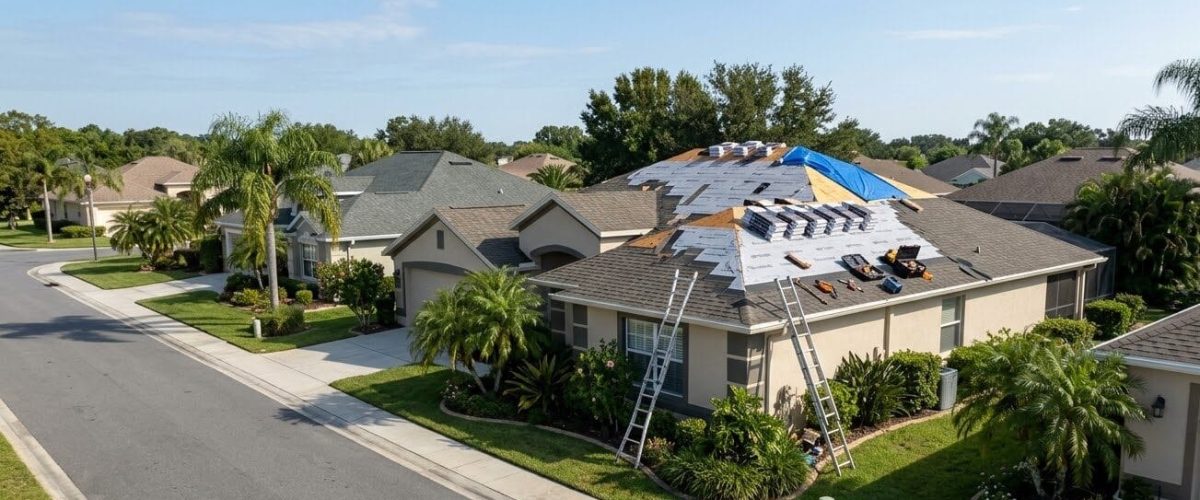
Why Roof Repair in The Villages Requires a Different Approach
Roof repair in The Villages, FL is not like repairing roofs in any other Central Florida community. This is a retirement community of over 130,000 residents spread across three counties. Sumter, Lake, and Marion counties each have their own building departments, their own permitting processes, and their own inspection schedules. A roofing contractor working in The Villages needs active licenses in all three jurisdictions, or the homeowner ends up dealing with unpermitted work that could void their insurance coverage and create problems at resale.
Protech Roofing holds licenses across the counties that make up The Villages and has repaired roofs in neighborhoods from Spanish Springs down through Lake Deaton and out to the newer villages in Marion County. We handle the permitting, the ARC paperwork, and the inspections so homeowners don’t have to figure out which county their house sits in or which building department to call.
The Villages started as a small mobile home community in the 1980s. But the real growth happened from the late 1990s through the 2010s, when thousands of single-family homes went up in rapid succession. Those early expansion homes are now 20 to 25 years old, and their roofs are showing it. Shingle granule loss, cracked pipe boots, failing flashing, and wind-lifted edges are everywhere. And because so many homes were built during the same time period, the demand for roof repair across the community is enormous right now.
The ARC Process and How It Affects Roof Repairs in The Villages
Every homeowner in The Villages knows about the Architectural Review Committee. The ARC oversees exterior modifications to keep the community looking uniform, and roofing work falls under their authority. Before you can start a roof repair that changes materials, colors, or profiles, you need ARC approval. Even if you’re just replacing damaged shingles with the same product, it’s smart to confirm your material choice won’t trigger a violation.
Applications go to the Community Standards Department at 3571 Kiessel Road in The Villages. You can submit by mail, in person, or email to ArchReview@DistrictGov.org. Results are posted on the Friday after the ARC meeting, typically after 2:00 PM. The turnaround adds time to your repair timeline, so if your roof has active leaks, we recommend submitting the ARC application the same day you schedule your repair estimate.
Florida House Bill 293, signed into law on May 28, 2024, changed the rules for hurricane protection modifications. Under HB 293, the ARC cannot deny an application for hurricane protection roofing materials that meet Florida Building Code and ASCE 7-22 standards. That includes impact-rated shingles, metal roof systems, and other wind-resistant products. So if you’re upgrading your roof repair to include better wind protection, the ARC must approve it as long as your application conforms to their color and style guidelines. This is a significant shift for Villages homeowners who previously had limited roofing material options.
We handle ARC submissions for our Villages customers as part of the repair process. Most homeowners don’t realize how specific the application needs to be. You need the exact product name, manufacturer, color code, and a description of where on the structure the work will happen. Incomplete applications get sent back, which delays everything by another week.
Three Counties, Three Permit Offices: Where Your Repair Gets Approved
One of the biggest points of confusion for Villages homeowners is figuring out where to pull a permit. Your neighbor two streets over might be in a completely different county than you. The Villages spans Sumter County (the largest portion), Lake County, and Marion County, and each has a separate building department with its own fee schedule and inspection process.
Sumter County handles the majority of Villages permits through the Building Services office at 7375 Powell Road, Suite 115, in Wildwood. You can reach them at (352) 689-4460. Their hours are 7:30 AM to 5:00 PM on weekdays. Most homes in the original Villages core, including Spanish Springs, the Village of Hadley, and Brownwood, fall under Sumter County jurisdiction.
Lake County Building Services operates out of 315 West Main Street in Tavares. Phone is (352) 343-9800. The newer sections of The Villages that pushed south and east into Lake County, including parts near the Village of Caroline and some areas around Lake Deaton, use this office for permits.
Marion County’s building department is at 2710 East Silver Springs Boulevard in Ocala. The Villages neighborhoods in the northern expansion zones fall under Marion County’s authority. This office handles permits for homes in areas like Orange Blossom Gardens and other communities that expanded into Marion County territory during the 2010s growth phase.
Standard roof repair permits in all three counties cost between $150 and $350 depending on the scope of work. Protech Roofing determines which county your home sits in, pulls the correct permit, schedules the inspection with the right building department, and closes out the permit after passing. You don’t need to make a single phone call to any county office.
What Back-to-Back Hurricanes Did to Villages Roofs
The Villages took hits from Hurricane Idalia in August 2023, followed by Hurricanes Helene and Milton in September and October 2024. Each storm left its own mark, and the cumulative effect on roofs across the community has been severe.
Idalia tracked north through the Big Bend region, and The Villages experienced tropical storm force winds. Homes in the Sumter County portion were built to withstand those predicted wind speeds, and most structures held up well. But “held up well” doesn’t mean zero damage. Idalia loosened shingle tabs, cracked aging pipe boots, and peeled back flashing along valleys and wall transitions on thousands of homes. Much of that damage went unnoticed or was deemed too minor to repair.
Then Milton arrived in October 2024, and it was the number one news story in The Villages that year. The wind damage from Milton was more widespread. Shingles that Idalia had loosened finally tore free. Flashing that had started separating during earlier storms gave way entirely. Water intrusion from Milton caused ceiling stains, attic mold, and damaged insulation in homes that had been holding on with compromised roof components for over a year.
The lesson here is straightforward. Small roof damage that seems cosmetic after one storm becomes structural damage after the next. We’ve repaired Villages roofs where a $400 shingle fix after Idalia would have prevented a $3,500 decking and underlayment replacement after Milton. If your roof took any damage during those storms and you haven’t had it professionally inspected, the time to act is now, before the next hurricane season starts.
Neighborhood-Specific Roof Problems Across The Villages
Different sections of The Villages face different roofing challenges based on when they were built, what materials were used, and their geographic position within the community.
Spanish Springs is one of the oldest developed areas. Homes here date to the late 1990s and early 2000s, and many still have their original roofs. After 20-plus years of Florida sun, heat, and storms, these roofs are past their expected lifespan. We see significant granule loss on asphalt shingles, cracked and curling tabs, and deteriorated underlayment. Repairs on these older roofs sometimes reveal soft spots in the decking where slow leaks went undetected for years.
Brownwood and the surrounding villages were built during a later phase. These homes are 10 to 15 years old with roofing materials that still have some life left. But the shingle products popular during that construction era, particularly three-tab shingles, don’t hold up as well in Florida’s UV environment as the dimensional shingles used today. Repairs here often involve replacing sections of three-tab with upgraded architectural shingles that provide better wind resistance and longer life.
Lake Deaton sits in a low-lying area that can hold moisture after heavy rains. Homes here deal with more humidity-related issues like algae streaking and moss growth on north-facing roof slopes. The moisture retention in this area also accelerates the breakdown of roofing cement and caulk around flashing points. We use algae-resistant shingles and higher-grade sealants for repairs in Lake Deaton to account for these conditions.
The Village of Hadley, Mallory Square, and the newer Marion County sections have relatively young roofs, but they’re not immune to storm damage. Wind doesn’t care how old your shingles are. These areas also face unique challenges with construction debris and settling that can affect roof connections at wall transitions and soffit joints during the first few years after construction.
Wind Zone Standards and Material Requirements for Villages Repairs
The Villages sits in the 115 mph basic wind speed zone under the Florida Building Code. Every roofing material installed here must carry a Florida Product Approval matching or exceeding that rating. This applies to shingles, underlayment, drip edge, fasteners, and adhesives. Using a product rated for 110 mph when the code requires 115 means the repair won’t pass inspection and your insurance could deny a future claim.
In the 115 mph zone, most shingle manufacturers require a specific fastening schedule. The standard four-nail pattern per shingle isn’t sufficient. Many products call for six nails per shingle, with precise placement in the nailing zone indicated on the shingle’s face. Going outside the nailing zone voids the manufacturer’s wind warranty. And Florida building inspectors in Sumter, Lake, and Marion counties check nail placement during their roof inspections.
Underlayment matters just as much as the shingles themselves. The Florida Building Code requires a peel-and-stick self-adhering underlayment at the eaves and in valleys for new installations. For repairs, the existing underlayment must be evaluated. If it’s a felt underlayment that has deteriorated or been punctured, we replace it with synthetic underlayment that won’t absorb water and lasts significantly longer.
Protech Roofing uses only materials that carry the correct Florida Product Approval for The Villages’ wind zone. We document every product’s approval number in our permit applications, and our crews follow manufacturer installation specifications exactly. Cutting corners on materials or installation in a retirement community this large, where inspectors are busy and insurance companies scrutinize claims closely, is something we simply won’t do.
Repair Costs and What Drives Pricing in The Villages
Roof repair costs in The Villages run slightly higher than the Central Florida average for a few reasons. The multi-county permitting adds fees. ARC applications add time. And the sheer volume of repair work needed across the community means material suppliers and contractors are stretched thin, especially after storm season.
Shingle repair and replacement after wind damage typically runs $300 to $1,000 depending on the area affected. A few missing shingles on an accessible section is a quick, affordable fix. But if the wind damage extends across multiple roof planes or if the underlayment beneath the shingles has been compromised, the cost goes up because we’re replacing layers instead of just surface material.
Flashing repairs along valleys, walls, and chimney transitions cost $350 to $900 per section. In The Villages, where many homes have hip roofs with multiple valleys, flashing failures are one of the most common leak sources. The original flashing sealant on homes from the early 2000s has hardened and cracked after two decades of thermal cycling. And when that sealant fails, water follows the flashing channel right into the wall cavity or ceiling.
Pipe boot replacement runs $150 to $400 per boot. This is the single most underestimated repair in The Villages. The rubber gasket on pipe boots degrades from UV exposure within 8 to 12 years. On homes built in the early 2000s, every pipe boot has already exceeded its useful life. A failed pipe boot sends water straight down the plumbing vent into the attic, causing stains, mold, and wood rot that are far more expensive to fix than the boot itself.
Soffit and fascia repairs cost $200 to $600 per section and are common in areas where gutter overflow or wind-driven rain has saturated the wood. We see this frequently along homes with older gutter systems that have sagged or pulled away from the fascia board over time. And because The Villages is a planned community with consistent architectural standards, a rotting fascia board is visible from the street and can trigger a standards notice from community management.
Related Roofing Services in The Villages, FL
- Emergency Roof Repair in The Villages, FL – 24/7 emergency roof repair services
- Roof Replacement in The Villages, FL – Complete roof replacement with quality materials
- Metal Roofing in The Villages, FL – Durable metal roofing installation
- Roof Inspection in The Villages, FL – Professional roof inspections
- The Villages, FL Roofing Services – All roofing services in The Villages
- Roof Repair in Sumter County, FL – Countywide roofing services
- Total Roof Replacement – Complete roof replacement services
- Roof Repair Services – All roof repair services across Central Florida
- My Safe Florida Home Program – After repairs, explore the state program to permanently harden your roof for up to $10,000