
Roof Repair Pinellas County FL
Roof Repair Demand Across Florida’s Most Densely Populated County
Roof repair in Pinellas County, FL has surged since back-to-back hurricanes battered this narrow peninsula between Tampa Bay and the Gulf of Mexico. Nearly 960,000 people live in Pinellas County, packed into just 280 square miles of land area. That makes it the most densely populated county in Florida at roughly 3,500 people per square mile. All those roofs took a beating from Hurricane Helene in September 2024 and Hurricane Milton just weeks later in October 2024.
Helene sent record-breaking storm surge into coastal Pinellas. Every tidal gauge in the region topped previous records, and the surge levels exceeded what Hurricane Idalia produced in 2023, which had already flooded over 1,500 homes in the county. Then Milton arrived with sustained Category 3 winds and dumped over 18 inches of rain on parts of St. Petersburg. Wind gusts hit 101 mph in some areas, strong enough to tear a section of the roof off Tropicana Field.
Protech Roofing provides roof repair services throughout Pinellas County, from the beach communities along the Gulf barrier islands through the mainland cities of Clearwater, Largo, Pinellas Park, and St. Petersburg. We understand how this county’s unique geography creates specific roofing challenges that differ from inland areas, and we bring that knowledge to every repair project.
Salt Air, Wind Exposure, and the Coastal Roofing Problem
Pinellas County is surrounded by water on three sides. Tampa Bay wraps around the east, Boca Ciega Bay sits in the middle, and the Gulf of Mexico borders the west. That means salt-laden air reaches every roof in the county, not just the beachfront homes. Salt accelerates corrosion on metal components like flashing, fasteners, drip edge, and any exposed steel on HVAC curbs or satellite mounts. It also breaks down the protective granule coating on asphalt shingles faster than what happens in inland counties.
We see the salt damage on flashing repairs constantly in Pinellas County. Galvanized steel flashing that might last 20 years in Polk or Hernando County starts showing rust and perforation in 8 to 12 years along the Pinellas coast. That’s why we recommend aluminum or copper flashing for coastal Pinellas homes whenever we’re doing repairs. The upfront cost is higher, but you won’t be replacing the same flashing again in a decade.
Wind exposure is the other constant factor. Because Pinellas County sits on a peninsula with minimal elevation change, there’s nothing to break storm winds as they cross the land. The wind speed design requirement in Pinellas is 145 mph, significantly higher than the 120 mph requirement in inland counties like Polk or Hernando. Every repair material we install here must carry Florida Product Approval for that wind zone, and fastening patterns follow the higher wind specifications.
Navigating Multiple Building Departments in One County
One thing that makes Pinellas County different from most Florida counties is the number of separate municipal building departments. Pinellas has 24 incorporated municipalities, and many of them operate their own permitting offices. If your home is in unincorporated Pinellas County, your permit goes through the Pinellas County Building Services Department at 440 Court Street in Clearwater, and you can reach them at (727) 464-3888.
But if you live within city limits of St. Petersburg, Clearwater, Largo, Pinellas Park, Dunedin, Seminole, Safety Harbor, Tarpon Springs, or any of the smaller municipalities, the city building department handles your roof repair permit. Each city has its own application process, fee schedule, and inspection timeline. It can be confusing for homeowners trying to figure out where to start.
Protech Roofing handles permits across all Pinellas County jurisdictions. We know which department covers your address, what documents they need, and how long their approval process typically takes. Permit turnaround ranges from same-day approval in some smaller cities to three to five business days in the larger jurisdictions like St. Petersburg during busy storm repair seasons.
Not every roof repair requires a permit. In Pinellas County, work valued under $750 may be exempt, though you should verify this with your specific jurisdiction. Small repairs like replacing a few damaged shingles, resealing a pipe boot, or fixing minor flashing issues often fall under maintenance and don’t trigger the permit requirement. But anything involving decking replacement, structural modification, or work over a large area does need a permit and a follow-up inspection.
Storm Damage Patterns We See Across Pinellas County Neighborhoods
The type of roof damage varies across Pinellas County based on proximity to the water, elevation, building age, and surrounding development. Our repair crews have worked in every part of this county, and the patterns are consistent enough that we can usually predict what we’ll find based on the neighborhood.
In the beach communities of Indian Rocks Beach, Madeira Beach, Treasure Island, and St. Pete Beach, wind-driven rain penetration is the primary repair issue. These homes sit right on the barrier islands and take the full force of Gulf storms without any buffer. We frequently repair lifted shingle edges where wind got underneath and broke the sealant strip, allowing rain to reach the underlayment. Flashing failures at wall transitions and around roof penetrations are common here because the salt air degrades the sealant faster.
In Clearwater and Safety Harbor, the housing stock includes a lot of homes built in the 1960s and 1970s with original tile or flat built-up roofs. These older roof systems develop cracks in the tile or blisters in the membrane that let water in slowly over time. Sometimes the leak shows up as a stain on a ceiling that’s been growing for months before the homeowner notices it. By that point, the decking underneath may be soft and in need of replacement along with the surface repair.
Largo and Pinellas Park have extensive 1980s and 1990s construction with architectural shingles that are now 25 to 35 years old. Many of these shingles have lost the majority of their granule coating and are well past their effective lifespan. We see a lot of repair calls in these areas that really should be full replacements. When shingles are that far gone, patching damaged sections just moves the next failure point to a different part of the roof. We’re honest about that assessment with homeowners because a repair that doesn’t actually solve the problem wastes your money.
The historic neighborhoods in St. Petersburg, including Old Northeast, Kenwood, and Crescent Heights, have some of the most architecturally diverse housing in the county. Craftsman bungalows, Mediterranean revival homes, and mid-century modern designs all require different repair approaches. Matching materials on a 1920s home with a barrel tile roof is very different from repairing a 1960s flat roof on a concrete block ranch. We source specialty materials when needed to maintain the character of these older homes.
Common Repair Types and What They Cost in Pinellas County
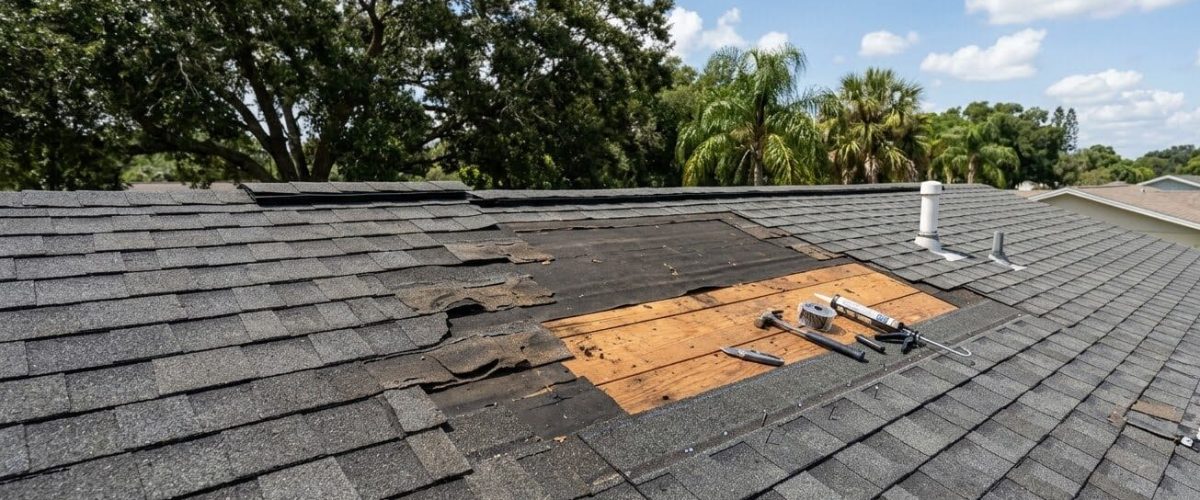
Shingle repair and replacement is the bread and butter of our Pinellas County repair work. Replacing wind-damaged shingles costs $250 to $1,000 depending on how many need to go and whether the underlayment beneath them held up. We match the existing shingle profile and color as closely as possible, though perfect color matching on weathered shingles is rarely achievable because UV exposure changes the color over time.
Flat roof repairs on commercial and residential properties run $400 to $1,500 per affected area. Pinellas County has a significant number of flat and low-slope roofs, especially on mid-century homes, condominiums, and commercial buildings. TPO, modified bitumen, and EPDM membranes each have their own repair methods, and we carry patching materials for all three systems on our trucks.
Tile roof repairs cost $400 to $1,200 per section. Broken or cracked concrete and clay tiles need individual replacement, and finding matching tiles for older installations can be a challenge. We maintain relationships with tile suppliers across the Tampa Bay area and keep salvaged tiles from tear-offs when the style matches homes we’re likely to service later. For barrel tile repairs in St. Petersburg’s historic districts, this inventory saves homeowners time and money.
Leak detection and repair is one of our most requested services. Not all leaks are obvious. Water can enter at one point on your roof and travel along rafters, sheathing, or electrical conduit before dripping onto a ceiling 15 feet from the actual entry point. Our technicians trace leaks back to their source before recommending repairs, so you’re fixing the actual problem and not just treating a symptom. Leak investigation and repair typically costs $300 to $900 depending on complexity.
Insurance Claims and the 2024 Storm Season in Pinellas
The back-to-back hits from Helene and Milton created a complicated insurance landscape across Pinellas County. Many homeowners filed claims after Helene, only to sustain additional damage from Milton before the first claim was settled. Adjusters across the county are still working through the backlog, and some homeowners are dealing with disputes over what damage came from which storm.
Document everything before you make temporary repairs. Take photos and video from multiple angles showing the damage extent, date-stamp your documentation, and keep receipts for any emergency tarping or temporary fixes. Your insurer needs to see the damage tied to a specific covered event. If you waited months between storms without addressing the initial damage, your carrier may argue that subsequent damage resulted from neglect rather than the second storm.
Protech Roofing provides detailed inspection reports and damage documentation that supports insurance claims. We photograph every deficiency, note the likely cause, and provide repair estimates that adjusters can use for their assessment. Our documentation has helped hundreds of Tampa Bay area homeowners get fair claim settlements.
After your repairs are complete, get a wind mitigation reinspection. A new or repaired roof with modern materials and proper installation techniques qualifies for premium discounts of 15 to 30 percent on the wind portion of your policy. In Pinellas County, where insurance costs are already high due to coastal risk factors, those savings add up fast. The reinspection costs about $100 to $125 and pays for itself within the first year of reduced premiums.
Maintaining Your Pinellas County Roof Between Storms
The best way to minimize expensive roof repairs is catching small problems before they grow. In Pinellas County’s subtropical climate, roof maintenance needs to happen more frequently than the national average. Heat, humidity, salt air, UV radiation, and frequent heavy rain all work against your roofing materials year-round.
Schedule a professional roof inspection at least once a year, ideally before hurricane season starts in June. An inspection catches loose or missing shingles, deteriorating flashing, cracked pipe boots, and early signs of moisture intrusion before a storm turns them into active leaks. The cost of an annual inspection is typically $150 to $250, a fraction of what emergency storm repairs cost.
Keep your gutters clean and flowing. Pinellas County may not have the heavy oak canopy that Hernando County has, but palm fronds, seed pods, and general debris still clog gutters and downspouts. Backed-up gutters force water under the drip edge and into the fascia, which leads to wood rot and eventual roof edge failure.
And watch for algae and moss growth, especially on north-facing roof slopes that get less direct sunlight. The dark streaks you see on many Pinellas County roofs are Gloeocapsa magma, a cyanobacteria that feeds on the limestone filler in asphalt shingles. It doesn’t destroy the shingles overnight, but over several years it breaks down the granule bond and shortens the roof’s effective lifespan. Professional soft-wash cleaning removes the algae without damaging the shingles and can extend the life of your existing roof by several years. Protech Roofing offers free roof inspections for Pinellas County homeowners who want to stay ahead of problems before storm season arrives.
Related Roofing Services in Pinellas County, FL
- Roof Replacement in Pinellas County, FL – Full roof replacement across Pinellas County
- Roofer in Pinellas County, FL – Licensed roofing contractor for Pinellas County
- Roof Repair in Hillsborough County, FL – Roof repair in neighboring Hillsborough County
- Roof Repair in Pasco County, FL – Roof repair in neighboring Pasco County
- Roof Repair Services – General roof repair services from Protech Roofing