
Roof Repair Polk County FL
Roof Repair Across Central Florida’s Largest Inland County
Roof repair in Polk County, FL covers a vast stretch of Central Florida that many homeowners don’t fully appreciate until they start looking for a roofer. Polk County spans over 2,000 square miles between Tampa and Orlando, making it one of the largest counties in the state by area. More than 750,000 people live here across cities like Lakeland, Winter Haven, Bartow, Auburndale, Haines City, and Lake Wales, plus dozens of smaller communities scattered between them.
Being inland doesn’t protect Polk County from hurricane damage. Hurricane Milton proved that in October 2024 when it crossed directly over the county as a Category 2 storm, dumping over 12 inches of rain on the Lakeland area in 24 hours. That was classified as a 1-in-1,000-year rainfall event. The RP Funding Center in Lakeland lost a newly installed roof to Milton’s winds, showing that even brand-new roofing systems can fail when a hurricane passes overhead.
Protech Roofing repairs roofs throughout Polk County. We work in every part of the county, from the northern communities near the Hillsborough County line down to Lake Wales and Frostproof in the south. Our crews understand how Polk County’s inland position, rolling terrain, and massive lake system create specific roofing challenges that differ from what coastal counties deal with.
How Polk County’s Terrain and Weather Create Unique Roof Problems
Polk County sits on the Lake Wales Ridge, a geological formation that runs through the center of the county and creates rolling hills that reach over 300 feet in elevation. For Florida, that’s practically mountainous. Homes built on ridge properties face more direct wind exposure because there’s less surrounding development and tree cover to buffer gusts. During Hurricane Milton, these higher-ground properties took disproportionate wind damage compared to homes in the lower-lying lake basins between the ridges.
The county contains over 550 named lakes, which gives it the nickname “Land of a Thousand Lakes.” All that surface water creates constant humidity, and that moisture works against your roof in ways you might not notice until damage appears. Moist air promotes algae and moss growth on shingle surfaces, accelerates the breakdown of organic roofing components, and creates ideal conditions for wood rot in fascia boards and roof deck edges where ventilation is poor.
Polk County also sits in a corridor that sees some of the highest lightning strike density in the United States. The area between Lakeland and Tampa is sometimes called “Lightning Alley.” While direct lightning strikes to residential roofs are rare, the intense thunderstorms that produce this lightning also produce severe wind gusts, large hail, and torrential downpours that cause cumulative roof damage throughout the spring and summer months.
And then there’s the temperature cycling. Summer temperatures routinely hit the mid-90s while overnight lows stay in the mid-70s. That daily 20-degree swing causes thermal expansion and contraction in roofing materials, which loosens fasteners, opens seams in flashing, and cracks aging sealant over time. Winter brings occasional freezes that add even wider temperature swings and can cause brittle older shingles to crack.
Permits and Building Codes for Polk County Roof Repairs
Polk County’s Building Division handles permits for unincorporated areas from their office at 330 West Church Street in Bartow, the county seat. You can reach them at (863) 534-6080. The county uses the Accela Citizen Access online portal for permit applications, which means you can submit and track permits electronically.
Within the incorporated cities of Lakeland, Winter Haven, Bartow, Auburndale, Haines City, and Lake Wales, each city operates its own building department. Lakeland’s is the busiest, handling permits for a city of over 115,000 residents. Winter Haven and Bartow have their own permitting offices as well. Protech Roofing is familiar with all Polk County jurisdictions and handles the permit process regardless of which department oversees your property.
Polk County falls within the 120 mph basic wind speed zone under the Florida Building Code. All roofing materials must carry Florida Product Approval for this zone. For shingle installations, most manufacturers require six nails per shingle in the 120 mph zone, placed in the specific nailing area printed on the shingle body. We follow these patterns on every repair that involves shingle replacement because your manufacturer warranty depends on it.
Not every repair requires a permit in Polk County. Minor maintenance work like replacing a handful of shingles, resealing flashing, or replacing a pipe boot typically falls below the permitting threshold. Repairs involving decking replacement, structural modifications, or coverage of a large portion of the roof surface do require permits. When in doubt, we pull the permit. It’s always better to have the documentation than to risk a code compliance issue later.
Storm Damage Repairs After Milton and the 2024 Hurricane Season
Hurricane Milton crossed Polk County as a Category 2 hurricane in October 2024, and the damage was widespread. The storm combined extreme rainfall with sustained winds that tore shingles, lifted tile, and ripped off flat roof membranes across the county. Lakeland alone estimated 200,000 to 250,000 cubic yards of debris needed collection after the storm, and a significant portion of that was roofing material.
The rainfall component made things worse. Over 12 inches of rain in 24 hours overwhelmed drainage systems and caused flooding across the Lake Parker and Bonny Lake watersheds. But for roofs, all that water exposed every weakness in the existing system. A small gap in flashing that might leak once during a normal thunderstorm suddenly let in gallons of water during Milton’s sustained deluge. Homeowners who had minor, unaddressed issues before the storm ended up with water-damaged ceilings, soaked insulation, and mold growth in their attics.
The eligible Polk County residents could apply for Operation Blue Roof, a free government tarping program that provided temporary protection while permanent repairs were scheduled. That program closed in November 2024, but many of those temporary tarps are still in place on homes where permanent repairs haven’t been completed yet. If your home still has a Blue Roof tarp, getting permanent repairs done before the 2025 hurricane season is important because those tarps were designed as temporary solutions with a limited effective lifespan.
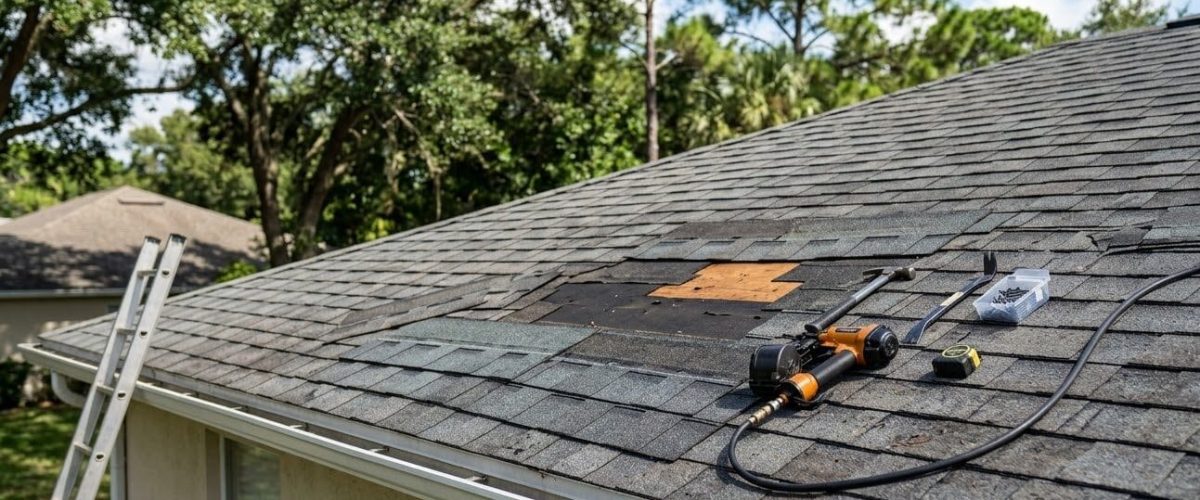
We’ve been repairing storm damage across Polk County since Milton, working through neighborhoods in Lakeland, Winter Haven, Bartow, and the surrounding communities. The most common repairs we’re doing are shingle replacement on sections where the wind peeled material off, flashing repairs at wall transitions and valleys that separated during the wind event, and decking replacement where prolonged water intrusion softened the plywood or OSB beneath the roofing surface.
Repair Costs and Common Issues in Polk County
The most frequent roof repairs we perform across Polk County break down into several categories based on the damage type and location on the roof.
Shingle repair and replacement runs $250 to $900 in Polk County, depending on the number of shingles affected and whether the underlayment beneath them needs replacement too. We match the existing shingle color and profile as closely as manufacturer offerings allow. Perfect matching on weathered shingles isn’t always possible because UV exposure changes shingle color over time, but we get close enough that the repaired area blends in within a few months of weathering.
Flashing repairs cost $300 to $800 per section. Flashing at roof-to-wall transitions, around chimneys, in valleys, and at pipe penetrations is where most Polk County leaks originate. The thermal cycling that’s common inland, with bigger daily temperature swings than coastal counties, breaks down sealant and caulk around flashing joints faster. We use polyurethane-based sealants that flex with temperature changes instead of hardening and cracking like silicone-based products do in this climate.
Pipe boot replacement is one of the simplest and most cost-effective repairs we do. Rubber pipe boot gaskets crack and split from UV exposure, usually within 8 to 12 years of installation. A failed pipe boot lets water run directly down the plumbing vent pipe and onto your decking, causing a slow leak that’s hard to detect until you see ceiling stains. Replacement costs $150 to $400 per boot and takes less than an hour per unit.
Soffit and fascia repair connects to roofing because damaged fascia boards let water get behind your drip edge and into the roof deck at the eaves. We see this frequently in Polk County where heavy summer rains overflow clogged gutters and saturate the fascia. Fascia repair or replacement costs $15 to $25 per linear foot plus labor, and it’s often combined with gutter work to prevent the same problem from recurring.
Citrus Country Roofing: How Polk County’s Agricultural Heritage Affects Your Roof
Polk County was historically the heart of Florida’s citrus industry, and that agricultural heritage shapes the roofing landscape in ways that newer residents don’t always expect. Many rural and semi-rural properties in the county were built during the citrus boom decades and sit on large lots surrounded by mature trees. Those trees, whether remaining citrus groves, live oaks, or slash pines, create specific roofing maintenance challenges.
Overhanging limbs deposit organic debris onto roof surfaces continuously. Leaves, needles, seed pods, and small branches collect in valleys, behind penetrations, and along ridges. This debris holds moisture against the roofing material, accelerates granule loss on shingles, and creates dams that redirect water under the surface. Homeowners on wooded lots in areas like Lake Wales, Frostproof, and the rural stretches between Bartow and Fort Meade should clean their roofs and gutters at least quarterly to prevent these issues.
The conversion of old citrus land to residential development has also created neighborhoods where the soil conditions affect roofing indirectly. Former grove land tends to have sandy, well-drained soil that shifts and settles over time. Foundation movement, even minor settling, can transfer stress to the roof framing and cause separation at ridge lines, hip intersections, and where additions meet the original structure. If you notice new cracks appearing along interior ceiling corners, the roof frame may be under stress from foundation movement, and the roof penetrations should be inspected for gaps.
Keeping Your Polk County Roof in Shape Year-Round
Polk County’s inland position means your roof deals with more extreme temperature swings, higher humidity, and more intense thunderstorms than coastal properties, even though you avoid the salt air problem. A proactive maintenance schedule reduces the chance of emergency repairs and extends the life of your existing roof system.
Get a professional inspection before hurricane season each year. May is the ideal month because it gives you time to address any issues before the June 1 start of the Atlantic hurricane season. The inspection should cover shingle condition, flashing integrity, pipe boot gaskets, soffit ventilation, and attic moisture levels. Our inspections take about 45 minutes to an hour and cover every component of the roof system.
Check your attic ventilation at least twice a year. Polk County’s summer heat pushes attic temperatures well above 150 degrees in homes with poor ventilation. That trapped heat bakes shingles from below and can cause decking to warp. Balanced soffit intake and ridge exhaust keeps air moving through the attic space and reduces the heat load on both the roof and your air conditioning system.
Clean your gutters after every major storm and at least monthly during the rainy season from June through September. Polk County’s afternoon thunderstorms dump enormous volumes of water in short bursts. Clogged gutters can’t handle that flow rate, and the overflow saturates fascia boards and works its way behind drip edge into the roof deck. Gutter guards help but don’t eliminate the need for periodic cleaning. Protech Roofing offers free roof inspections for Polk County homeowners who want to catch small problems before they turn into expensive repairs.
Related Roofing Services in Polk County, FL
- Roof Replacement in Polk County, FL – Full roof replacement across Polk County
- Roofer in Polk County, FL – Licensed roofing contractor for Polk County
- Roof Repair in Hillsborough County, FL – Roof repair in neighboring Hillsborough County
- Roof Repair in Pasco County, FL – Roof repair in neighboring Pasco County
- Roof Repair Services – General roof repair services from Protech Roofing