
Roof Replacement Pinellas County FL
Replacing Your Roof on Florida’s Most Exposed Peninsula
Roof replacement in Pinellas County, FL requires planning around a reality that no other Florida county shares: nearly every home sits within a few miles of saltwater. Pinellas County occupies a narrow peninsula between Tampa Bay and the Gulf of Mexico, stretching about 38 miles long and averaging just 6 miles wide. With roughly 960,000 residents spread across 280 square miles of land, this is the densest county in the state. And every single roof here faces accelerated wear from salt air, intense UV exposure, and direct hurricane wind paths off the open Gulf.
Hurricane Helene pushed record storm surge through Pinellas in September 2024, and Hurricane Milton followed in October with 101 mph wind gusts and over 18 inches of rain in parts of St. Petersburg. The combined damage from those two storms pushed thousands of homeowners from the repair conversation into full roof replacement. When your roof takes two major hits in four weeks, the underlying structure often sustains enough hidden damage that patching the surface doesn’t address the real problem underneath.
Protech Roofing installs new roofs across all of Pinellas County, from the barrier island communities on the Gulf side to the mainland cities along the Tampa Bay shore. We select materials and installation methods specifically for this county’s coastal conditions, because a roof system that performs well in Hernando or Polk County doesn’t always hold up the same way in Pinellas.
What the 145 MPH Wind Zone Means for Your New Roof
Pinellas County sits in a 145 mph basic wind speed zone under the Florida Building Code. That’s 25 mph higher than the 120 mph requirement in most inland Central Florida counties. This difference affects everything about your roof replacement, from material selection to fastening methods to the underlayment system beneath the surface.
At 145 mph, the code requires enhanced roof-to-wall connections. Hurricane straps or clips must tie the roof trusses to the wall framing, and the specific connector type depends on your home’s construction. For a full replacement, we inspect the existing connections and upgrade them if they don’t meet current standards. This is one of the most important wind mitigation features for your insurance, and a new roof installation is the ideal time to address it.
Shingle fastening patterns in the 145 mph zone require six nails per shingle with specific placement. The nails must be in the manufacturer’s designated nailing zone, which is typically a narrow band across the shingle body. Nails placed too high won’t hold the shingle in uplift conditions, and nails placed too low can crack the exposed tab of the shingle below. Proper nail placement is one of those details that separates a roof that survives a hurricane from one that fails.
The 2025 Florida Building Code update also requires sealed roof decks on new installations. This means applying a self-adhering modified bitumen membrane or spray-applied foam adhesive to the roof deck joints before the underlayment goes on. Sealed decks provide secondary water resistance, so even if the primary roofing material is torn off during a storm, the deck itself keeps water from entering your home. In Pinellas County, this feature is worth its weight during hurricane season.
Choosing Materials Built for Pinellas County’s Coastal Conditions
Material choice matters more in Pinellas County than almost anywhere else in Florida. The constant salt air exposure, extreme UV levels, and high wind requirements narrow down the options that will actually perform well over a 20 to 50 year lifespan. We’ve seen what works and what fails across hundreds of Pinellas installations, and that experience shapes our recommendations.
Standing seam metal roofing is our top recommendation for Pinellas County homes where the architecture and HOA rules allow it. Metal panels interlock without exposed fasteners, which eliminates the salt corrosion problem that plagues screw-down metal systems near the coast. Galvalume-coated steel panels resist coastal corrosion well, and aluminum panels are even better for homes within a mile of the Gulf. Installed costs run $700 to $1,200 per square, but a metal roof in Pinellas can last 40 to 60 years with minimal maintenance.
Concrete and clay tile remain popular across Pinellas County, especially in the Mediterranean and Spanish-influenced architecture found throughout Clearwater, Dunedin, and St. Petersburg’s historic neighborhoods. Tile is naturally salt-resistant, handles UV without degradation, and provides excellent wind resistance when properly fastened. The installed cost runs $800 to $1,500 per square. Tile is heavy, so the roof structure must support the load. We verify the truss system capacity before recommending tile for any replacement project.
High-quality architectural shingles are the most affordable option and still perform well in Pinellas when selected carefully. Look for products specifically labeled for coastal environments with algae-resistant granules and 130 to 150 mph wind ratings. GAF Timberline HDZ and CertainTeed Landmark Pro both offer coastal-appropriate options. Shingle installations cost $350 to $500 per square, making a typical replacement $8,000 to $16,000. But recognize that shingles in Pinellas County will have a shorter effective lifespan than the same shingles in an inland county because of the salt and UV exposure.
Permitting Your Replacement Across 24 Pinellas Municipalities
Pinellas County contains 24 incorporated municipalities, and many operate independent building departments with their own permitting processes. This makes Pinellas one of the more complicated counties in Florida for roofing permits because the rules and timelines vary depending on your exact address.
Unincorporated Pinellas County permits go through the county Building Services Department at 440 Court Street in Clearwater. You can reach them at (727) 464-3888. The county also oversees permitting through the Pinellas County Construction Licensing Board, which handles contractor licensing for the entire county regardless of municipal jurisdiction.
The city of St. Petersburg, Pinellas County’s largest municipality with over 259,000 residents, has its own Building Department that handles all permits within city limits. Clearwater, Largo, Pinellas Park, Dunedin, Safety Harbor, Tarpon Springs, and Seminole each have separate building departments as well. The application requirements are similar across jurisdictions, but fee schedules, turnaround times, and inspection scheduling processes differ.
Every full roof replacement needs a permit regardless of which jurisdiction covers your property. The application requires the scope of work, Florida Product Approval numbers for all materials, a Notice of Commencement for jobs over $2,500, and in some cases a signed contract. Protech Roofing manages the permit process for every Pinellas County installation. We know the requirements for each jurisdiction and submit complete applications that move through quickly.
Replacement Costs and Insurance Dynamics in Pinellas County
A full roof replacement in Pinellas County typically runs 10 to 15 percent more than the same job in an inland county. The higher material specifications for the 145 mph wind zone, corrosion-resistant flashing and fasteners, and additional labor for enhanced code compliance all contribute to the cost difference. But the trade-off is a roof built to survive the specific conditions this county throws at it.
For a typical 2,000 square foot Pinellas County home, expect to pay $9,000 to $16,000 for architectural shingles, $20,000 to $38,000 for standing seam metal, and $22,000 to $42,000 for concrete tile. These ranges account for standard roof complexity. Multi-level roofs with many hips, valleys, and penetrations cost more because they require more flashing, more cutting, and more labor time.
Insurance is a big part of the financial equation in Pinellas County. Annual premiums here are among the highest in Florida due to the coastal risk profile. But a new roof with full wind mitigation features can reduce your wind premium by 20 to 40 percent. On a policy with a $4,000 annual wind premium, that’s $800 to $1,600 saved every year. Over the 25-year life of a shingle roof, those savings total $20,000 to $40,000, which often exceeds the cost of the replacement itself.
If your replacement is storm-related, your homeowner’s insurance covers the cost minus your hurricane deductible. Hurricane deductibles in Florida are percentage-based, typically 2 to 5 percent of your dwelling coverage. We work with adjusters throughout the Tampa Bay area and provide the documentation they need for fair claim settlements.
Neighborhoods and Communities We Serve in Pinellas County
Pinellas County’s housing stock spans more than a century of construction styles and materials, from Craftsman bungalows in downtown St. Petersburg to brand-new developments in the Clearwater and East Lake corridors. Each neighborhood presents its own replacement considerations.
In St. Petersburg’s historic districts like Old Northeast, Kenwood, Crescent Heights, and the Grand Central District, architectural preservation matters. Many homes here feature barrel tile, clay tile, or distinctive flat roof designs that define the neighborhood character. We source matching materials and follow local historic preservation guidelines when they apply. Replacing a 1925 barrel tile roof with commodity asphalt shingles would be a visual disaster in these neighborhoods, and some historic districts have overlay requirements that prevent it.
Clearwater’s mainland neighborhoods and the communities around Clearwater Beach include a mix of 1960s-era concrete block homes and newer construction. The older homes often have flat or low-slope roof sections combined with sloped areas, creating complex roof geometries that require careful waterproofing at the transitions. We specialize in these hybrid systems and use compatible membrane and shingle combinations that work together at the intersection points.
Largo and Pinellas Park have extensive residential neighborhoods built during the 1980s and 1990s building boom. Many of these homes still have their original roofs or first-generation replacements that are now 25 to 35 years old. This is the sweet spot for replacement because the shingles are well past their effective lifespan but the underlying structure is usually still sound. A straightforward tear-off and re-roof brings these homes back to full protection without the structural complications that older homes sometimes present.
The beach communities of Indian Rocks Beach, Madeira Beach, Treasure Island, and Redington Shores have some of the harshest roofing conditions anywhere in the county. Direct Gulf exposure means maximum salt, maximum wind, and maximum UV. Homes here benefit most from metal or tile roofing systems that resist all three degradation factors simultaneously. Shingle roofs on the barrier islands rarely last beyond 15 to 18 years, while metal roofs installed in the same location can go 40 years or more with proper maintenance.
The Replacement Process From Estimate to Final Inspection
Every Pinellas County roof replacement we do follows the same process, regardless of the material or neighborhood. We start with a thorough inspection of your existing roof, including the decking condition, ventilation system, flashing, and structural connections. This tells us what’s underneath the current roofing material and identifies any hidden issues that need to be addressed during the tear-off.
After the inspection, we provide a written estimate detailing every material, the labor scope, permit costs, and the project timeline. If you’re filing an insurance claim, we coordinate with your adjuster and provide the documentation they need. Once you approve the estimate, we pull the permit from the appropriate jurisdiction and schedule the work.
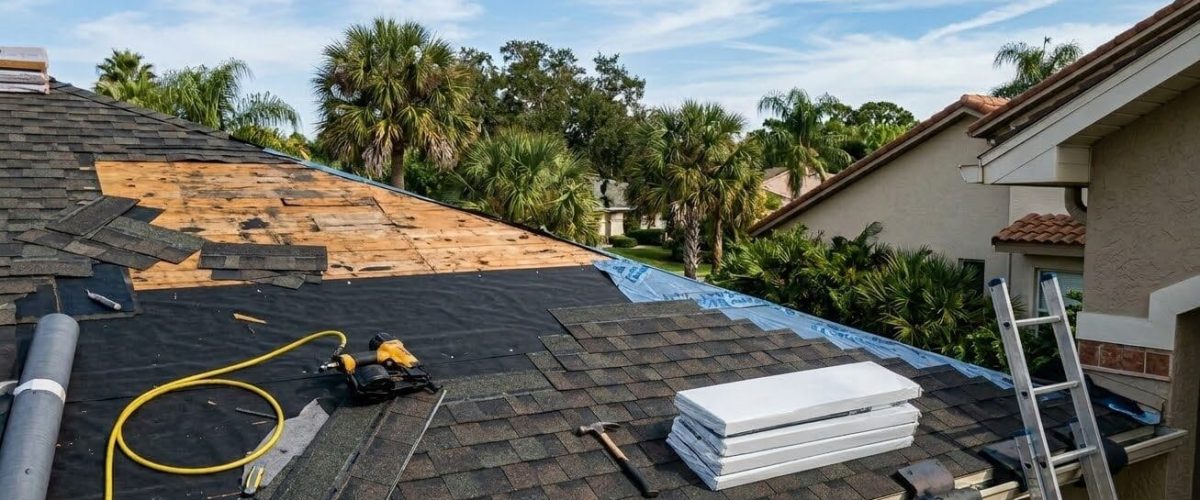
On installation day, the crew strips the existing roofing material down to the deck. We inspect every sheet of decking and replace any sections that show moisture damage, delamination, or soft spots. In Pinellas County, we find decking issues on roughly 30 percent of replacements because the coastal environment is harder on the wood than inland conditions. After decking repairs, we install the secondary water barrier, underlayment, drip edge, flashing, and then the primary roofing material.
Cleanup and debris removal happens the same day for shingle installations and within two days for tile or metal. We schedule the final building inspection with the appropriate municipal or county office, and a Protech crew member meets the inspector on-site to walk the job. Once the inspection passes, the permit is closed, and we provide you with all warranty documentation, product approval numbers, and photos of the completed installation for your records. That documentation package is what you’ll need for your wind mitigation inspection and any future insurance renewals.
Related Roofing Services in Pinellas County, FL
- Roof Repair in Pinellas County, FL – Storm damage and leak repairs across Pinellas County
- Roofer in Pinellas County, FL – Licensed roofing contractor for Pinellas County
- Roof Replacement in Hillsborough County, FL – Roof replacement in neighboring Hillsborough County
- Roof Replacement in Pasco County, FL – Roof replacement in neighboring Pasco County
- Roof Replacement Services – Full roof replacement from Protech Roofing