Central Florida Roofing Service
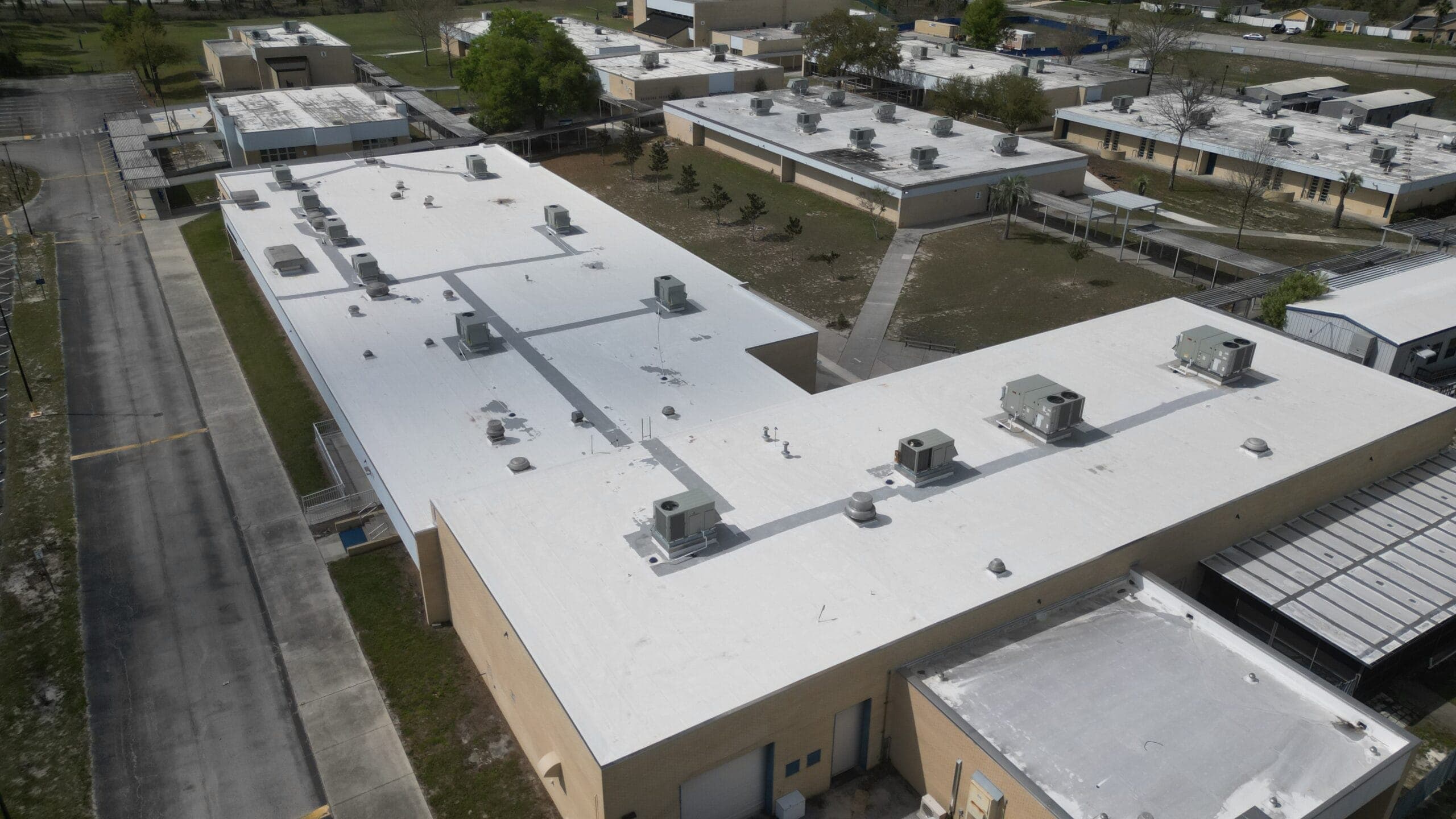
Commercial Flat Roofing
Flat and low-slope roofing near you in Central Florida: TPO, EPDM, and modified bitumen for commercial buildings. Repairs and replacement. Call (352) 605-0696.
Call (352) 605-0696The material you choose for a commercial flat roof determines how it handles heat, UV exposure, chemical contact, and long-term weathering. Each system has genuine advantages and genuine limitations, and the right choice depends on the building’s use, budget, and expected service life.
TPO vs. PVC vs. Modified Bitumen: Performance Data for Florida’s Climate
The material you choose for a commercial flat roof determines how it handles heat, UV exposure, chemical contact, and long-term weathering. Each system has genuine advantages and genuine limitations, and the right choice depends on the building’s use, budget, and expected service life.
TPO (Thermoplastic Polyolefin) has become the dominant commercial roofing membrane in the southeastern United States, and the reasons are straightforward. TPO reflects approximately 87 percent of UV radiation in its white configuration, which translates directly to lower cooling costs in a climate where air conditioning runs eight to ten months per year. On a 15,000-square-foot commercial building in Central Florida, the energy savings from a reflective TPO roof versus a dark built-up roof can reach $3,000 to $6,000 annually depending on the building’s insulation, HVAC efficiency, and internal heat loads.
TPO installs with heat-welded seams, where a hot-air gun fuses the membrane sheets together at temperatures between 900 and 1,100 degrees Fahrenheit. When done correctly, the welded seam is actually stronger than the membrane field, which means the seam becomes the strongest point on the roof rather than the weakest. Installed costs for TPO in our market run $5.00 to $9.00 per square foot, depending on membrane thickness, insulation requirements, and roof complexity.
The knock against TPO has historically been longevity. Early TPO formulations from the late 1990s and early 2000s had inconsistent performance, with some membranes cracking or becoming brittle within 10 years. The current generation of TPO from major manufacturers like Carlisle, Firestone, and GAF has largely resolved those issues, and we are seeing expected service lives of 20 to 25 years from quality TPO installations.
PVC (Polyvinyl Chloride) is the premium single-ply option and the most durable flat roofing membrane available today. PVC membranes use heat-welded seams identical to TPO, but the membrane chemistry provides superior resistance to chemicals, grease, and standing water. This makes PVC the default choice for restaurants, food processing facilities, and any building where rooftop equipment produces chemical exhaust or grease-laden air that settles on the roof surface.
PVC carries the longest expected service life of any single-ply membrane at 25 to 30 years, and some manufacturers offer 25-year full-system warranties on PVC installations that they will not offer on TPO. The tradeoff is cost. PVC runs $8.00 to $15.00 per square foot installed, which puts it at a significant premium over TPO. For a 10,000-square-foot commercial roof, that difference can amount to $30,000 to $60,000, which is why PVC makes the most sense on buildings where the chemical resistance or extended warranty justifies the investment.
Modified Bitumen remains a viable option for certain commercial applications, particularly on buildings where budget is the primary constraint or where the roof will see regular foot traffic from maintenance personnel. Modified bitumen consists of asphalt reinforced with polymer modifiers (either APP or SBS) and is installed in multiple layers that create a thick, redundant waterproofing system. Installed costs run $4.00 to $9.00 per square foot.
The advantages of modified bitumen include proven long-term performance (the system has been in use since the 1960s), excellent puncture resistance from the multi-layer construction, and relatively simple repairs when damage occurs. The disadvantages in Florida are significant: modified bitumen absorbs heat rather than reflecting it, which increases cooling costs and subjects the membrane to greater thermal stress. Dark modified bitumen surfaces can reach 170 degrees on a summer afternoon in Central Florida, compared to 110 to 120 degrees for white TPO or PVC.
EPDM (Ethylene Propylene Diene Monomer) is a synthetic rubber membrane that has been a commercial roofing staple for decades. EPDM runs $5.00 to $10.00 per square foot installed and offers excellent flexibility, which allows it to handle building movement and thermal expansion without cracking. However, EPDM uses adhesive or tape-bonded seams rather than heat-welded seams, and those seams are the weak point of the system. In Florida’s heat and UV environment, adhesive seams degrade faster than welded seams, and we see more seam-related failures on EPDM roofs than on TPO or PVC. EPDM is also available primarily in black, which means it absorbs heat and offers none of the energy-saving benefits of reflective white membranes.
For most commercial buildings in Central Florida, our recommendation is TPO for general use and PVC for restaurants, chemical environments, or owners who want the longest possible warranty. We install both systems and can provide detailed comparisons for your specific building. Call (352) 605-0696 to discuss your project.
Apartment, condo, or HOA property? Protech also handles multi-family roofing projects across Hernando County and surrounding areas, with discreet scheduling and minimal disruption to residents.
The Ponding Water Problem and How Proper Drainage Design Solves It
Ponding water is the single most destructive force acting on a commercial flat roof, and it is entirely preventable with proper design. The National Roofing Contractors Association defines ponding as water that remains on a roof surface 48 hours or more after rainfall ends. In Central Florida, where summer storms can drop two to four inches of rain in under an hour, poor drainage turns a flat roof into a shallow pool that accelerates membrane degradation, adds structural load, and creates conditions for biological growth.
The physics are simple but unforgiving. One inch of standing water on a 10,000-square-foot roof weighs approximately 5,200 pounds. After a heavy Florida thunderstorm, ponding depths of two to three inches are common on poorly drained roofs, which means 10,000 to 15,000 pounds of water sitting on a structure that was not designed to hold it indefinitely. Over time, that weight deflects the structural members downward, which creates deeper ponding, which adds more weight, which causes more deflection. This progressive failure cycle has collapsed commercial roofs in Florida.
The Florida Building Code addresses this directly. FBC Section 1507.10 requires a minimum slope of one-quarter inch per foot on all low-slope roof installations. That might not sound like much, and on a 100-foot-wide warehouse, it translates to roughly 25 inches of total fall from the high point to the drain. But that quarter-inch per foot is the difference between water reaching the drain in minutes and water sitting on your roof for days.
Achieving proper slope on a commercial flat roof happens in one of three ways.
Structural slope is built into the roof framing itself. This is the ideal approach for new construction because it creates permanent, reliable drainage without adding material to the roof assembly. Retrofitting structural slope onto an existing building is rarely practical or cost-effective.
Tapered polyisocyanate insulation is the standard solution for reroofing projects and the method we use most frequently. Tapered polyiso boards are manufactured in wedge shapes that create built-in slope when installed on a flat deck. The insulation serves double duty, providing both thermal performance and drainage slope in a single layer. We design tapered insulation layouts using manufacturer software that calculates exact board dimensions and thicknesses for each section of roof to ensure water reaches the drains efficiently.
Cricket and saddle construction supplements the primary slope system by directing water around large penetrations, equipment curbs, and other obstructions that would otherwise create ponding behind them. We fabricate crickets from tapered insulation or sheet metal depending on the application.
FBC Section 1503.4.1 also requires both primary and secondary (overflow) drain systems on commercial flat roofs. The secondary overflow drains must be set two inches above the primary drain level, which provides a backup drainage path if the primary drains become clogged or overwhelmed during an extreme rain event. We install overflow drains on every commercial project and strongly recommend regular maintenance to keep both systems clear.
60-Mil vs. 80-Mil Membrane: When the Upgrade Makes Sense
Membrane thickness is one of the most common decision points in commercial flat roofing, and it deserves a straightforward explanation because the cost difference is real and so are the performance implications.
Single-ply membranes like TPO and PVC are manufactured in several thicknesses, with 45-mil, 60-mil, and 80-mil being the most common options. In Florida, 60-mil is the practical minimum for any commercial installation. The combination of intense UV radiation, extreme heat cycling, and the potential for hurricane-force wind uplift means that 45-mil membranes simply do not have the physical mass to perform reliably over a 20-year service life in this climate.
The difference between 60-mil and 80-mil is more nuanced. An 80-mil membrane is approximately 33 percent thicker than a 60-mil membrane, which provides proportionally greater puncture resistance, UV degradation resistance, and overall durability. The additional thickness also provides a larger margin for the heat-welding process, meaning seam quality is more consistent because the installer has more material to work with.
On the cost side, upgrading from 60-mil to 80-mil TPO typically adds $0.75 to $1.50 per square foot to the installed price. For a 15,000-square-foot commercial roof, that is an additional $11,250 to $22,500. Whether that investment makes sense depends on several factors.
Buildings with high foot traffic on the roof benefit significantly from 80-mil membrane. If HVAC technicians, maintenance crews, or equipment service personnel are on the roof regularly, the added puncture resistance of 80-mil membrane reduces the risk of damage from dropped tools, dragged equipment, and concentrated foot traffic around mechanical units.
Buildings in areas with high debris exposure, such as properties near wooded lots or construction zones, also benefit from the thicker membrane. Windborne debris during tropical storms is a primary cause of membrane damage, and the additional thickness provides meaningful additional protection.
For buildings with minimal roof traffic and standard exposure, 60-mil membrane installed correctly with proper protective measures will deliver 20-plus years of reliable performance. We discuss thickness options with every commercial client and make recommendations based on the specific building, its use, and its exposure conditions.
Code Compliance and Permitting for Commercial Flat Roofs in Florida
Commercial roofing in Florida operates under a more rigorous regulatory framework than residential work, and understanding the requirements helps property owners make informed decisions and avoid costly compliance failures.
The Florida Building Code governs all commercial roof installations, and several sections apply specifically to flat and low-slope systems. FBC 1507.10 establishes the minimum slope requirement of one-quarter inch per foot. FBC 1503.4 addresses drainage requirements including the primary and secondary drain mandate. FBC Chapter 16 governs structural load requirements including the dead load of the roofing system and the live load of maintenance personnel and equipment. Wind uplift resistance requirements come from ASCE 7, which the FBC references, and are calculated based on building height, exposure category, and location within the county’s wind speed map.
The permitting process for commercial roofing is more involved than residential. A commercial reroof permit in Hernando County requires a complete plan review, which means submitting drawings that show the membrane type, insulation specifications, fastening pattern, drainage design, and flashing details. The building department reviews these plans for code compliance before issuing the permit, and the review process typically takes five to fifteen business days depending on project complexity and the department’s current workload.
Inspections follow a similar pattern to residential but with additional checkpoints. We typically encounter a deck inspection after tear-off, an insulation and fastener inspection before membrane installation, and a final inspection after completion. On larger projects, the inspector may visit multiple times during the membrane installation phase to verify seam welding quality and attachment patterns.
For property owners dealing with insurance carriers, code compliance documentation is increasingly important. After Hurricane Ian and the subsequent shakeup in Florida’s property insurance market, carriers are requiring more detailed documentation of roof condition and code compliance as a condition of coverage. A properly permitted and inspected commercial roof installation creates a paper trail that supports insurance applications and can reduce premiums.
We handle the entire permitting and inspection process for our commercial clients. The permit fees, plan preparation, and inspection coordination are included in our project pricing.
Energy Efficiency and Cool Roof Requirements
Energy performance has moved from a nice-to-have to a regulatory requirement for commercial roofs in much of Florida. Understanding the standards and how different membrane choices affect energy costs helps property owners make decisions that pay for themselves over the roof’s service life.
Florida adopted the Florida Energy Conservation Code, which aligns with the International Energy Conservation Code with Florida-specific amendments. For commercial buildings, the code establishes minimum roof insulation values and, in many cases, minimum solar reflectance requirements for the roof surface.
White TPO and PVC membranes naturally meet cool roof requirements because their reflective surfaces bounce solar energy back into the atmosphere rather than absorbing it into the building. A quality white TPO membrane has an initial solar reflectance of 0.80 or higher, meaning it reflects 80 percent of incoming solar energy. Even after three years of weathering, a well-maintained TPO surface retains reflectance values of 0.60 to 0.70, which still qualifies under most cool roof standards.
The energy impact in Central Florida is substantial. Commercial buildings with dark roofs in our area typically spend 15 to 25 percent more on cooling than comparable buildings with reflective roofing systems. For a 20,000-square-foot retail building running commercial HVAC equipment, that difference can amount to $4,000 to $8,000 per year in electricity costs. Over a 20-year roof life, the cumulative savings from a reflective membrane can exceed the total cost of the roofing system itself.
Insulation works in conjunction with the reflective membrane to reduce energy transfer. Polyisocyanate insulation, which we use as the standard for commercial flat roofs, provides R-values of approximately 5.7 per inch of thickness. The FBC requires minimum insulation values that depend on the climate zone and building type, and in our area, commercial roofs typically need R-20 to R-30 of continuous insulation above the deck. When we design a tapered insulation system for drainage, we ensure the minimum point of the taper still meets or exceeds the code-required R-value.
Some utility companies in our service area offer rebates for cool roof installations on commercial buildings. Duke Energy and Tampa Electric Company have both offered commercial efficiency incentives in recent years, and we can help property owners determine whether their project qualifies. Even without rebates, the energy savings alone typically justify the choice of a reflective membrane system.
Common Commercial Building Types and Their Roofing Needs
Different building types present different challenges for flat roofing systems, and the right material choice depends partly on what happens inside and on top of the building.
Warehouses and distribution centers typically have large, unobstructed roof areas with minimal penetrations. These are ideal candidates for TPO because the large, open field allows for efficient membrane installation with fewer seams per square foot. The primary challenges are wind uplift (large flat surfaces catch enormous wind loads during hurricanes) and the potential for forklift damage from inside. A warehouse roof that deflects under forklift load from heavy stacking can develop ponding issues at the deflection points. We account for interior loading patterns when designing the drainage layout.
Retail strip malls and shopping centers present more complex roofing challenges because of the multiple tenant spaces, each with its own HVAC unit, exhaust fan, and plumbing vent penetrating the roof. A 10-unit strip mall might have 30 to 40 roof penetrations, each one a potential leak point. Proper flashing and detailing around each penetration is critical, and we use prefabricated boots and curb flashings that are compatible with the primary membrane to ensure watertight seals.
Medical offices and healthcare facilities often require PVC membrane because of the chemical exhaust from sterilization equipment and laboratory processes. These buildings also tend to have higher insurance requirements and benefit from the longer warranty periods available with PVC systems. Leak prevention is especially critical in medical environments because water intrusion can compromise sterile areas, damage sensitive equipment, and create mold conditions that violate health department standards.
Restaurants and food service buildings are the strongest case for PVC membrane. Rooftop grease exhaust from commercial kitchens settles on the roof surface and attacks membrane chemistry over time. TPO, EPDM, and modified bitumen all degrade when exposed to animal fats and cooking oils. PVC is essentially immune to grease damage, which is why every major membrane manufacturer recommends PVC for restaurant applications. We have seen TPO roofs on restaurants fail in under 10 years from grease exposure, while PVC roofs on identical buildings next door show no degradation.
Schools and government buildings often have specific procurement requirements and may require competitive bidding. These projects also tend to have strict budget constraints, which makes TPO the most common choice. We work with school districts and municipal agencies in our service area and understand the documentation, insurance, and safety requirements that public-sector projects demand.
Regardless of building type, every commercial flat roof in Central Florida must contend with the same environmental challenges: extreme UV, heavy rainfall, hurricane-force winds, and relentless heat. The material and design choices differ, but the engineering principles remain consistent.
Maintenance Programs and Extending Your Roof’s Service Life
A commercial flat roof is a significant capital investment, and proactive maintenance is the single most effective way to protect that investment. We have inspected commercial roofs that failed at 12 years due to neglect and others that were performing perfectly at 25 years because the property owner maintained them consistently.
Our commercial maintenance program includes biannual inspections, typically scheduled in spring before hurricane season and in fall after the worst of the storm threats have passed. During each inspection, we examine every seam, flashing, penetration detail, drain, and field area for signs of damage, separation, ponding, or wear.
Specific items we check and address include:
Seam integrity on heat-welded membranes. Even properly welded seams can be compromised by foot traffic, thermal movement, or impact damage. We probe seams with a blunt tool to check for separation and reweld any areas that show lifting or gaps.
Drain and overflow drain function. Clogged drains are the most common cause of ponding on commercial flat roofs, and they are the most preventable. We clear debris from all drain baskets, check that strainer domes are intact, and verify that water flows freely through the drain system. We also check overflow drains to ensure they are set at the correct height and are not obstructed.
Flashing condition at walls, curbs, pipes, and equipment supports. Flashing is the most failure-prone component of any flat roofing system because it is where horizontal surfaces meet vertical surfaces and where movement and stress concentrate. We inspect every flashing termination and reseal any areas showing signs of pulling away or cracking.
Membrane surface condition including granule loss on modified bitumen, chalking or discoloration on TPO and PVC, and any punctures, tears, or abrasions from roof traffic or debris impact.
Equipment curb and support conditions. Rooftop HVAC units, exhaust fans, and satellite equipment all sit on curbs or supports that penetrate or bear on the membrane. Over time, vibration from operating equipment can loosen flashing and degrade the membrane beneath supports. We check every equipment point and recommend repairs before small issues become leak sources.
The cost of a biannual maintenance program is minimal compared to the cost of premature roof failure. For a typical 10,000 to 20,000-square-foot commercial roof, our maintenance program runs $800 to $2,000 per year. A premature roof replacement on the same building would cost $80,000 to $200,000. The math speaks for itself.
Real Costs and Project Timelines for Commercial Flat Roofing in 2026
Transparency on pricing helps property owners budget accurately and evaluate competing bids. Commercial flat roofing costs in Central Florida in 2026 reflect the same inflationary pressures affecting the entire construction industry: material costs are up 4 to 8 percent over 2025 levels, and skilled labor rates have increased 5 to 7 percent across the region.
For a straightforward commercial reroof on a single-story building with standard access, here are the installed cost ranges by membrane type:
TPO (60-mil): $5.00 to $9.00 per square foot. A 15,000-square-foot warehouse or retail building falls in the $75,000 to $135,000 range for a complete tear-off and replacement including insulation, drainage design, and all flashings.
PVC (60-mil): $8.00 to $15.00 per square foot. The same 15,000-square-foot building runs $120,000 to $225,000. The wide range reflects the significant difference between a basic PVC installation and a premium system with 80-mil membrane, enhanced warranty, and complex detailing.
Modified Bitumen: $4.00 to $9.00 per square foot, placing the same building at $60,000 to $135,000. Modified bitumen tends to come in at the lower end of that range because the material is less expensive, though multi-layer installations with granulated cap sheets push toward the upper end.
EPDM: $5.00 to $10.00 per square foot, or $75,000 to $150,000 for our example building.
Factors that push commercial projects toward the higher end of these ranges include multiple stories requiring crane access, extensive structural repairs discovered during tear-off, complex roof geometry with numerous penetrations and level changes, and buildings that must remain fully operational during the work (which requires phased installation and temporary protection measures that add labor hours).
Project timelines vary with building size and complexity. A 10,000-square-foot single-story commercial reroof typically takes five to eight working days from tear-off to final inspection. A 30,000-square-foot multi-level commercial building with occupied tenant spaces may require three to four weeks. Weather delays during Florida’s rainy season can extend timelines, and we build contingency days into every commercial project schedule to account for afternoon thunderstorms during summer months.
We provide detailed written proposals that break out every cost component: tear-off and disposal, deck repairs, insulation, membrane, flashings, drainage modifications, permits, and warranty. There are no surprise charges. If we discover conditions during tear-off that require additional work, we document them photographically and get written approval before proceeding.
Why Protech Roofing Services for Your Commercial Project
Commercial flat roofing is specialized work that requires different skills, equipment, and knowledge than residential roofing. Not every company that installs shingles on houses is qualified to install a TPO system on a 30,000-square-foot warehouse, and the consequences of hiring a crew that is learning on your building are severe.
Protech Roofing Services brings specific commercial capabilities to every project. Our crews are trained and certified in heat-welding techniques for both TPO and PVC, with ongoing quality verification through seam testing on every project. We own the specialized equipment required for commercial work, including hot-air welding machines, seam probes, membrane thickness gauges, and core-cut tools for verifying insulation and attachment.
We handle the engineering aspects of commercial roofing that residential contractors often overlook. Wind uplift calculations, drainage design, tapered insulation layouts, and structural load verification are standard parts of our project development process. We work with structural engineers when projects require it, and we prepare the complete permit documentation package for building department review.
Our service area covers Hernando, Citrus, Pasco, Sumter, Polk, Hillsborough, and Pinellas counties, which means we understand the specific requirements and inspection practices of each county’s building department. What passes in one jurisdiction does not always satisfy another, and local knowledge eliminates delays and failed inspections.
We also understand that commercial roofing projects have business implications beyond the roof itself. Tenants may need to remain operational during the work. Delivery schedules cannot be disrupted indefinitely. Noise-sensitive neighbors or businesses may limit work hours. We plan around these constraints and communicate proactively with property owners, managers, and tenants throughout the project.
For property owners managing multiple buildings, we offer portfolio pricing and coordinated scheduling that reduces per-building costs and simplifies vendor management. Several property management companies in our area use us as their exclusive roofing contractor because of the consistency and reliability we provide across their portfolios.
If you own or manage a commercial building in Central Florida with a flat or low-slope roof, we would welcome the opportunity to inspect your current system and discuss your options. Whether you need a complete replacement, a targeted repair, or an ongoing maintenance program, Protech Roofing Services has the expertise to protect your building and your investment.
Call us at (352) 605-0696 to schedule a commercial roof inspection or request a project estimate. We respond to all commercial inquiries within one business day and can typically have an inspector on your roof within the week.
FAQ
Frequently Asked Questions
Is there a flat roof contractor near me with TPO, PVC, or modified bitumen expertise?
+
What type of flat roof is best for Florida businesses?
+
How long does a commercial flat roof last?
+
Do flat roofs require special maintenance?
+
Do I need permits for a new flat roof?
+
Is there flat roof repair near me?
+
Roofing Knowledge
Articles and guides for homeowners
Roofing Warranties in Florida: What Voids Them
A new Florida roof usually carries two warranties: one from the manufacturer for the product and one from the contractor for the installation. Here is what each covers, what quietly voids them and how to keep your coverage.
Read ArticleSolar Roofing in Florida: Solar Shingles vs Panels (2026)
Every solar system on a Florida roof is either bolted to the roof or is the roof. Here is how panels and solar shingles compare in 2026, what changed with the federal credit, and why the cheapest solar project often starts with a re-roof.
Read Article
Pinellas Flood Zone Roofing: The 49% Rule Explained
Every article calls it the FEMA 50 percent rule. In unincorporated Pinellas County the number that governs your permit is 49 percent, measured against structure value without land. Here is what counts toward it, where a roof replacement actually lands in that math, and why simultaneous permits still aggregate even where the lookback period was repealed.
Read ArticleReady When You Are
Get your free roof inspection today.
No-pressure, written estimate. Same-week scheduling across Hernando County. Call us now or request a visit online.