Central Florida Roofing Service
Metal Roofing Systems
Metal roofing near you in Central Florida: standing seam, stone-coated steel, and metal roof replacement built for hurricanes. Free estimates. Call (352) 605-0696.
Call (352) 605-0696Most homeowners hear “metal roof” and picture one thing. In reality, there are three distinct product families, and each one serves a different purpose, budget, and aesthetic.
Standing Seam, Corrugated, and Metal Shingles: What Each System Actually Does
Most homeowners hear “metal roof” and picture one thing. In reality, there are three distinct product families, and each one serves a different purpose, budget, and aesthetic.
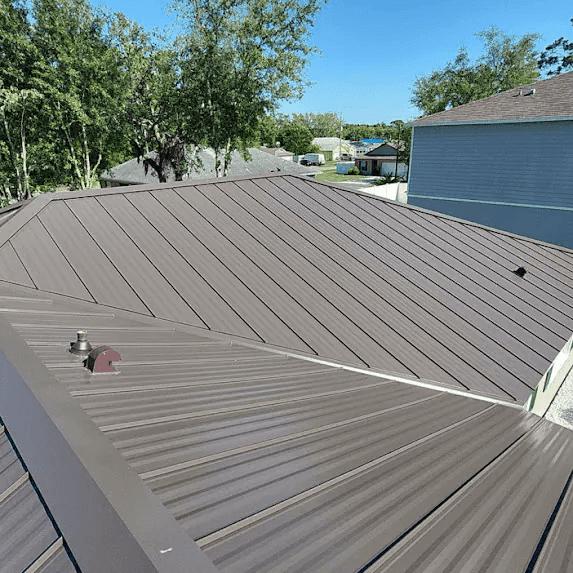
Standing seam is the flagship of residential metal roofing. The panels run vertically from ridge to eave with raised seams that lock together mechanically or with snap-fit engagement. The critical detail is that all fasteners are concealed beneath the seam. No screws penetrate the face of the panel. This matters enormously in Florida because exposed fasteners are the number one failure point on cheaper metal roofs. The neoprene washers around exposed screws degrade in UV exposure over 7 to 12 years, and once they crack, water gets in. Standing seam eliminates that problem entirely.
Standing seam panels typically come in 12-inch, 16-inch, or 18-inch widths. They are roll-formed either at the factory or on-site using a portable roll former that our crews bring on the truck. On-site forming means each panel is cut to the exact length of your roof slope with no horizontal seams, no overlaps, and no potential leak points along the run. The installed cost for standing seam in Central Florida runs $10 to $18 per square foot depending on gauge, coating, and roof complexity. A straightforward 2,000-square-foot ranch home with a simple hip roof will land on the lower end. A two-story with multiple dormers, valleys, and penetrations will push toward the upper range.
Corrugated metal is the workhorse. The wavy or ribbed panels use exposed fasteners with rubber gaskets, and they overlap at the edges. Installation is faster and less technical than standing seam, which is why the price drops to $5 to $9 per square foot installed. For agricultural buildings, detached garages, workshops, pool enclosure roofs, and properties going for a rustic or farmhouse look, corrugated is a perfectly good choice. We install a lot of corrugated on commercial and light industrial buildings in Brooksville and the rural parts of Hernando and Citrus counties where the aesthetic fits and the budget matters more than a 50-year warranty.
The tradeoff is maintenance. Those exposed fasteners need inspection every 5 to 7 years. Gaskets will eventually need replacement. In high-wind zones, corrugated panels can be more vulnerable to uplift because the fastener pattern creates stress points. For a primary residence in a subdivision, we generally steer clients toward standing seam or metal shingles instead.
Metal shingles are the chameleon of the category. These are individual panels stamped and formed to mimic the appearance of slate, clay tile, cedar shake, or dimensional asphalt shingles. From the street, most people cannot tell they are metal. Stone-coated steel shingles from manufacturers like DECRA and Gerard take this a step further by embedding crushed stone granules into the surface, creating a texture and color depth that is genuinely convincing.
Stone-coated steel runs $13 to $18 per square foot installed, which puts it in the same range as standing seam. The advantage is curb appeal flexibility. If you live in a neighborhood with HOA restrictions that prohibit “industrial-looking” roofing, or if you simply prefer the look of tile without the weight, metal shingles solve that problem. They are also HVHZ (High Velocity Hurricane Zone) approved and carry wind warranties up to 120 mph, which matters for anyone in the coastal sections of our service area.
Why 24-Gauge Galvalume with Kynar 500 Is the Florida Standard
Not all metal roofing is created equal, and in Florida the material specification makes or breaks the system’s longevity. Let us walk through the layers of a properly specified metal roof panel.
The base metal for most residential standing seam is Galvalume steel, which is a steel substrate coated with an alloy of 55% aluminum, 43.4% zinc, and 1.6% silicon. Galvalume outperforms traditional galvanized steel (pure zinc coating) in corrosion resistance by a factor of two to four, depending on the environment. For Central Florida, where salt air reaches well inland during tropical systems and humidity sits above 70% for half the year, Galvalume is the minimum standard we recommend.
Gauge thickness matters. 24-gauge steel is 0.025 inches thick and is the industry standard for standing seam residential roofing. It provides the right balance of rigidity, wind resistance, and workability. Some budget installers will push 26-gauge (0.018 inches) to save on material cost, but the thinner metal is more prone to oil-canning (visible waviness in flat panel areas), denting from hail or debris, and fastener pull-through in high winds. On commercial projects or in particularly exposed locations near the Gulf, we sometimes spec 22-gauge for extra strength, but 24-gauge is the sweet spot for the vast majority of homes we work on in Spring Hill, Hudson, Tarpon Springs, and Clearwater.
The paint system on top of the Galvalume is where the real long-term performance lives. There are two main chemistries: SMP (Silicone Modified Polyester) and PVDF (Polyvinylidene Fluoride), which is marketed under the brand name Kynar 500 by Arkema.
SMP paint is the standard finish on most mid-range metal roofing. It holds up reasonably well, offers decent color retention, and keeps costs down. PVDF/Kynar 500 costs 30 to 40 percent more but delivers dramatically better performance. The resin chemistry resists UV degradation, chalking, and color fade at a level that SMP simply cannot match. Kynar 500 finishes carry 30 to 40 year fade warranties from the coating manufacturer, and in practice the panels still look sharp after decades of Florida sun exposure.
For a standing seam roof on your primary residence, the material cost difference between SMP and Kynar 500 might add $1.50 to $2.50 per square foot. On a 2,000-square-foot roof, that is $3,000 to $5,000. Over a 40 to 50 year roof life, that is a trivial cost for a finish that will not chalk, streak, or fade into a washed-out version of the color you chose.
We always recommend Kynar 500 for any property within 15 miles of the coast and for any homeowner who plans to stay in their home long-term. For rental properties or situations where budget is the primary driver, SMP is acceptable, but we make sure clients understand the tradeoff before they sign.
Aluminum is the other base metal option, and it becomes the preferred choice for properties directly on the coast or on barrier islands. Aluminum does not rust. Period. It is naturally corrosion-resistant without relying on a sacrificial coating like zinc or Galvalume. The downside is that aluminum is softer, more expensive per square foot, and more prone to denting. For waterfront homes in Clearwater, Tarpon Springs, and the coastal stretches of Pinellas and Pasco counties, we often spec aluminum standing seam with a Kynar 500 finish as the gold standard for salt air environments.
What a Metal Roof Installation Actually Looks Like, Day by Day
One of the most common questions we hear at Protech is “how long does it take?” The answer depends on the system, the roof complexity, and the weather, but here is what a typical standing seam installation looks like on a standard residential home in our service area.
Before the crew arrives. The project starts weeks before installation day. Our estimator has already measured the roof using a combination of drone imagery and physical measurements. We have created a panel layout drawing that maps every ridge, hip, valley, eave, and penetration. Panels have been ordered or scheduled for on-site roll forming. Trim pieces, underlayment, fasteners, sealant, and flashing components are staged and ready. We pull the building permit through the local jurisdiction, which in Hernando County typically takes 5 to 10 business days.
Day 1: Tear-off and deck preparation. The crew strips the existing roofing material down to the deck sheathing. On most Central Florida homes built after the mid-1990s, the deck is 7/16 or 15/32 OSB or plywood. We inspect every sheet for rot, soft spots, or delamination. Any compromised decking gets replaced with new plywood. In Hernando, Citrus, and Pasco counties, we commonly find localized rot around old plumbing boots, satellite dish mounts, and chimney flashings. Deck repair is included in our scope, and we do not charge surprise fees for minor replacement. If the damage is extensive, we discuss it with the homeowner before proceeding.
Once the deck is solid, we install the underlayment. Florida Building Code requires a minimum of one layer of ASTM D226 Type II (30-lb felt) or a synthetic equivalent. For metal roofing, we use a high-temperature synthetic underlayment rated for metal panel contact because metal roofs get hot. Standard asphalt felt can degrade prematurely under metal panels in Florida heat. We also install ice-and-water shield (peel-and-stick membrane) at all eaves, valleys, and penetrations as an extra waterproofing layer, even though Florida code does not require ice dam protection the way northern states do. It is cheap insurance.
Day 2-3: Panel installation. If we are roll-forming on-site, the portable machine sets up in the driveway or yard. Coil stock feeds through the former, and panels come out cut to the exact length needed for each roof slope. Panels go up starting from one gable end or hip and work across. Each panel clips to the deck using concealed clips that allow for thermal expansion and contraction. This is critical. A 20-foot metal panel in Central Florida can expand and contract by nearly a quarter inch between a cool January morning and a July afternoon. If the panel is rigidly fixed, it will buckle or oil-can. The clip system lets the panel float on the clips while remaining locked at the seams.
Trim work is where the skill shows. Ridge caps, hip caps, valley flashing, drip edge, gable trim, and penetration boots all have to be fabricated and installed with precision. Our crews hand-brake custom trim on-site using a portable sheet metal brake. Every joint gets sealed with a high-quality, UV-stable sealant. Pipe boots use flexible EPDM or silicone boots rated for metal roof temperatures.
Day 4: Detail work and cleanup. Final trim installation, touch-up on any scratched panels, gutter reattachment or replacement, and thorough debris cleanup. We use magnetic sweepers on the ground to pick up every stray screw and metal shaving. A final walkthrough with the homeowner covers how the ventilation system works, what normal thermal expansion sounds like (yes, metal roofs tick and pop a little as they heat up and cool down, especially in the first year), and warranty registration.
Day 5: Inspection. We schedule the final building inspection with the local authority. In Hernando County, the inspector checks fastener patterns, underlayment installation, flashing details, and overall code compliance per the Florida Building Code 8th Edition. We have a near-perfect pass rate because we do not cut corners during installation.
The whole process for a straightforward re-roof typically takes 3 to 5 working days. Complex roofs with steep pitches, multiple levels, or extensive custom trim work can take longer. We keep homeowners updated daily and work clean.
Apartment, condo, or HOA property? Protech also handles multi-family roofing projects across Hernando County and surrounding areas, with discreet scheduling and minimal disruption to residents.
Metal vs. Shingles in Hurricane Country: The Performance Gap
Central Florida is hurricane country. That is not a possibility we plan around. It is a certainty. The question is not whether a major storm will affect your property but when. And when it does, the difference between a metal roof and an asphalt shingle roof becomes painfully obvious.
Asphalt shingles are rated by wind speed. A standard 3-tab shingle carries a 60 to 70 mph wind warranty. Architectural (dimensional) shingles are rated to 110 or 130 mph. Those numbers sound adequate until you understand how shingles fail. Wind does not need to exceed the rated speed to cause damage. It just needs to find an edge. Once a single shingle tab lifts, the one next to it is exposed. Then the next one. Failure cascades. After Hurricane Ian in 2022, we saw entire shingle roofs stripped to the felt paper even in areas where sustained winds were below the shingles’ rated threshold. Gusts, directional shifts, and debris impact all contribute to progressive failure.
Metal standing seam systems perform differently under wind load. The interlocking seams create a continuous surface with no exposed edges for wind to catch. Concealed clips allow the panels to flex under pressure without releasing. A properly installed standing seam roof on a home in Spring Hill or Brooksville can withstand sustained winds of 140 to 180 mph depending on the clip spacing, gauge, and seam profile. Stone-coated steel shingles from DECRA and Gerard carry tested wind ratings of 120 mph with interlocking panel designs that resist uplift far better than individual asphalt shingles.
The Florida Building Code 8th Edition sets specific wind resistance requirements based on your location within the state. Most of our service area falls into wind zones requiring resistance to 140 to 150 mph design wind speeds when you factor in the 3-second gust calculations and exposure categories. Metal roofing systems meet or exceed these requirements when installed to manufacturer specifications, which is why proper installation technique matters so much.
Beyond wind, metal roofs carry a Class A fire resistance rating, which is the highest available. They are non-combustible. In the aftermath of a hurricane, when downed power lines and gas leaks create fire hazards across neighborhoods, a non-combustible roof is a meaningful safety advantage. Metal roofs also do not absorb water. After days of driving rain from a tropical system, an asphalt roof can absorb moisture that contributes to deck rot and mold growth. Metal sheds water instantly and completely.
One myth that persists is that metal roofs attract lightning. They do not. Lightning strikes the highest point in an area regardless of material. A metal roof does not increase the probability of a strike. However, if lightning does hit a metal roof, the non-combustible surface is actually safer than asphalt or wood because it will not catch fire. The energy dissipates across the conductive surface.
We have been through enough storm seasons at Protech to say this with confidence: every dollar spent upgrading from asphalt to metal is a dollar that pays for itself the first time a serious storm makes landfall near your home. The roof stays on, the interior stays dry, and you are not fighting with your insurance company for months afterward.
Energy Savings, Insurance Discounts, and the Real ROI of Metal
The upfront cost of a metal roof is higher than asphalt shingles. There is no way around that. A quality standing seam installation on a 2,000-square-foot home might run $20,000 to $36,000, while a comparable asphalt shingle roof costs $10,000 to $18,000. The gap is real. But the ROI calculation over the life of the roof tells a completely different story.
Energy savings. Metal roofs reflect a significant portion of solar radiation rather than absorbing it the way dark asphalt shingles do. A light-colored metal roof with a Kynar 500 finish and high solar reflectance can reduce cooling costs by 10 to 25 percent. In Central Florida, where air conditioning accounts for 40 to 50 percent of a home’s annual energy bill, that translates to $300 to $800 per year in savings depending on the size of your home and your current system efficiency. Over 40 years, that is $12,000 to $32,000 in energy cost avoidance. Cool metal roofing with ENERGY STAR certification and high SRI (Solar Reflectance Index) values performs even better.
The mechanism is straightforward. Asphalt shingles absorb heat and transfer it to the attic space, which radiates into the living area below. On a July afternoon in Lakeland or The Villages, a dark asphalt roof surface can reach 160 to 170 degrees Fahrenheit. A light-colored metal roof surface under the same conditions typically stays 50 to 70 degrees cooler. That temperature differential reduces the thermal load on your attic insulation and HVAC system significantly.
Insurance discounts. This is where the Florida-specific math gets interesting. Many Florida homeowners insurance carriers offer premium discounts for metal roofing, particularly for standing seam and stone-coated steel systems that meet enhanced wind resistance standards. Discounts vary by carrier, location, and policy, but reductions of 5 to 25 percent on the wind portion of your premium are common. For homeowners in coastal Pasco, Pinellas, or Hillsborough counties where wind premiums are substantial, that can mean $500 to $2,000 or more per year in savings.
Some carriers also offer credits for Class A fire resistance and for impact resistance ratings. Metal panels generally qualify for the highest available credits in both categories. We recommend contacting your insurance agent before your installation to understand exactly what documentation they need. We provide manufacturer specification sheets, wind rating certifications, and installation compliance documentation to support your discount claim.
Lifespan economics. An asphalt shingle roof in Central Florida lasts 15 to 20 years in practice, regardless of what the warranty says. The combination of UV exposure, heat cycling, humidity, and storm damage degrades shingles faster here than in northern climates. That means a homeowner who stays in their house for 40 years will need two to three shingle roofs during that period.
A metal roof installed once lasts the full 40 to 70 years. When you factor in the avoided cost of one or two complete re-roofs ($10,000 to $18,000 each), the elimination of ongoing repair costs from storm damage, the energy savings, and the insurance discounts, the total cost of ownership for a metal roof is lower than asphalt shingles over a 30-plus year horizon. The breakeven point in Central Florida typically falls somewhere between year 12 and year 18, depending on storm activity and insurance savings.
There is also the resale value component. Studies from the Metal Roofing Alliance and various real estate analyses indicate that a metal roof adds 1 to 6 percent to a home’s resale value. In our market, where buyers are increasingly aware of hurricane risk and insurance costs, a metal roof is a genuine selling point that can set your listing apart.
Coastal Considerations: Salt Air, Corrosion, and Material Selection
Central Florida’s geography creates a corrosion challenge that many inland homeowners do not think about until it is too late. Salt air from the Gulf of Mexico does not stop at the beach. Airborne chlorides travel 10 to 15 miles inland during storm events and tropical weather patterns. Even in Spring Hill, which sits 8 to 12 miles from the coast depending on the neighborhood, salt deposition on roofing materials is measurable and meaningful over a multi-decade roof life.
For properties within 5 miles of the Gulf coastline in Pasco and Pinellas counties, we spec aluminum panels as the default. Aluminum’s natural oxide layer provides inherent corrosion resistance that steel-based products cannot match in direct coastal exposure. The cost premium for aluminum over Galvalume steel is roughly 20 to 35 percent, but the extended service life in a salt environment more than justifies it.
For properties in the 5 to 15 mile range, which includes much of Spring Hill, Hudson, and the inland portions of Tarpon Springs and Clearwater, 24-gauge Galvalume steel with a Kynar 500 PVDF finish is our standard recommendation. The Galvalume coating handles moderate salt exposure effectively, and the Kynar 500 paint system provides an additional barrier against chloride attack on the finish coat.
Beyond the base metal and paint, there are installation details that matter in coastal environments. All exposed fasteners (on corrugated systems, trim, and accessories) should be stainless steel, not zinc-plated carbon steel. Zinc-plated fasteners in salt air environments can show corrosion within 3 to 5 years. Stainless steel costs more but eliminates the problem entirely. We use 304 stainless steel fasteners as standard on any project within 15 miles of the coast.
Dissimilar metal contact is another coastal concern. When aluminum touches steel or copper in the presence of moisture and salt, galvanic corrosion accelerates the deterioration of the less noble metal (usually the aluminum). Our installation details include isolation barriers at any point where different metals contact each other. This means butyl tape separators, EPDM washers, or painted barrier coatings at flashing-to-panel transitions and at any point where the roof system meets gutters, vents, or other metallic components.
We also pay attention to the underside of the panels. In humid coastal environments, condensation can form on the bottom surface of metal panels, especially during the spring and fall transition seasons when nighttime temperatures drop while humidity remains high. Our underlayment specification and ventilation design account for this, ensuring that any condensation that does form can dry without causing deck damage.
Installation Over Existing Shingles: When It Works and When It Does Not
One question that comes up regularly at Protech is whether a metal roof can be installed over existing asphalt shingles without a full tear-off. The short answer is yes, in some cases, but the details matter and the decision is not as simple as saving on tear-off labor.
The method involves installing a grid of furring strips (typically 1×4 pressure-treated lumber or metal hat channels) over the existing shingles, creating an air gap between the old roof and the new metal panels. The metal panels then attach to the furring strips. This approach can work well when the existing shingle layer is a single layer in reasonably good condition, when the deck sheathing beneath is structurally sound, and when the additional weight is within the structural capacity of the framing.
The advantages are real. You save $1,500 to $3,000 on tear-off and disposal costs. The air gap created by the furring strips adds a thermal break that can improve energy performance. And the project generates significantly less waste going to the landfill.
But there are situations where we will not do it. If the existing roof has two layers of shingles already, we tear off. Florida Building Code limits residential roofs to two layers of roofing material, and adding metal over two layers of shingles would exceed that. If the existing shingles show signs of moisture damage, curling, or moss/algae growth that suggests trapped moisture, we tear off. Installing over a compromised layer just traps the problem. If the homeowner’s insurance requires a tear-off for their wind mitigation credit, we tear off. Some carriers will not grant the full metal roof discount if the old shingles remain underneath.
During our initial inspection, we evaluate the existing roof condition, check the attic for signs of deck damage, verify the shingle layer count, and discuss the insurance implications with the homeowner. We give an honest recommendation rather than just defaulting to whatever option costs less. In our experience across Hernando, Pasco, and Hillsborough counties, roughly 60 to 70 percent of metal roof projects involve a full tear-off because the existing roof condition or insurance requirements make it the better choice.
Protech’s Metal Roofing Process and Certifications
Protech Roofing Services is not a one-product company that only installs metal. We hold GAF certifications for asphalt shingle systems and Carlisle certifications for flat and low-slope commercial roofing. That breadth of experience matters because it means we understand how different roofing systems perform relative to each other, and we can give clients an honest comparison rather than pushing metal as the answer to every situation.
That said, our metal roofing division has grown steadily because the product genuinely makes sense for Central Florida conditions. Our installers are trained specifically in standing seam fabrication and installation techniques, including on-site roll forming, mechanical and snap-lock seaming, and custom trim fabrication. Metal roofing installation is a specialized skill set. The tolerances are tighter than shingle work, the tools are different, and the consequences of installation errors are more severe because metal does not forgive sloppy flashing details the way a thick asphalt shingle system sometimes can.
We carry full licensing and insurance for work in Hernando, Citrus, Pasco, Sumter, Polk, Hillsborough, and Pinellas counties. Our roofing license covers both residential and commercial projects, and our liability and workers’ compensation coverage meets or exceeds the requirements in every jurisdiction we serve. We pull permits for every project, schedule and attend all required inspections, and do not close out a job until the final inspection is passed and the homeowner has all warranty documentation in hand.
Our warranty structure for metal roofing has three layers. The panel manufacturer provides a material and finish warranty, typically 30 to 40 years for Kynar 500 finishes and 20 to 25 years for SMP. The coating manufacturer (Arkema for Kynar 500 systems) provides a separate coating performance warranty. And Protech provides our own workmanship warranty covering the installation itself. We stand behind our work because we plan to be here for the long haul serving this community.
For homeowners in Spring Hill, Brooksville, Hudson, The Villages, Lakeland, Tarpon Springs, Clearwater, and everywhere in between, the conversation starts with a phone call. Reach us at (352) 605-0696 to schedule a property evaluation. We will assess your existing roof condition, discuss your goals and budget, explain the material options that make sense for your specific location and exposure, and provide a detailed written estimate with no pressure and no gimmicks.
Metal roofing is not the cheapest option on day one. But for homeowners who think in terms of decades rather than years, who value storm protection over short-term savings, and who want to install a roof once and never think about it again, it is the smartest investment you can make in your Central Florida home. That is not a sales pitch. It is forty years of performance data talking.
Available By City
Metal Roofing Systems in cities across our service area
Metal Roofing Systems in Brooksville
Metal roofing in Brooksville, FL. Standing seam and metal shingle installation by Protech Roofing. Call (352)
Metal Roofing Systems in Clearwater
Metal roofing in Clearwater, FL. Standing-seam aluminum for coastal homes. 150 mph rated. Call (352) 605-0696
Metal Roofing Systems in Largo
Metal roofing in Largo, FL. Standing seam, metal shingle, aluminum, mobile home panels. Protech Roofing. Call
Metal Roofing Systems in Spring Hill
Metal roofing in Spring Hill, FL. Standing seam and metal shingle experts. Protech Roofing. Call (352) 605-069
Metal Roofing Systems in St. Petersburg
Metal roofing in St. Petersburg, FL. Standing seam and metal shingle by Protech Roofing. Call (352) 605-0696 f
Metal Roofing Systems in Tampa
Metal roofing in Tampa, FL. Aluminum for bay salt air, PVDF coatings, 130 mph code. Standing seam and metal sh
Metal Roofing Systems in The Villages
Metal roofing in The Villages, FL. Standing seam and metal shingle installation. Protech Roofing. Call (352) 3
FAQ
Frequently Asked Questions
Where can I find a metal roofing installer near me in Central Florida?
+
What are the main types of metal roofing systems?
+
How long does a metal roof last?
+
Is metal roofing noisy during rain?
+
Does metal roofing attract lightning?
+
Can a metal roof be installed over existing shingles?
+
Do you install metal roofing near me?
+
Roofing Knowledge
Articles and guides for homeowners
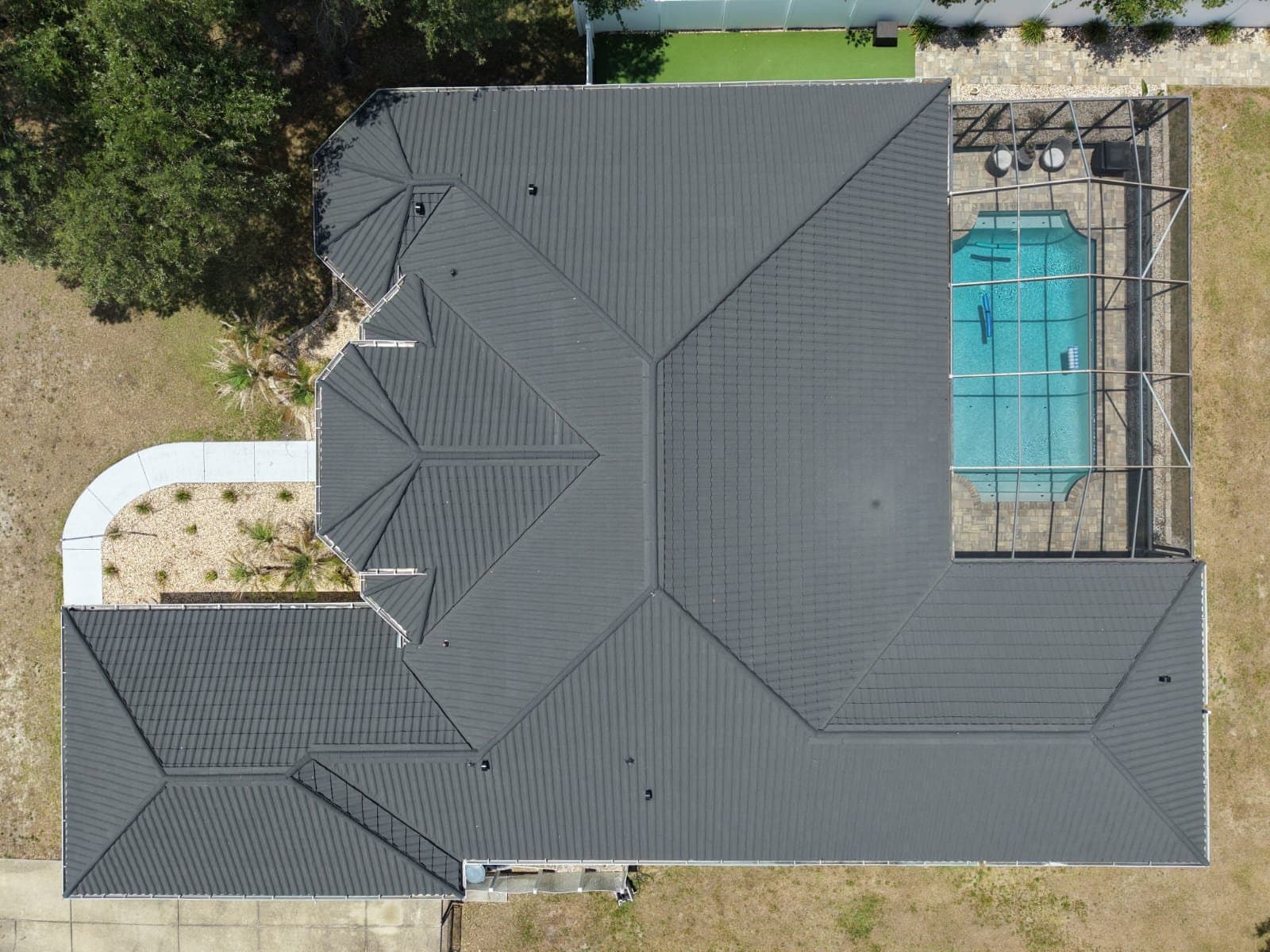
Metal Roof Cost in Florida 2026: Per-Sqft Guide
Metal roofs in Florida run about $8 to $23 per square foot installed, depending on the system. Here is what standing seam, stone coated steel and exposed fastener panels cost, what a typical home pays and how to compare quotes.
Read Article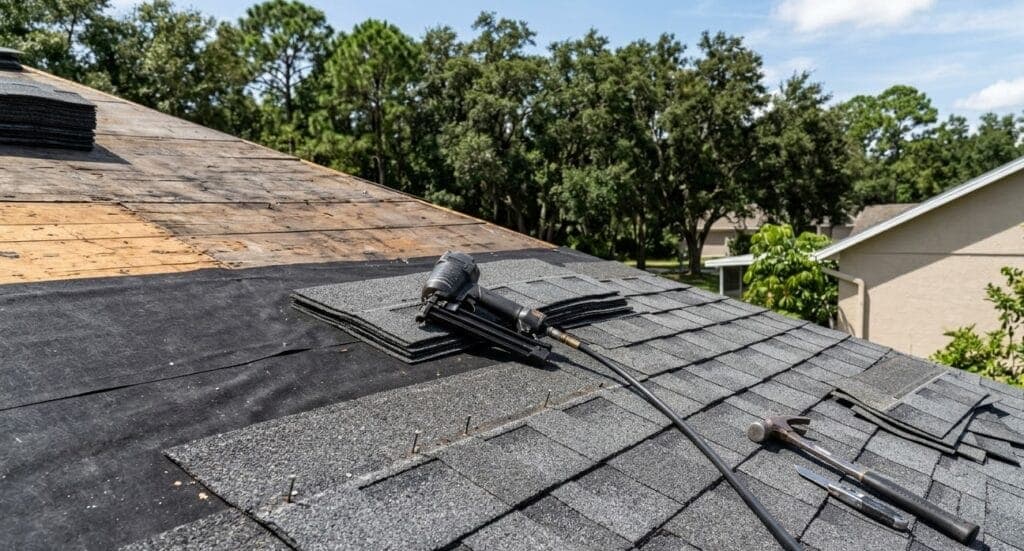
Roofing Warranties in Florida: What Voids Them
A new Florida roof usually carries two warranties: one from the manufacturer for the product and one from the contractor for the installation. Here is what each covers, what quietly voids them and how to keep your coverage.
Read ArticleSolar Roofing in Florida: Solar Shingles vs Panels (2026)
Every solar system on a Florida roof is either bolted to the roof or is the roof. Here is how panels and solar shingles compare in 2026, what changed with the federal credit, and why the cheapest solar project often starts with a re-roof.
Read ArticleReady When You Are
Get your free roof inspection today.
No-pressure, written estimate. Same-week scheduling across Hernando County. Call us now or request a visit online.