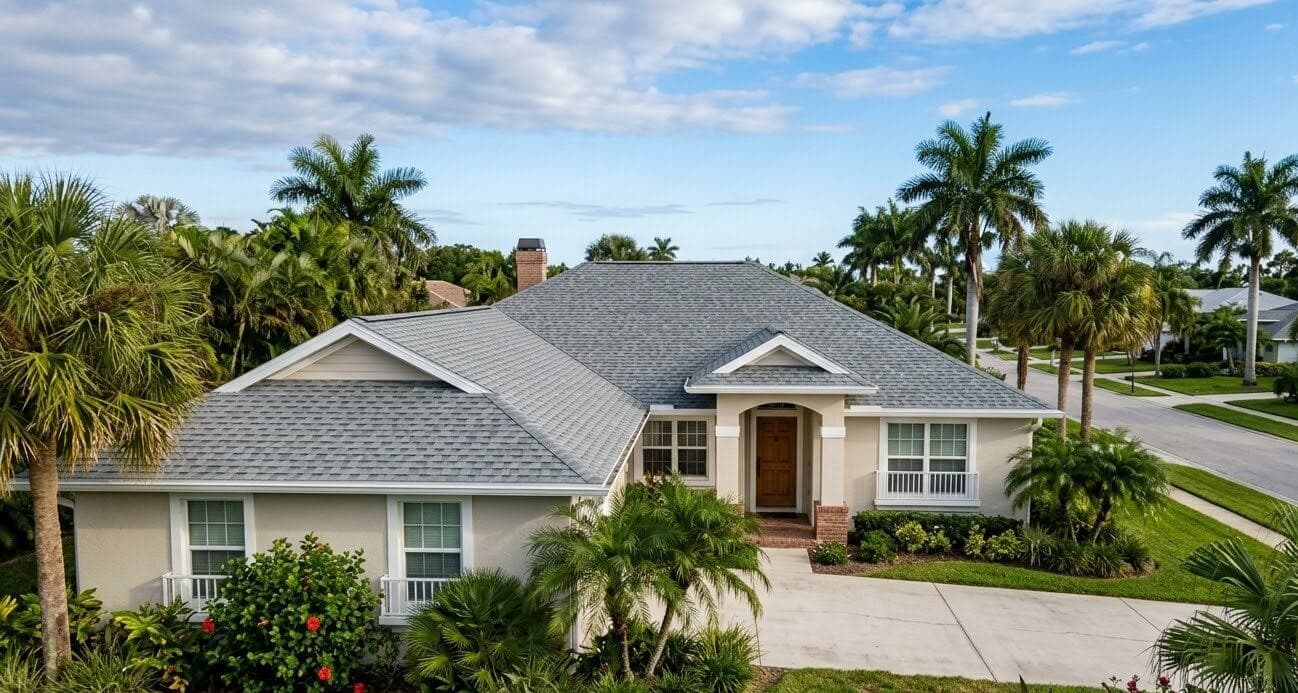
Tampa, FL
Metal Roofing in Tampa, FL
Metal roofing in Tampa, FL. Aluminum for bay salt air, PVDF coatings, 130 mph code. Standing seam and metal shingle. Call (352) 605-0696.
Call (352) 605-0696Protech Roofing Services installs metal roofs across Tampa and Hillsborough County every week, from aluminum standing seam on Bayshore Boulevard waterfront homes to metal shingle on historic Hyde Park bungalows and steel standing seam on inland Tampa Palms properties. Every install is engineered to the 130 mph Hillsborough wind code, permitted through the City of Tampa Construction Services office, and built with high-temperature peel-and-stick underlayment for full waterproof redundancy. Call (352) 605-0696 for a free material consultation and onsite measurement.
You Are Viewing
Metal Roofing for homeowners and businesses in Tampa, part of Hillsborough County, FL, Florida.
Why Tampa Is Switching to Metal
Metal roofing in Tampa, FL has gone from a coastal curiosity to a mainstream choice in about a decade, and the shift is accelerating. We started installing metal on Tampa Bay homes in small numbers in the early 2010s. Now it is roughly one of every four replacement quotes we write across Hillsborough County, and in coastal Tampa neighborhoods like Ballast Point, Harbour Island, Bayshore Beautiful, and the waterfront streets of Davis Islands, metal is already the majority choice on new replacements. The reasons are not mysterious. A properly installed metal roof in Tampa lasts 40 to 50 years, survives 130 mph winds with the right attachment, reflects enough solar heat to drop attic temperatures by 20 degrees or more during a 91 degree August afternoon, and handles the salt-air corrosion that eats steel and galvanized systems alive near the bay.
Insurance is the second driver. Citizens has dropped 90,000 Tampa Bay policies over the past two years, and private carriers have tightened their roof-age underwriting. A metal roof resets the clock to 50 years for the carrier's classification, which means a Tampa homeowner who installs metal in 2026 will not face the age-based inspection cycle until 2076. The current insurance environment makes that reset worth the higher upfront cost for a lot of Tampa owners. Call (352) 605-0696 to walk through the numbers for your specific address.
The third driver is the hurricane math. Hurricane Milton's October 9, 2024 landfall at Siesta Key and the 6 to 9 foot surge it pushed into Tampa Bay reminded every Tampa homeowner that a shingle roof fights a losing war with sustained 120 mph wind. Metal installed to 130 mph code and ASCE 7-22 load requirements handles those winds without lifting. For a lot of Tampa owners sitting on a 15 year old shingle roof with another hurricane season coming, metal is the permanent answer instead of the next cycle of repairs.
Standing Seam vs. Metal Shingle for Tampa Historic Districts
The two main metal roofing profiles on Tampa homes are standing seam and metal shingle. Standing seam is the clean vertical-ribbed profile you see on new coastal construction and on commercial buildings. The panels run the full length of the slope with concealed fasteners, and the seams are raised ribs that interlock or fold to seal against water. Standing seam is the strongest profile, the longest-lasting, and the most expensive. It is the right answer on modern Tampa architecture, on rural Hillsborough properties, and on coastal waterfront homes where wind-driven rain is the worst-case scenario.
Metal shingle is the profile designed to mimic an architectural asphalt shingle, a wood shake, or a traditional tile from street level. Up close you can see it is metal, but from 15 feet away it reads as the traditional material. That distinction matters enormously in Tampa's historic districts, where the City of Tampa Architectural Review Commission has design guidelines that restrict standing seam on contributing historic structures. Hyde Park, Ybor City, Tampa Heights, and parts of Seminole Heights all fall under some form of historic review, and metal shingle is often the path to a 50 year metal roof that the review board approves without a long appeal process.
HOA considerations apply in the non-historic neighborhoods too. Tampa Palms, New Tampa, and the master-planned communities generally have ARC guidelines that specify approved roof profiles. We handle the ARC submission as part of the job and have worked with most of the Tampa HOA boards enough to know which profiles and colors pass on the first submission. For homeowners still in the material-decision stage, we can pull the ARC requirements for your community before the quote so the cost comparison is real apples to apples.
Aluminum vs. Steel for Bay-Front Tampa Addresses
If your Tampa home is within a mile of salt water, the metal choice is aluminum, not steel. This is one of the most important decisions in a coastal Tampa replacement and one of the easiest to get wrong. Steel, even with a Galvalume coating or a paint system, eventually succumbs to chloride salt in the air. The failure mode is usually the cut edges and the fastener penetrations first, then streak corrosion along panel seams, then red rust bleeding down the face of the panel. A steel roof on Bayshore Boulevard or Davis Islands that lasts 40 years inland will look rough by year 12 to 15 near the bay.
Aluminum does not rust. Period. A chloride molecule hitting an aluminum panel does nothing. That is why aluminum is the standard for marine environments, for boat hulls, for dock hardware, and for coastal Tampa roofs. The trade-off is cost. Aluminum runs roughly 20 to 30 percent more per square than comparable steel, and it dents more easily during hail events, though hail is not a frequent issue in Tampa. For coastal Tampa neighborhoods the math is clean: aluminum is the right long-term answer at Ballast Point, Harbour Island, Davis Islands, Bayshore Beautiful, and the waterfront streets of Westshore and Palma Ceia.
Steel is fine for inland Tampa. Tampa Palms, New Tampa, Carrollwood, Seminole Heights, Forest Hills, Sulphur Springs, and the inland portions of Westshore are far enough from the salt air that a Galvalume-coated steel panel will last its full 40 to 50 year rated life. Steel is typically 20 to 30 percent cheaper than aluminum for the same profile and thickness, which can be the difference between staying on budget and stretching. We write both options on coastal quotes and recommend aluminum if you are within the salt zone. The salt zone is not a published boundary, but our working rule is about one mile from any tidal water.
PVDF Coatings and Why They Matter in Tampa
Metal panels are almost always painted. The paint system is what determines how the color holds up in the Tampa sun. The two main categories of paint on metal roofing are SMP (silicone-modified polyester) and PVDF (polyvinylidene fluoride, sold under trade names like Kynar 500 and Hylar 5000). SMP is the cheaper system and holds up fine in mild climates, but in Tampa's UV-heavy, humidity-heavy environment it starts to fade and chalk within seven to ten years. PVDF is the premium coating and holds color, gloss, and chalking resistance for 30 to 40 years in the same Tampa environment.
On a 50 year metal roof, the paint system is the actual lifespan-limiting factor, not the metal itself. A PVDF-coated aluminum roof will outlast an SMP-coated aluminum roof by a decade or more on appearance alone. The cost difference is usually 10 to 15 percent at the material level, which translates to maybe 5 to 7 percent on the total job because labor and underlayment are the same. We recommend PVDF on every Tampa metal install and we default to it on coastal replacements. SMP remains an option on inland homes where the owner is specifically trading lifespan for upfront cost.
Color choice matters too. Lighter colors reflect more solar heat and drop attic temperatures further, which is meaningful in Tampa's 91 degree summers. Darker colors look sharper on contemporary architecture but absorb more heat. For homes with minimal attic insulation or older ductwork in the attic, a lighter PVDF finish is usually the better energy answer. For homes with closed-cell spray foam at the roofline, the color choice is more about aesthetics than performance.
Metal Lifespan in 70 to 80 Percent Humidity and 91 Degree Summers
Tampa's climate is classified as humid subtropical. Summer highs sit around 91 degrees. Annual rainfall is 49.48 inches, with August alone averaging 9.03 inches. Humidity rarely drops below 60 percent and spends most of the year in the 70 to 80 percent range. That climate is hard on every roofing material, but it is actually where metal shines relative to the alternatives. Shingle roofs in Tampa average 15 to 20 years. Concrete tile averages 40 to 50. Metal averages 40 to 50 with much less maintenance along the way.
The maintenance difference is the quiet benefit. An aluminum standing-seam roof in Tampa requires essentially zero maintenance for the first 20 years. A shingle roof over the same period needs two or three cleanings for algae, probably one pipe-boot replacement round, and usually a few storm-related spot repairs. A tile roof needs underlayment awareness, occasional slip repair, and sealant attention at the ridge. Metal needs a visual check once a year to look for loose fasteners (rare with concealed-fastener standing seam) and a wash-off spray on the bay side of the roof to rinse salt deposits. That is the whole maintenance plan.
Algae and mildew that streak Tampa shingle roofs do not adhere well to metal. The smooth painted surface sheds biological growth faster, and a light rain usually rinses off anything accumulated. In 70 to 80 percent humidity that resistance is not cosmetic. It is a lifespan advantage. The same property that makes shingle roofs need copper-granule algae resistance in Tampa is the property that makes metal a simpler long-term choice.
130 mph Code Compliance for Metal Installs in Tampa
Every metal roof we install in Tampa is designed and fastened to the 130 mph minimum design wind speed that Hillsborough County enforces under the Florida Building Code 8th Edition 2023, which references ASCE 7-22. The wind load is not uniform across the roof. The corners and edges see much higher uplift than the field, so the clip spacing tightens at the perimeter. On a typical Tampa metal install, the field might have clips every 24 inches while the corners and eaves drop to 12 inches or less depending on the engineered specification. Getting this right is the difference between a metal roof that passes a 130 mph event and one that peels like a sardine can.
Every panel, clip, fastener, and accessory we install carries a Florida Product Approval number matched to the 130 mph requirement. The approval number goes on the permit application through the City of Tampa Construction Services office at 2555 E. Hanna Avenue, Tampa FL 33610, phone 813-274-3100. The inspector verifies the product approvals and the installation pattern during the final inspection. Any deviation is a fail.
One item that gets overlooked in Tampa metal installs is the underlayment choice. Metal roofs need high-temperature peel-and-stick underlayment rated for the temperatures that metal panels generate in direct sun. Standard asphalt-impregnated felt can soften and bleed through metal panels during hot Tampa summers. We default to a synthetic high-temp peel-and-stick across the entire deck on every metal install, which adds a waterproof layer independent of the metal itself. That redundancy is why metal roofs installed correctly survive the worst Tampa storm events with zero interior water intrusion even when panels are stressed.
More in this area
Other roofing services in Tampa
FAQ
Frequently Asked Questions
How much does a metal roof cost in Tampa, FL?
+
Is aluminum or steel better for a Tampa home near the bay?
+
Will a metal roof pass the Hyde Park historic review in Tampa?
+
How long does a metal roof last in Tampa's humidity?
+
Is a metal roof noisier than shingle during Tampa rain storms?
+
From the Blog
Stay informed about roofing in Florida.
Roofing Warranties in Florida: What Voids Them
A new Florida roof usually carries two warranties: one from the manufacturer for the product and one from the contractor for the installation. Here is what each covers, what quietly voids them and how to keep your coverage.
Read ArticleSolar Roofing in Florida: Solar Shingles vs Panels (2026)
Every solar system on a Florida roof is either bolted to the roof or is the roof. Here is how panels and solar shingles compare in 2026, what changed with the federal credit, and why the cheapest solar project often starts with a re-roof.
Read Article
Pinellas Flood Zone Roofing: The 49% Rule Explained
Every article calls it the FEMA 50 percent rule. In unincorporated Pinellas County the number that governs your permit is 49 percent, measured against structure value without land. Here is what counts toward it, where a roof replacement actually lands in that math, and why simultaneous permits still aggregate even where the lookback period was repealed.
Read ArticleReady When You Are
Get your free roof inspection today.
No-pressure, written estimate. Same-week scheduling across Hernando County. Call us now or request a visit online.