Spring Hill, FL
Gutter Installation in Spring Hill, FL
Seamless gutter installation in Spring Hill, FL. Aluminum, copper, super gutters for lanais. Call (352) 605-0696.
Call (352) 605-0696Ask any longtime Hernando County roofer what's piled up in the average Spring Hill gutter, and the answer is pine straw. Lots of it. Spring Hill sits on top of what used to be a longleaf pine flatwood, and the slash pine, saw palmetto, and scattered live oak that replaced the original canopy still drop a steady carpet of needles and catkins onto roof slopes year-round. That ecological history is what makes gutter installation in Spring Hill, FL a different planning conversation than most contractors run. Protech Roofing measures, fabricates, and installs seamless aluminum, copper, and super gutter systems across Timber Pines, Glen Lakes, Sterling Hill, Wellington, Forest Oaks, Berkeley Manor, and Seven Hills. We're based out of Brooksville, so the trucks roll south on 41 in under twenty minutes. Call (352) 605-0696 for a free on-site walkthrough and a written quote.
You Are Viewing
Gutter Installation for homeowners and businesses in Spring Hill, part of Hernando County, FL, Florida.
Why Slab-on-Grade Spring Hill Homes Need Gutters
Spring Hill traces its layout back to Deltona Corporation, which started platting the original tract sections in 1967 and kept building through the late 1980s. What that company sold, in volume, was the affordable Florida tract home: poured slab foundation, concrete block walls finished in stucco, single story, between roughly 1,800 and 2,500 square feet of conditioned space. That recipe is still the dominant housing stock here. Drive any older block off Mariner or Spring Hill Drive and you'll see variations on the same theme over and over again.
The reason that matters for gutters is the relationship between the eave and the dirt. A Deltona-built slab home sits maybe three or four inches above finish grade. The stucco wall runs straight down to the slab edge with no transition, no buffer, and no crawlspace underneath to absorb water that doesn't get carried away from the perimeter. So when rain pours off an unguttered roof, it lands in the mulch bed, throws spray back against the lower stucco, and saturates the slab edge over and over again through every summer storm.
Walk the south side of an older Berkeley Manor or Forest Oaks ranch after July and you'll see what that does. There's usually a discolored band along the lower two feet of the wall where splash has driven mud, mildew, and pine tannin into the stucco pores. On homes with mature slash pine, the staining repeats faster because pine straw resin rinses out brown and binds to whatever it touches.
Then there's the pest story. Subterranean termites thrive on consistently moist soil at the slab perimeter, and an unguttered Deltona tract creates exactly that microclimate. A gutter system that captures runoff and discharges it past the dripline interrupts the whole chain, which is why gutters give the best dollar-for-dollar exterior return Spring Hill homeowners can fund.
Seamless Aluminum vs Copper for Spring Hill Subdivisions
Spring Hill breaks roughly into two housing tiers, and the material conversation tracks that split. On one side you have the original Deltona tract subdivisions: unrestricted lots, no HOA, modest budget per home, owner often retired and on fixed income. On the other side you have the modern gated communities like Timber Pines, Glen Lakes, Sterling Hill, and Wellington, where lot sizes are bigger, fascia runs are longer, and roof pitches climb above the standard 4:12 of the older tract stock. The right gutter for each tier looks different.
For Deltona tract homes, we install seamless aluminum in a 5-inch K-style profile almost every time. It's brake-formed on-site into a single continuous piece, hung with hidden hangers into the sub-fascia, and finished with 2x3-inch downspouts at the corners. The whole system runs about $7 to $11 per linear foot installed, and a typical 100 to 140 foot job lands somewhere between $1,000 and $1,900. We standardize on .032-gauge aluminum because the .027-gauge that warehouse-store installers cut corners with will start oil-canning after two or three Florida summers.
Step into Sterling Hill, Glen Lakes, or Wellington and the spec changes. Larger homes mean longer fascia runs, more roof area shedding into each downspout, and steeper pitches that accelerate the water before it hits the gutter. We upgrade those installs to 6-inch K-style aluminum, still in .032 gauge, with 3x4-inch downspouts to keep up with the peak intensity of a Hernando County thunderstorm. That spec runs $2,000 to $3,900 for the typical Sterling Hill or Glen Lakes home with 160 to 240 linear feet, four to six downspouts, and a few transition miters around bay windows and bonus rooms.
Copper sits in its own tier. We install it on Timber Pines and Glen Lakes homes where the architecture warrants it, usually Mediterranean revival or transitional designs. The trade-off is a 60-plus year service life and a finish that develops green patina by year ten without any maintenance. For owners aging in place in a Timber Pines villa, that math sometimes works out fine.
Super Gutter Installation for Spring Hill Birdcage Lanais
Once a Spring Hill home moves past the original 1970s tract era, odds are good there's a birdcage pool enclosure or screened lanai bolted onto the back. That feature, more than anything else, drives the super gutter conversation. A super gutter is the oversized aluminum channel that sits between the bottom edge of the house roof and the top rail of the screen cage, catching everything that sheds off the house slope before it can cascade into the cage and the pool deck below.
Spec on a super gutter is significantly heavier than standard eave gutter. The channel itself measures 7 or 8 inches wide and 4 or so deep, formed in .040-gauge aluminum instead of the .032 we use for standard runs. Brackets sit closer together, typically every 18 inches, because the water volume during a thunderstorm cell is several multiples higher than what a standard 5-inch K-style ever carries. Downspouts step up to 3x4-inch as well, since 2x3-inch outlets cannot move the volume fast enough to keep the channel from backing up and dumping into the cage.
Slope is where amateurs go wrong. The channel needs about 1/4 inch of fall per 10 feet, no more, no less. Too flat and water ponds in the middle, then overflows the cage rail during August downpours. Too steep and you'll get visual sag along the screen frame. We string a line before setting brackets and verify with a hose test.
Retrofit costs on an existing Spring Hill cage run higher than a clean install because we're working around the screen frame, the old gutter or drip edge that has to come off first, and prior caulking hardened in the channel rail. Expect $1,800 to $4,500 depending on cage length and access. A new build where we coordinate with the screen contractor up front comes in toward the lower end. Either way, the system holds 20-plus years on .040 aluminum and stops the most common lanai service call we get from October through May.
Downspout Sizing for Spring Hill Stormwater and Retention Ponds
Plenty of gutter installs fail on the downspout side, not the gutter side. The channel itself can be spec'd right and pitched right and still overflow during a heavy cell because the downspouts can't drain it fast enough. Our rule of thumb for Spring Hill: one 2x3-inch downspout per 30 linear feet of standard 5-inch gutter, one 3x4-inch downspout per 40 feet of 6-inch gutter, and never trust the absolute minimum on a south-facing run that takes the worst of summer convection.
Discharge planning matters too. The original Deltona plats were engineered with shallow swales between adjacent yards, feeding into culverts under driveways, then carrying stormwater to the retention ponds tucked between neighborhood pods. Sterling Hill and Glen Lakes use the same hydrology, just with cleaner edges and curbside catch basins. The right discharge point is always a splashblock or pop-up emitter handing water off to the swale, never a direct hookup to the curb or pond.
Splashblocks are the budget option and they work fine for most installs. We set a concrete or composite splash pad into the mulch, sloped away from the slab, positioned so water exits at least four feet from the wall. For homeowners who want a cleaner look, buried PVC drain lines run from each downspout out to a daylight discharge point at the swale or property edge. Smooth-wall 4-inch PVC, set on a sand bed, with a pop-up emitter at the daylight end so the line stays sealed when it's dry. That option adds $15 to $25 per linear foot of drain run.
HOA Architectural Approval for Visible Gutters in Spring Hill Communities
Here's where Spring Hill diverges sharply from a lot of central Florida markets. The original Deltona-era subdivisions, which still make up the bulk of the housing stock, were platted without any HOA structure at all. No architectural review board, no deed restrictions on exterior changes, no committee to satisfy. So if your address falls in original Spring Hill outside any of the modern gated communities, the install path is short: we measure, we cut, we hang, we test. Done.
Same goes for the Hernando County building department at 789 Providence Boulevard in Brooksville. The county does not require a building permit for gutter installation on residential properties. Roof replacement triggers a permit, structural repair triggers a permit, but adding or replacing a gutter system falls outside the structural pathway. That permit-exempt status combined with the no-HOA reality of the older tract neighborhoods is why most Spring Hill gutter projects can move from estimate to install inside a week.
The gated communities are where review comes back into the picture. Timber Pines, Glen Lakes, Sterling Hill, Wellington, Berkeley Manor, and Seven Hills each run their own architectural committee with their own application form, review cadence, and color palette. White aluminum is pre-approved in every one of these communities because it disappears against white fascia. Bronze and dark brown finishes are pre-approved in most. Anything past that, including copper, ribbed profiles, or custom colors, kicks into full review.
Timber Pines runs the heaviest paperwork. Non-standard finish review takes 30 to 45 days because the committee meets monthly and late submissions slip to the next cycle. Wellington and Glen Lakes turn around in two to three weeks. We don't order specialty materials until the approval letter is in the file, because re-ordering on a denied application creates restocking fees nobody enjoys eating.
What a Gutter Installation Day Looks Like in Spring Hill
A typical Spring Hill install fits inside a single day. Single-story Deltona tract homes between 1,800 and 2,400 square feet, which describes most of what we work on, carry 100 to 160 linear feet of gutter and wrap in six to eight hours from arrival to hose test. Larger Sterling Hill or Glen Lakes Designer homes with longer runs, multiple downspout transitions, or a super gutter component on the rear lanai can stretch to a day and a half, sometimes split across two mornings if a copper material delivery is staged separately.
Crew arrival is around 7:45 to 8:30 in the morning. First stop is a walkthrough with the homeowner to confirm every downspout location, miter point, and discharge endpoint. Disagreement on placement gets sorted before any coil comes off the truck, because moving a downspout post-install means new fascia holes that have to be sealed.
Once the layout is locked, the brake machine sets up in the driveway and the coil gets loaded. That machine is what makes these gutters seamless. A 45-foot fascia run comes off the brake as one continuous piece, gets carried to the eave on a crew handoff, and gets hung in place before any end cuts are made. Hidden hangers go into the sub-fascia every 24 inches on standard runs, every 18 inches on 6-inch upgrades, every 18 inches on super gutter retrofits. We never use spike-and-ferrule hangers because they back out of pine sub-fascia after a year or two of thermal cycling.
Last item is the hose test. Water through every section, every downspout watched for free flow, the perimeter checked for drips and slow drains. If a section needs adjustment, we lift and re-pitch it before packing up. Homeowner signs the warranty paperwork and gets a written care guide covering cleaning intervals during pine straw season and what to inspect after the next named storm.
Cost Ranges for Spring Hill Gutter Installation
Pricing in Spring Hill tracks the housing tier directly. Older Deltona tract homes in Forest Oaks, Berkeley Manor, and the unrestricted blocks of original Spring Hill typically land in the $1,000 to $1,900 range for a basic seamless aluminum install. That covers about 100 to 140 linear feet of 5-inch K-style, three downspouts with 2x3-inch outlets, standard splashblocks at each discharge, and our hidden hanger system. It's the most common ticket we write in this market.
Sterling Hill, Glen Lakes, Wellington, and the larger Seven Hills homes step up to $2,000 to $3,900 because the linear footage runs 160 to 240, the spec moves to 6-inch K-style with 3x4-inch downspouts, and the configuration usually includes a few transition miters around bay windows or bonus rooms. Add buried PVC drain lines instead of splashblocks and the project gains another $15 to $25 per linear foot of drain run. Gutter guards installed at the same time run $4 to $9 per linear foot depending on the system the homeowner selects.
Super gutter additions on a Spring Hill birdcage lanai are quoted separately because the scope and access are so different from standard eave gutter. A new super gutter on an existing cage runs $1,800 to $4,500 depending on cage length, downspout count, and how much demolition is needed on the old screen-frame attachment hardware. Adding the super gutter at the same time as a standard eave install lets us share mobilization and trim a few hundred dollars off the combined ticket.
Copper installs sit in their own pricing world: $6,000 to $12,000 for material alone on a Glen Lakes or Timber Pines home, plus HOA review handling. Every quote in every tier includes on-site brake forming, the hidden hanger system, downspouts, splashblocks or drains, the hose test, and our written warranty. Storm activity from Idalia in August 2023 and the Helene-Milton sequence in fall 2024 pushed a lot of Spring Hill owners to take eave drainage seriously, and we're still working through that demand. The earlier in the dry season the call comes in, the more flexibility we've got on the schedule.
More in this area
Other roofing services in Spring Hill
FAQ
Frequently Asked Questions
Why does pine straw matter so much for gutter planning in Spring Hill?
+
Are most Spring Hill homes really slab-on-grade tract houses?
+
If my Spring Hill block has no HOA, do I still need any approval to install gutters?
+
Which Spring Hill gated community has the strictest gutter approval process?
+
What's the realistic price for a basic gutter install on an older Forest Oaks or Berkeley Manor home?
+
From the Blog
Stay informed about roofing in Florida.
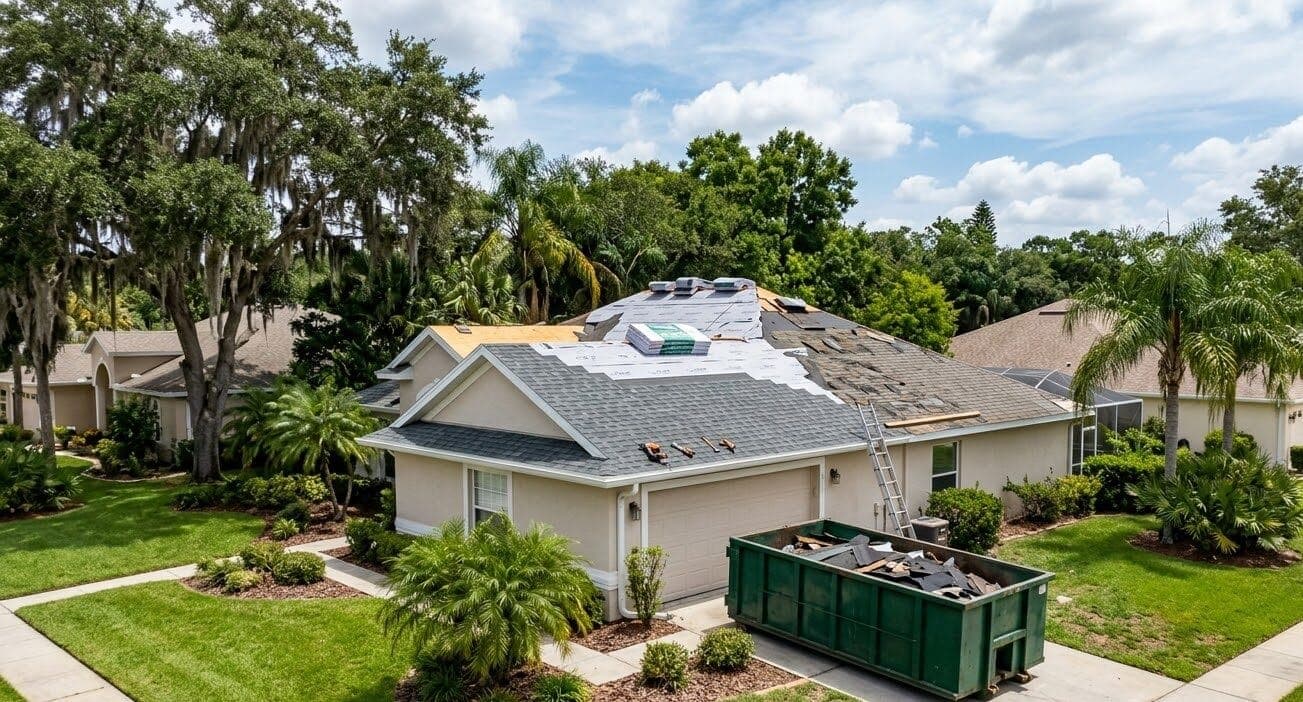
Skylights in Florida: Install, Leaks and Hurricane Ratings
A skylight is a deliberate hole in the one assembly built to keep water out. Florida code puts it through a 9 pound 2x4 at 34 mph and 9,000 pressure cycles. Here is what that means for specifying one, why they leak here, and what replacement runs in 2026.
Read Article
Gutters for Florida Homes: Seamless vs Sectional Guide
Seattle gets 38 inches of rain a year and runs 5-inch gutters. Tampa gets 52.6 and overflows, because 30 of those inches fall in four months and mostly in short bursts. Gutters are sized on inches per hour, not inches per year. Here is the sizing math, what seamless actually buys you, and the two spec lines that matter more than the word seamless in a hurricane state.
Read Article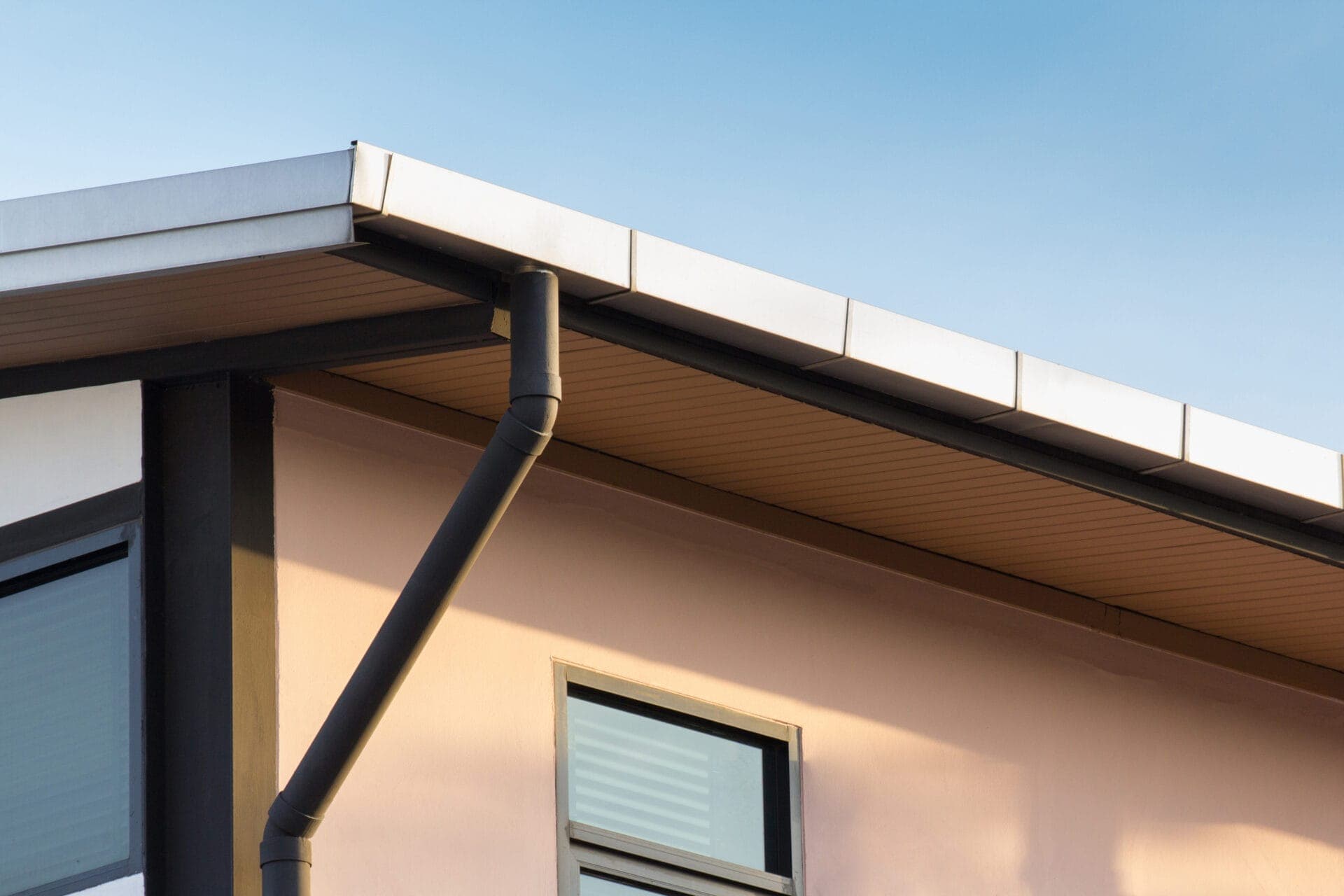
Box Gutter Solutions for Commercial Roofs in Central Florida
Complete guide to box gutter systems for commercial flat roofs in Central Florida. Types, materials, sizing for Florida rainfall, common problems, repair costs, and maintenance. Call (352) 605-0696.
Read ArticleReady When You Are
Get your free roof inspection today.
No-pressure, written estimate. Same-week scheduling across Hernando County. Call us now or request a visit online.