Service Area
Roofing Services in Marion County, FL
Marion County roof repair, replacement, and storm damage work in Summerfield, Belleview, and south Ocala. We pull the permit. Call (352) 320-0062.
Call (352) 320-0062If your roof is leaking, missing shingles after a storm, or simply old enough that you have started counting the years, you want a straight answer from someone who works in Marion County every week. Protech Roofing Services runs its Summerfield office at 10935 SE 177th Place, Ste 404-M7, Summerfield, FL 34491, covering Summerfield, Belleview, south Ocala, and the surrounding county. We are rated 4.9 across 592 Google reviews. Call (352) 320-0062 to get a roof looked at.
Roof Repair and Replacement Across Marion County
Marion County is not one roofing market. It is a spread of very different neighborhoods that happen to share a building department. There are 1970s and 1980s homes on wooded lots south of Ocala where oak limbs sit directly over the shingles. There are 55+ planned communities like On Top of the World, where the developer builds with steel-reinforced concrete block and the homes sit in tight, uniform rows. There are newer subdivisions around Belleview and Summerfield where the original builder roof is now aging out all at once, street by street.
Our Summerfield office was opened to serve this side of the county directly instead of running trucks down from the Brooksville headquarters. From that one office we cover three counties: Marion, including Summerfield, Belleview, and south Ocala; Sumter, including Wildwood; and Lake, including Lady Lake. The Villages sits across those county lines, which is why the same crews and the same office handle all three. If you want to see how the neighboring coverage lines up, our Sumter County page covers the Wildwood side, and Citrus County and Hernando County are served from our Brooksville headquarters.
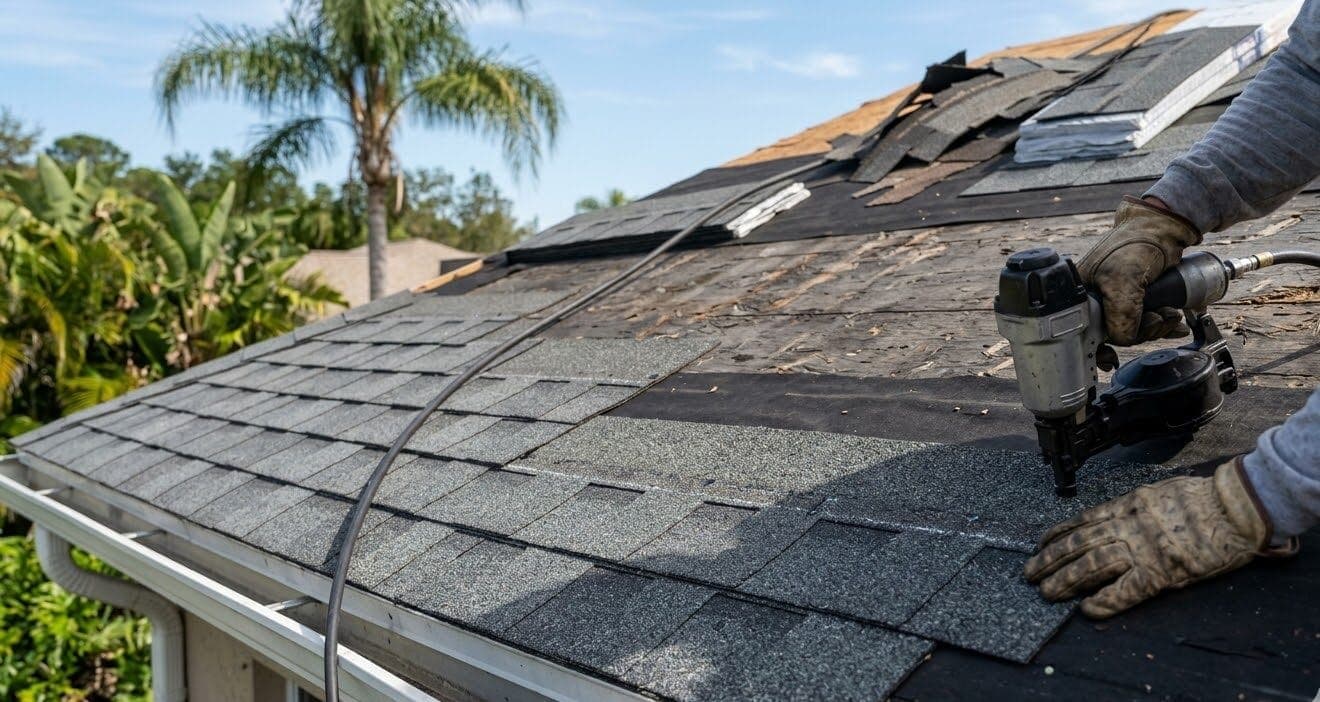
What we do here is the full range, not just replacements. Roof repair. Leak detection. Total roof replacement. Shingle installation, metal roofing systems, tile repairs, and stone-coated steel tile. Storm damage restoration and insurance claims assistance. Roof inspection and regular maintenance. Roof coating. Gutter installation, gutter cleaning, and gutter protection. On the commercial side, flat roofing, multi-family, and new construction. A homeowner in Belleview with one bad valley and a property manager in south Ocala with a 40,000 square foot TPO deck are both normal calls for us.
The number to reach the Summerfield office is (352) 320-0062. If you are calling about an active leak, say so on the first call so the conversation starts in the right place.
What Marion County Weather Actually Does to a Roof
Marion County is inland. That matters more than most homeowners realize, and it cuts both ways.
The good news first. Because the county sits away from the coast, there is no storm surge exposure here. Salt spray is not chewing at your fasteners and flashing the way it does on a house in Hernando Beach. Marion is also not in the High Velocity Hurricane Zone. That designation, with its much stricter product approval and installation rules, applies only to Miami-Dade and Broward. Marion falls in the standard inland Florida classification, with a lower basic design wind speed than the coastal counties. Your roof still has to meet the Florida Building Code. It just is not being engineered to the Miami rulebook.
Now the part people underestimate. Inland does not mean safe. In October 2024, the weather station at Ocala Regional Airport recorded a gust of 78 mph during Hurricane Milton, logged as the first hurricane-force event ever officially recorded at that station. Before that, Ocala had never taken a direct hit from a full-strength hurricane. A lot of roofs in this county were installed under the quiet assumption that the storms always weaken before they get here. Milton was the counterexample.
Hail is the other inland problem. The Ocala and Marion County area carries a moderate hail risk, with 14 hail reports confirmed on the ground by trained observers and radar detection of hail on 77 separate occasions, nine of those in the last year of the survey we track. Hail damage is the kind that hides. It bruises the mat under the granule surface of a shingle without tearing anything visible from the driveway, and the leak shows up two summers later.
Then there is the calendar. Atlantic hurricane season runs June 1 through November 30, with peak activity from mid-August to mid-October and a statistical peak on September 10, according to NOAA and the National Hurricane Center. That is the window everything is measured against. A roof inspection in April or May gives you time to fix what is found. The same inspection in September gives you a problem and a crowded schedule.
Add year-round afternoon thunderstorms, tornado activity when tropical systems push inland, and relentless UV, and you have a climate that ages asphalt faster than the number printed on the shingle wrapper suggests.
Permits and Inspections: Who Approves Roofing Work in Marion County
This is where a lot of homeowners get bad information, so here is how it actually works.
In unincorporated Marion County, a building permit is required to replace a roof. Full stop. There is one carve-out worth knowing: a roof repair of 100 square feet or less is exempt from both the permit and the inspection. That is a genuinely small area, roughly a 10 by 10 patch. It covers a single problem valley, a flashing repair around one penetration, or a handful of blown shingles. It does not cover a slope. If a contractor tells you a large repair does not need a permit, that is a signal to ask a lot more questions.
The permit for unincorporated county addresses is issued by Marion County Development Services, with its office at 2710 E Silver Springs Blvd, Ocala, FL 34470. If your property sits inside the Ocala city limits, it is handled by the city's own building department instead, not the county. Same street, potentially different jurisdiction, depending on which side of the line your address falls on. We confirm which one applies before writing the scope, because the submittal and the inspection scheduling are not identical.
Protech pulls the permit for the job and conducts the final inspection. That is part of the service, not something we hand back to you with a phone number and a good luck. You are not filling out an application, you are not driving to Silver Springs Boulevard, and you are not the one on the phone trying to get an inspector scheduled. On our commercial work we already handle the entire permitting and inspection process, with permit fees, plan preparation, and inspection coordination built into the project pricing. Residential is handled the same way.
Why insist on this? A permitted, inspected roof creates a paper trail. That record is what an insurance carrier looks for when you file a claim later, and it is what a buyer's inspector looks for when you sell. An unpermitted re-roof can quietly become your problem years after the crew has moved on, at exactly the moment you need it to not be a problem.
Repair or Replace: How the Call Gets Made
Nobody wants to replace a roof that had years left, and nobody wants to spend money patching a roof that is finished. The honest answer depends on four things, and an inspection is what separates them.
Age relative to the system. The median year of construction for homes in Marion County is 1993, across roughly 188,277 housing units, and 67.5% of those are detached single-family homes. That median tells you something useful: a large share of this county's housing stock is now past 30 years old. Most of those homes are on their second or third roof. If yours has an original or early-replacement asphalt system on it, age alone is a legitimate reason to be evaluated, even with no visible symptom.
Whether the damage is isolated or systemic. One failed pipe boot is a repair. Granule loss across every south-facing slope is not. Hail bruising scattered across the whole field is not. When we inspect, we are checking shingles for wind lift and hail bruising, examining flashing at penetrations and valleys, assessing soffit and fascia for wind damage, and looking for water intrusion in the attic space. The pattern of the damage is what answers the question.
The condition underneath. The shingles are the part you can see. The underlayment, the decking, and the fasteners are the part that decides whether a repair holds. On tile roofs especially, the tile can outlive the underlayment beneath it by a wide margin, which is why a tile roof can look perfect from the street and still be leaking.
Ventilation. A poorly ventilated attic in this climate cooks the underside of the deck and shortens the life of everything above it. If we replace a roof over the same ventilation problem that killed the last one, we have sold you a slower version of the same failure. So we evaluate it as part of the inspection, not as an upsell afterward.
When a repair genuinely solves the problem, we say so and we do the repair. Selling a full replacement to someone who needs a flashing detail fixed is how a company burns through a county's worth of goodwill in about two years.
What Actually Drives the Cost of a Roof Here
We are not going to quote a number on a web page, because any company that does is guessing at your house. What we can do is tell you exactly which variables move the price, so you can read two proposals side by side and understand why they differ.
Material system. Architectural asphalt shingle, standing seam metal, concrete or clay tile, and stone-coated steel are four different price tiers with four different service lives. This is the largest single swing.
Tear-off and layers. Removing one layer of shingles is one disposal cost. Removing two is more labor, more dumpster, more time. What is up there is not always what the last owner said was up there.
Deck condition. Nobody knows how much rotted or delaminated sheathing is under a roof until the old system comes off. Any proposal you receive should state clearly how deck replacement is priced, whether by the sheet or by the square foot, so a bad surprise on day two is a known rate rather than a negotiation.
Complexity and penetrations. A simple gable is fast. A cut-up roof with multiple valleys, dormers, skylights, solar attachments, a chimney, and a dozen vents is slow, and the flashing details at those transitions are where roofs actually leak.
Pitch and access. Steep slopes require additional safety measures and slow the crew down. A house on a tight lot with limited staging area for material and debris costs more to work than one with an open driveway.
Underlayment and code upgrades. Bringing a roof to current code often means the assembly is not identical to what came off it. That is not padding, that is compliance.
Ventilation and accessories. Ridge vent, off-ridge vents, drip edge, and gutter work may be included or excluded. Compare line by line.
Our standard is a written proposal that breaks out every cost component: tear-off and disposal, deck repairs, the roofing system itself, flashings, permits, and warranty. On commercial projects that same breakdown includes membrane type and thickness, insulation type and R-value, attachment method, warranty terms, and project timeline, with no hidden fees. If a competitor hands you a single number on a half page, you have no way to tell whether they priced the same job.
Roofing Materials That Make Sense in Inland Florida
Architectural asphalt shingle is the default across most of Marion County, and for good reason. The price point works, the wind ratings are solid when the installation is correct, and repairs are straightforward because materials are readily available. The failure mode here is heat and UV, not salt. Attic ventilation quality has a real effect on how long a shingle roof lasts in this county.
Metal roofing systems cost more upfront and last substantially longer. Standing seam has concealed fasteners, meaning there are no exposed screws with rubber washers slowly degrading in the Florida sun. For homeowners who intend to stay in the house long term, the arithmetic often favors metal, especially when a longer service life means never managing another tear-off.
Concrete and clay tile is common in parts of the county and carries a specific maintenance reality: the tile itself is extremely durable, but the underlayment beneath it is the actual waterproofing layer and it has a shorter life than the tile. A great deal of tile work is not replacement at all, it is tile removal, underlayment replacement, and reinstallation of sound tile with breakage replaced. We also do standard tile repairs where individual pieces have cracked or slipped.
Stone-coated steel tile splits the difference. You get the appearance of a tile profile with the weight and wind performance of steel, which matters on structures where the framing was never designed for a heavy tile load.
Roof coatings apply mainly to low-slope and flat surfaces. On the right substrate, in the right condition, a coating extends service life meaningfully. On a substrate that is already saturated, it seals the water in. The inspection determines which situation you have, and we will tell you when a coating is the wrong answer.
Commercial flat systems. For most commercial buildings in Central Florida, our recommendation is TPO for general use and PVC for restaurants, chemical environments, or owners who want the longest possible warranty. When we design a tapered insulation system for drainage, we make sure the minimum point of the taper still meets or exceeds the code-required R-value, which is a detail that quietly disappears from cheaper proposals.
Storm Damage and Insurance Claims in Marion County
After a wind or hail event, the sequence matters as much as the repair.
The first priority is stopping active water intrusion. Emergency tarping buys the interior time while the real scope gets built. It is a stopgap, and we are direct about that, but a tarp placed early can be the difference between a roof claim and a roof plus ceilings plus flooring plus contents claim.
Next comes documentation. We provide storm damage assessment inspections at no charge, because having an accurate picture of the damage from day one is what the entire claim rests on. We check shingles for wind lift and hail bruising, examine flashing around penetrations and valleys, assess soffit and fascia for wind damage, and look for signs of water intrusion in the attic space. Images from the inspection are saved as part of your permanent record.
Many of our customers ask us to be present during the adjuster's inspection, and we recommend it. When Protech meets your adjuster at the property, we walk them through every area of concern documented in our report, so nothing gets quietly left off the scope. An adjuster on a tight schedule after a regional storm event is working fast. Someone standing on the roof who already knows where the damage is changes what ends up in the file.
On leaks that are not obvious, we do not guess. Thermal imaging identifies suspect areas, then a moisture meter is pressed directly against decking, insulation, and framing for precise readings. When imaging points to a general zone but the exact entry point is unconfirmed, one technician runs water systematically across sections of the roof while a second monitors the attic from inside. That is how you find the penetration instead of replacing three things and hoping.
One more step that homeowners in this county leave on the table: after Protech completes a roof replacement, we recommend scheduling a wind mitigation inspection right away. A new roof built to current Florida Building Code standards will typically qualify for the highest available credits, and those credits apply to your insurance premium going forward. It is a short inspection with a long payback.
How to Vet Any Roofer in Marion County
After a storm, the trucks arrive. Some of them are legitimate. Here is how to sort them, whether or not you end up calling us.
Check the license, and know which kind it is. Florida issues two types of roofing contractor license. A Certified Contractor holds a state license issued by the DBPR and can work in any county. A Registered Contractor holds a local license and needs a certificate of competency from the specific county where they are working. Both can be legitimate. What matters is that the license is real and current, and you can verify that yourself at myfloridalicense.com. Look up the exact name on the contract, not the name on the truck door.
Ask whose name the permit is pulled in. The permit should be pulled by the licensed contractor doing the work. If anyone suggests you pull it as a homeowner to save time or money, that shifts the code liability onto you. Decline.
Demand a scope, not a number. A written proposal should identify material and manufacturer, underlayment, flashing work, ventilation, deck repair pricing, disposal, permit handling, and warranty terms. Anything less and you cannot compare bids honestly.
Be skeptical of pressure. A roof is a large, permanent purchase. A legitimate contractor's assessment is still valid tomorrow. Urgency that comes from your leak is real. Urgency that comes from a contract deadline is a sales technique.
Read the reviews, including the mediocre ones. We hold a 4.9 rating across 592 Google reviews. That is not a perfect score, and it should not be. What you are looking for in any company's reviews is how they handled the jobs that did not go smoothly.
Working With Protech in Marion County
Here is what the process looks like from your side.
You call (352) 320-0062, or send the form, and describe the situation. We schedule an on-site inspection. That inspection starts with a thorough visual examination of the roof and includes the attic where it is accessible, checking for daylight penetration, water staining on the decking, and moisture in the insulation. We document what we find with photographs, and those images become part of your permanent inspection record.
Then you get a written scope and a proposal with the cost components broken out, so you can see what you are buying. If it is a repair, we say it is a repair. If the honest answer is that the roof has two or three years left and you should plan rather than panic, we will tell you that too.
If you proceed, we pull the permit through the correct jurisdiction, whether that is Marion County Development Services or the City of Ocala building department, based on your address. We schedule and manage the inspections. The project ends with a closed permit and warranty documentation in your hands, not with a crew driving off and a folder you have to chase.
The best time to do any of this is before hurricane season peaks, which means an inspection scheduled in spring rather than a phone call in mid-September. If Milton in 2024 taught this county anything, it is that being inland is an advantage, not immunity.
Protech Roofing Services, Summerfield office, 10935 SE 177th Place, Ste 404-M7, Summerfield, FL 34491. Call (352) 320-0062 to schedule a roof inspection in Summerfield, Belleview, south Ocala, or anywhere across Marion County.
Roofing By City
Roofing services in cities across Marion County, FL
FAQ
Frequently Asked Questions
Do I need a permit to replace my roof in Marion County?
+
Yes. In unincorporated Marion County, a building permit is required for a roof replacement. The one exception is a roof repair of 100 square feet or less, which is exempt from both the permit and the inspection. Protech pulls the permit and conducts the final inspection as part of the job, so it is not something you have to handle yourself.
Who issues the roofing permit where I live?
+
It depends on which side of the city line your address falls on. Properties in unincorporated Marion County are permitted through Marion County Development Services at 2710 E Silver Springs Blvd, Ocala, FL 34470, while properties inside the Ocala city limits go through the city's own building department. We confirm which jurisdiction applies to your address before we write the scope, because the submittal and inspection scheduling are not the same.
Is Marion County under the same strict roofing code as Miami?
+
No. The High Velocity Hurricane Zone designation, which carries the most demanding product approval and installation requirements in Florida, applies only to Miami-Dade and Broward counties. Marion is classified as a standard inland zone with a lower basic design wind speed than coastal counties. Your roof still has to meet the Florida Building Code, but it is not engineered to the Miami-Dade rulebook.
How do I know if a storm damaged my roof if I can't see anything from the ground?
+
Most wind and hail damage is invisible from the driveway. Hail bruises the mat beneath the granule surface without tearing anything, and the leak can show up a year or two later. Marion County has a moderate hail risk, with radar detection of hail on 77 separate occasions, so an inspection after a significant storm is worth doing. We provide storm damage assessment inspections at no charge.
When is the best time to have my roof inspected?
+
Spring, before the season builds. Atlantic hurricane season runs June 1 through November 30, with peak activity from mid-August to mid-October and a statistical peak on September 10. An inspection in April or May leaves time to correct what is found. The same inspection in September finds the same problems with far less room to act on them.
From the Blog
Stay informed about roofing in Florida.
Ready When You Are
Get your free roof inspection today.
No-pressure, written estimate. Same-week scheduling across Hernando County. Call us now or request a visit online.