Central Florida Roofing Service
Gutter Cleaning
Gutter cleaning in Central Florida. Seasonal pollen and post-storm debris removal. Protech Roofing. Call (352) 605-0696.
Call (352) 605-0696Why Central Florida Gutters Need More Cleaning Than Most Markets
If you've ever talked to family up north and tried to explain why your gutter cleaning schedule feels different, you're not imagining it. Central Florida runs through more organic debris in a single calendar year than most parts of the country see in two. That's not marketing hype. It's the result of three overlapping conditions that hit at the same time: a year-round growing season, a tree canopy that includes some of the messiest species in the southeast, and a rainfall pattern that swings between calm dry weeks and tropical downpours that dump three inches in an hour.
Start with the trees. Live oaks dominate older neighborhoods in Brooksville, Inverness, and Dade City, and they drop leaves and catkins almost every month of the year. Slash pines and longleaf pines, which line acreage lots across Hernando and Sumter counties, shed needles constantly and never really stop. Sabal palms and queen palms throw seed pods that look harmless until one wedges into a downspout outlet and dams up a whole run. And the loquat, jacaranda, magnolia, and crape myrtle that show up in almost every Pasco and Citrus subdivision each have their own seasonal mess. By the time you finish raking one tree's debris off the roof, the next one is already started.
Then there's the climate cycle. Our gutter cleaning crews see the same pattern every year. Spring brings a heavy load of oak catkins and pollen that turn fresh aluminum into a yellow-green pond if it isn't cleared. Summer thunderstorms wash twigs, leaves, and shingle granules into the troughs. Hurricane season piles on whatever it can rip off neighboring trees, sometimes in a matter of hours. Fall is the only stretch where the load eases up, and even then it doesn't stop because most Florida hardwoods aren't fully deciduous. You don't get the clean break from leaf drop that homeowners in Georgia or the Carolinas get.
And humidity makes everything worse. Up north, debris that lands in gutters dries out for weeks at a time and turns into a brittle pile that can be scooped or blown out in a few minutes. In Central Florida, that same debris sits wet most of the year. Wet leaves compact into a dense mat that traps sediment, breeds mosquitoes, and grows roots into the seams between gutter sections. We've pulled live mushrooms, frogs, and seedling oaks out of gutters that hadn't been cleaned in eighteen months. So when somebody tells you they clean their gutters every two years like they did back home, our honest answer is that the math just doesn't work down here.
The Three-Window Cleaning Schedule for Florida Homes
Most national gutter cleaning guides recommend spring and fall. That cadence is wrong for Central Florida. After fifteen years of cleaning gutters across Hernando, Sumter, Citrus, Pasco, Lake, Marion, Hillsborough, and Pinellas counties, our crews have settled on a three-window schedule that tracks the actual debris and weather load homeowners face here. The windows are late February through mid-March, early June, and late October through November. Each one targets a specific risk, and skipping any of them tends to show up as a problem during the next storm.
The late-winter window is about catkin and pollen cleanup. Live oaks dump their catkins in waves between mid-February and early April depending on how warm the winter ran. Those catkins are stringy, oily, and they mat into a dense yellow-green carpet that sheds water sideways instead of toward the downspouts. If you wait until May to deal with it, the spring thunderstorms have already shoved most of that material into the downspout elbows, and what should be a vacuum-and-flush job turns into a snake-and-pressure-wash job. We hit this window first because clearing it cheaply prevents the more expensive scenario down the road.
Early June is the pre-hurricane-season window. The point here isn't to remove a huge amount of debris, because most of what blew in during spring has either decomposed or washed through. The point is to verify that every downspout is flowing freely, every hanger is tight, and every seam is intact before the first tropical system rolls through. We've seen homes lose a gutter run during a category-one storm strictly because a hanger had loosened over the spring and nobody caught it. A ten-minute inspection in June would have flagged the issue. So we treat this window as a tune-up rather than a deep clean.
The late-fall window catches the leaf drop from the hardwoods that do go partially deciduous, plus whatever Atlantic hurricane season left behind. November is also when our crews find the most fascia damage from the previous summer because rotted boards finally show through after months of being wet. By cleaning and inspecting in this window, you start the dry season with a system that's actually ready to handle it. So if you're trying to budget gutter cleaning for the year, plan three visits, not two. The total cost runs roughly 30 to 50 percent more than the standard two-visit schedule, but it prevents the much bigger costs that come with a backed-up system during a hurricane.
Live Oak Pollen and Spring Catkin Cleanup
Live oak catkins deserve their own conversation because they cause more gutter trouble in Central Florida than any other single source. If your property has even one mature live oak within a hundred feet of the house, you'll feel this in your gutters. The catkin is the male flower of the oak, a stringy yellow-green strand about two to four inches long that the tree drops by the millions over a four to six week stretch in late winter and early spring. They look like fuzzy worms when they're fresh, and they hit the roof in a steady rain that lasts for weeks.
What makes them difficult isn't volume alone. It's the way they behave once they're in the gutter. Catkins are stringy, so they tangle around hangers, gutter screws, and downspout outlets in a way that loose leaves don't. They're oily from the pollen they carry, so they stick to aluminum and pick up every other particle that lands on top of them. Within a few weeks of falling, they compress into a thick mat that holds water like a sponge. And once that mat dries out during a hot stretch, it shrinks and gets cement-hard, which is why removing late-season catkin buildup often requires a pressure washer rather than a scoop or blower.
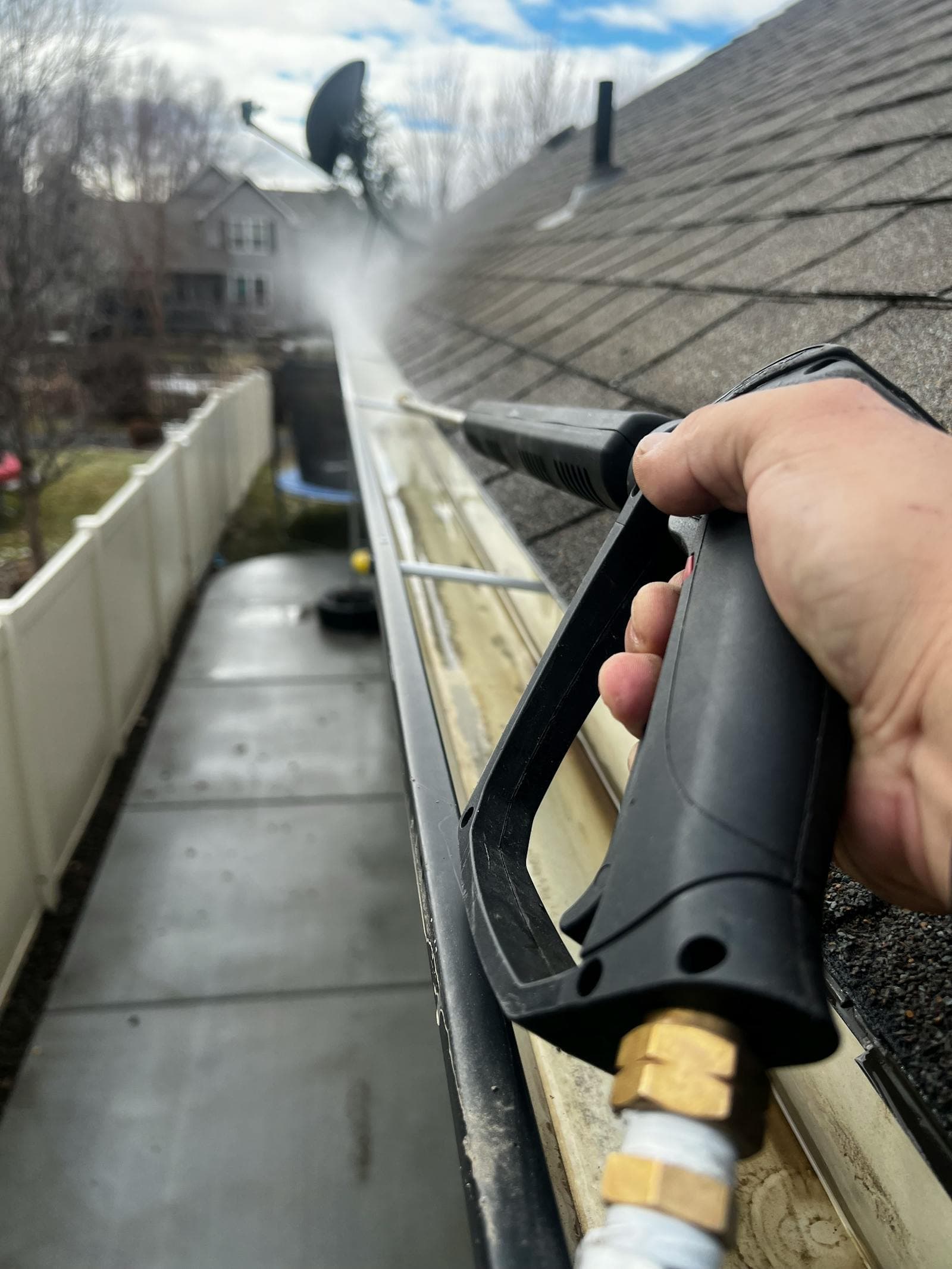
Our crews use a specific approach for catkin cleanup. We don't blow them. Blowing scatters them across the roof and lawn and just moves the problem to the downspout outlets. Instead, we hand-scoop the bulk material into bags on the ground, then run a wet-vacuum through every linear foot of the gutter to pull the remaining strands and the pollen they leave behind. Once the troughs are clear, we flush each downspout with a garden hose at full pressure to verify flow and to wash out any catkin fragments that worked their way into the elbows. On gutter guards, especially micro-mesh systems, catkin pollen forms a yellow film that has to be brushed and rinsed off, otherwise water sheets right over the top of the guard during the next rain.
If your house sits under multiple oaks and the catkin drop is heavy, we sometimes recommend a follow-up visit two to three weeks after the first cleaning. The reason is that catkins don't all fall at once. The tree releases them in waves, so a thorough cleaning in early March might still leave you with another half-load of material falling through late March. A short follow-up visit clears that second wave before it has a chance to compact and dry out. It's also worth noting that catkin season is the worst possible time to skip a cleaning because the material is at its softest and easiest to remove. Waiting until summer turns a one-hour job into a three-hour job.
Storm Debris Cleanup After Hurricane Season
Post-storm gutter cleaning is a different animal from routine maintenance. After Hurricane Idalia tracked through the Big Bend in 2023, our phones rang for weeks with homeowners across Citrus, Hernando, and Pasco counties dealing with gutters that had been packed solid with palm fronds, oak limbs, pine boughs, and shingle granules. Hurricane Milton in 2024 produced similar volumes across Sumter and Lake counties, and the smaller tropical storms in between never really gave the trees a break. Every named storm leaves a footprint in the gutter system, and the longer that debris sits, the more damage it does to the roof and fascia underneath.
The first thing we look for after a storm isn't the debris itself. It's structural damage. Wind loads during a tropical system can pull gutters away from the fascia, bend the front lip of the trough, snap hangers, and tear downspouts loose at the elbow. If a gutter is hanging at the wrong angle or pulling away from the house, no amount of cleaning will restore proper function until the structural issue is fixed. So our post-storm process starts with a walk of the entire system, checking pitch with a level, verifying that each hanger is still seated, and looking for sealant failures at corners and end caps where the wind may have flexed the metal.
Once the structural check is done, the cleanup itself is heavier work than spring cleaning. We're typically pulling out wet, compacted vegetation that weighs three to four times what dry debris weighs. Palm fronds in particular are brutal because they don't break down and they wedge into corners in ways that make them hard to extract without bending the gutter. We use telescoping grabbers, hand removal, and on stubborn loads, careful saw work to cut larger limbs that have gotten stuck in the trough. Everything comes down by hand or rope, never thrown, because debris dropped from a two-story height onto a wet lawn destroys the grass underneath.
There's also the question of timing. After a hurricane, the worst thing you can do is wait three months to clean up. Wet organic material in a Florida gutter starts decomposing within days, and the acidic runoff from that decomposition attacks the protective coating on aluminum gutters. Even a few months of standing rot can permanently stain the inside of a gutter and shorten its useful life by years. So if you've been through a named storm, the right move is to schedule a post-storm cleaning within two to four weeks of the all-clear. We'll prioritize storm calls during active hurricane season because we know what's at stake, and we typically run extended hours through October and November to keep up with demand.
Super Gutter Cleaning on Birdcage Lanai Enclosures
If you live in The Villages, Sun City Center, or any of the 55-plus communities that dot Sumter and Lake counties, your home likely has what's called a super gutter running along the back of the house where the pool cage or screened lanai attaches. Super gutters are larger than standard residential gutters, usually 8 inches wide instead of 5 or 6, and they're integrated into the screen enclosure structure so that rainwater coming off the roof is captured before it hits the screen. They're a smart design for Florida homes, but they create a cleaning challenge that most homeowners don't see coming.
The issue is access. A standard gutter is accessible from a ladder set on the ground or against the fascia. A super gutter sits behind the screen enclosure, sometimes ten or twelve feet up, with the screen panels making direct ladder access impossible. The only ways to reach a super gutter are from the roof above or from inside the cage with a tall stepladder that has to clear the pool, the patio furniture, and any landscaping inside the enclosure. Neither approach is what we'd call easy, and both require equipment and technique that the average homeowner doesn't have on hand.
Our super gutter cleaning process accounts for these constraints. We typically work from the roof, using fall protection anchored to the structure above, and we extract debris with telescoping vacuum lances rather than scooping by hand. The reason is that anything we drop into the cage ends up in the pool or on the patio, and nobody wants to fish a wet handful of oak leaves out of a pool filter. The vacuum approach captures debris cleanly and dumps it directly into a bag at the edge of the roof. If the gutter has a lot of compacted material, we sometimes have to do a preliminary loosening pass with a stiff brush before the vacuum can pull it free.
Super gutters are also more prone to standing water than standard gutters because of how they're pitched and where the downspouts exit. Some installations route the downspout through the screen frame to a discharge point at the corner of the cage, and that route includes more bends than a typical downspout has. Each bend is a potential clog point, and we check every one during a cleaning visit. If you've noticed water dripping through the screen during rain, or you've seen the pool refill rate climb during the wet season, that's usually a sign that the super gutter is overflowing somewhere and needs attention. We'll diagnose and clear it in one visit on most homes, and we'll flag any structural issues that need follow-up work.
What Our Gutter Cleaning Service Includes
When a Protech crew shows up for a gutter cleaning, the work isn't just scooping leaves out of a trough. Our standard cleaning service covers every component of the water management system from the roof edge down to the discharge point, and we document anything we find that needs attention beyond routine cleaning. The reason we run the service this way is simple: a gutter that's clean today but feeding into a clogged underground drain is going to overflow during the next rain anyway, and the homeowner won't understand why.
The service starts with a walk of the property to identify all gutter runs, downspouts, and discharge points. We note tree exposure, fascia condition visible from the ground, and any signs of past overflow such as water staining on siding or erosion below downspouts. Then we set up safe access using ladders or fall protection on roof access, depending on the height and pitch of the roof. We don't lean ladders against gutters because that bends the front lip and creates a leak point at every contact. Every ladder gets a standoff that lets us work without touching the gutter itself.
In the trough, we remove all debris by hand or with appropriate tools, bagging it as we go rather than dropping it on landscaping below. After the bulk material is out, we use a wet-vacuum or pressure-controlled flush to clear residual sediment and pollen film. Then we test every downspout by running water in at the top and watching for free flow at the bottom. If a downspout is restricted, we clear it from the elbow with a snake or by disassembling the section that's blocked. We don't consider the job done until every downspout flows freely. Underground drain lines get the same flow test, and if there's a clog in the buried run, we'll usually be able to clear it with a hose-end snake or recommend a follow-up visit with cleaning equipment if the blockage is deep.
Before we leave, we walk the property again and rinse any debris off the roof, siding, or landscaping so the only sign we were there is a system that drains the way it's supposed to. We also leave a written report that notes the condition of each gutter run, any maintenance items that came up during the visit, and our recommendation for when the next cleaning should be scheduled. If we found something that's not a cleaning issue but needs repair, like a loose hanger, a failed seam, or a section of rotted fascia, we'll flag it on the report and price the repair separately so you can decide how to handle it. Nothing is hidden in the cleaning charge, and we don't add repair work to the invoice without explicit approval.
Pricing and Bundle Options for Central Florida Homes
Gutter cleaning pricing in Central Florida runs across a wide range, and understanding what drives the cost helps you compare proposals without getting talked into something you don't need. Our base price for a standard single-story home with a typical linear footage of 150 to 200 feet of gutter starts around $150 to $200 for a routine cleaning. Two-story homes typically run $225 to $325 because of the additional ladder work and the higher risk that comes with elevation. Three-story homes, steep pitches, and properties with limited ladder access fall into a custom-quote category that depends on the specific conditions.
Beyond home height, the biggest cost drivers are tree exposure, debris load, and special features. A home that's been cleaned regularly and has minimal tree canopy is a fast job. A home that hasn't been cleaned in two years and sits under three live oaks is a slow job that often requires a wet-vacuum, a pressure washer, and sometimes a second technician to keep pace. Super gutters, screen enclosure cleanup, and underground drain testing each add line items because each one represents additional time and equipment. We quote these as separate items so you can see exactly where the money is going.
For homeowners who want to lock in the three-window schedule we recommend for Central Florida, we offer an annual maintenance plan that bundles three cleaning visits into a single price with a small discount versus paying per visit. The plan also includes priority scheduling during hurricane season, which matters when a tropical system is approaching and every gutter company in the region is booked solid. Plan members get on the schedule first, and we keep a slot open for them when storms are forecast. The annual plan typically runs $400 to $600 for a standard single-story home depending on tree exposure and home size, and it's the most cost-effective way we know to handle routine gutter maintenance.
We also offer bundle pricing when gutter cleaning is combined with roof inspection, soft wash, or other roof services. If we're already on the property with the right access equipment, adding a gutter cleaning to a roof inspection visit costs significantly less than scheduling each service separately. The same goes for soft wash treatments where we're already setting up at the roof edge. Talk to us about what you're trying to accomplish and we'll work out a package that makes sense for your situation. We're not interested in selling you services you don't need, but we're also not going to make you pay for two trips when one will cover everything.
When Cleaning Isn't Enough: Repair and Replacement Triggers
Most service calls we get are straightforward cleanings. But every so often, we show up expecting to clean a gutter system and find one that's past the point where cleaning alone will fix the problem. Recognizing those situations matters because pouring more cleaning visits into a failed system just delays the inevitable and costs more than addressing the root cause. Here are the conditions where we tell homeowners that they need repair or replacement, not just another cleaning.
Sagging or detached sections are the most obvious trigger. If a gutter run is visibly pulling away from the fascia or hanging at an angle, the hangers have failed and the system can't drain properly even when it's empty. The fix depends on the cause. Sometimes it's a few loose hangers that can be re-secured with longer screws into solid wood. Other times the fascia board behind the gutter has rotted and there's nothing left to anchor into. In that case, we have to replace the fascia before we can reinstall the gutter, and at that point it often makes sense to put up a new gutter system at the same time rather than reusing material that's already at the end of its life.
Persistent leaks at seams and end caps are another trigger. Gutter sealant has a service life that's measured in years, not decades, and once the original sealant starts failing, every seam in the system tends to go within a year or two of the first one. Resealing individual joints buys you some time, but if more than two or three seams are leaking on a single run, the better answer is usually to replace that run with a continuous one-piece section formed on-site. A one-piece run eliminates the joints entirely and doesn't have this failure mode. It's more expensive up front but cheaper over the life of the system because you're not chasing leaks.
Visible corrosion, rust streaks, or holes in the trough mean the metal itself is failing. This shows up most often on older galvanized steel gutters or on aluminum systems that have been left to sit with standing organic debris for years. Once a gutter has holes, sealant patches are a temporary fix that rarely lasts a full season. Replacement is the only durable answer. We'll inspect the rest of the system at the same time because if one run has reached end-of-life, the others are usually close behind. Better to budget for a full replacement than to keep paying for piecemeal repairs that don't last.
Finally, if you're cleaning your gutters more than three times a year and they're still overflowing during heavy rain, the system itself may be undersized for your roof. Central Florida thunderstorms can produce rainfall intensities that exceed what 5-inch gutters can handle on larger roofs. Upgrading to 6-inch gutters with bigger downspouts often solves the overflow problem without changing anything about your cleaning routine. We can size the upgrade against your actual roof area and rainfall data, and the cost is usually recovered within a few years through reduced repair and cleaning visits. If you've been frustrated by recurring overflow even with a clean system, that's the conversation worth having.
Available By City
Gutter Cleaning in cities across our service area
FAQ
Frequently Asked Questions
How often should I clean my gutters in Central Florida?
+
What's the best time of year for gutter cleaning in Florida?
+
Do you clean gutters on screened lanais and pool enclosures?
+
How much does gutter cleaning cost in Central Florida?
+
Can I clean my own gutters or should I hire a service?
+
Roofing Knowledge
Articles and guides for homeowners

Gutters for Florida Homes: Seamless vs Sectional Guide
Seattle gets 38 inches of rain a year and runs 5-inch gutters. Tampa gets 52.6 and overflows, because 30 of those inches fall in four months and mostly in short bursts. Gutters are sized on inches per hour, not inches per year. Here is the sizing math, what seamless actually buys you, and the two spec lines that matter more than the word seamless in a hurricane state.
Read Article
Box Gutter Solutions for Commercial Roofs in Central Florida
Complete guide to box gutter systems for commercial flat roofs in Central Florida. Types, materials, sizing for Florida rainfall, common problems, repair costs, and maintenance. Call (352) 605-0696.
Read ArticleReady When You Are
Get your free roof inspection today.
No-pressure, written estimate. Same-week scheduling across Hernando County. Call us now or request a visit online.