Tampa, FL
Gutter Cleaning in Tampa, FL
Gutter cleaning in Tampa, FL. Protech Roofing clears oak debris and storm buildup and handles post-hurricane cleanup near the bay. Call (352) 605-0696.
Call (352) 605-0696Honest gutter cleaning in Tampa, FL isn't a once-a-year ladder job the way it is up in Atlanta or Charlotte. Between the live oak catkin shed that hits Seminole Heights and Hyde Park every March, the salt crust that builds up on Bayshore Boulevard and Davis Islands gutters week after week, and the post-Milton debris that some homeowners are still working through, two scheduled visits a year is the floor. We've cleaned bungalow troughs on Florida Avenue, two-story stilt homes off Bayshore, and modern stucco runs in Westshore and Carrollwood. Protech Roofing handles the climb, the flush, and the photo proof. Call (352) 605-0696 to put your next visit on the schedule.
You Are Viewing
Gutter Cleaning for homeowners and businesses in Tampa, part of Hillsborough County, FL, Florida.
The Tampa Gutter Cleaning Calendar That Actually Fits the City
Tampa's debris cycle doesn't follow a northern calendar, and the homeowners who try to run one cleaning a year in November usually call us in July with overflow streaks down a stucco wall. We work from a two-visit minimum on every Tampa home we service, and we push three on properties under heavy live oak canopy. The late spring visit lands between mid-April and late May, after the worst of the oak catkin drop has finished but before summer thunderstorms start hammering the trough every afternoon. The early fall visit lands in late September or early October, after the August storm cycle has dumped pine straw and palm fronds into every gutter on the block and before the leaf shed starts in earnest.
That second visit also gives us a chance to catch any storm damage from the named-system window, which in Tampa runs late August through mid-November based on the last decade of activity. Hurricane Milton hit on October 9, 2024, Hurricane Helene on September 26, 2024, and Hurricane Idalia on August 30, 2023. All three put debris into Tampa gutters, and all three were inside the second-visit window. If a homeowner skips the fall cleaning and a tropical system blows through, the trough is already half-full of summer debris when storm rain shows up, and overflow starts on the first inch.
A third visit between January and February covers the slow winter shed of magnolia leaves, the last of the live oak leaf turnover, and any debris that's compacted over the holidays. We don't push the third visit on every house. But on Seminole Heights properties with a 70-foot live oak crown, on Hyde Park bungalows tucked under a continuous canopy, and on any home where the homeowner has had recurring overflow problems, three visits is the cadence that holds up.
We schedule the visits on a calendar that's tied to a Tampa address, not a generic one. So a Bayshore home that needs salt-flush work in summer gets its visit slotted differently from a Westshore home behind an oak hedge. We send a reminder a week before each visit, the homeowner confirms or reschedules, and we show up with the right gear for the debris mix we expect to find.
Live Oak Catkin Bio-Sludge in Seminole Heights and Hyde Park
If you live anywhere in the Seminole Heights or Hyde Park bungalow belt, you've already seen the yellow-brown catkin strings on your driveway in late March. What you might not have seen is what those catkins turn into once they hit a wet gutter trough. We've started calling it bio-sludge, and the name fits. The catkins drop in waves over about three weeks, they soak the next rain, and they decompose into a sticky brown mat that bonds to the bottom of the gutter and traps every leaf, twig, and seed pod that lands on top for the next four months.
From the ground the gutter still looks clean. From the roof, the bottom of the trough is paved with what looks like wet cardboard pulp. We've pulled bio-sludge mats four to six inches thick out of bungalow gutters on Florida Avenue in Seminole Heights and on Bayshore Boulevard's tree-shaded inland stretches near Hyde Park Village. The mats hold so much water that the gutter never fully drains, which means the downspout outlet is constantly running through wet biological material that corrodes the inside of the aluminum and pulls the protective oxide layer off the metal.
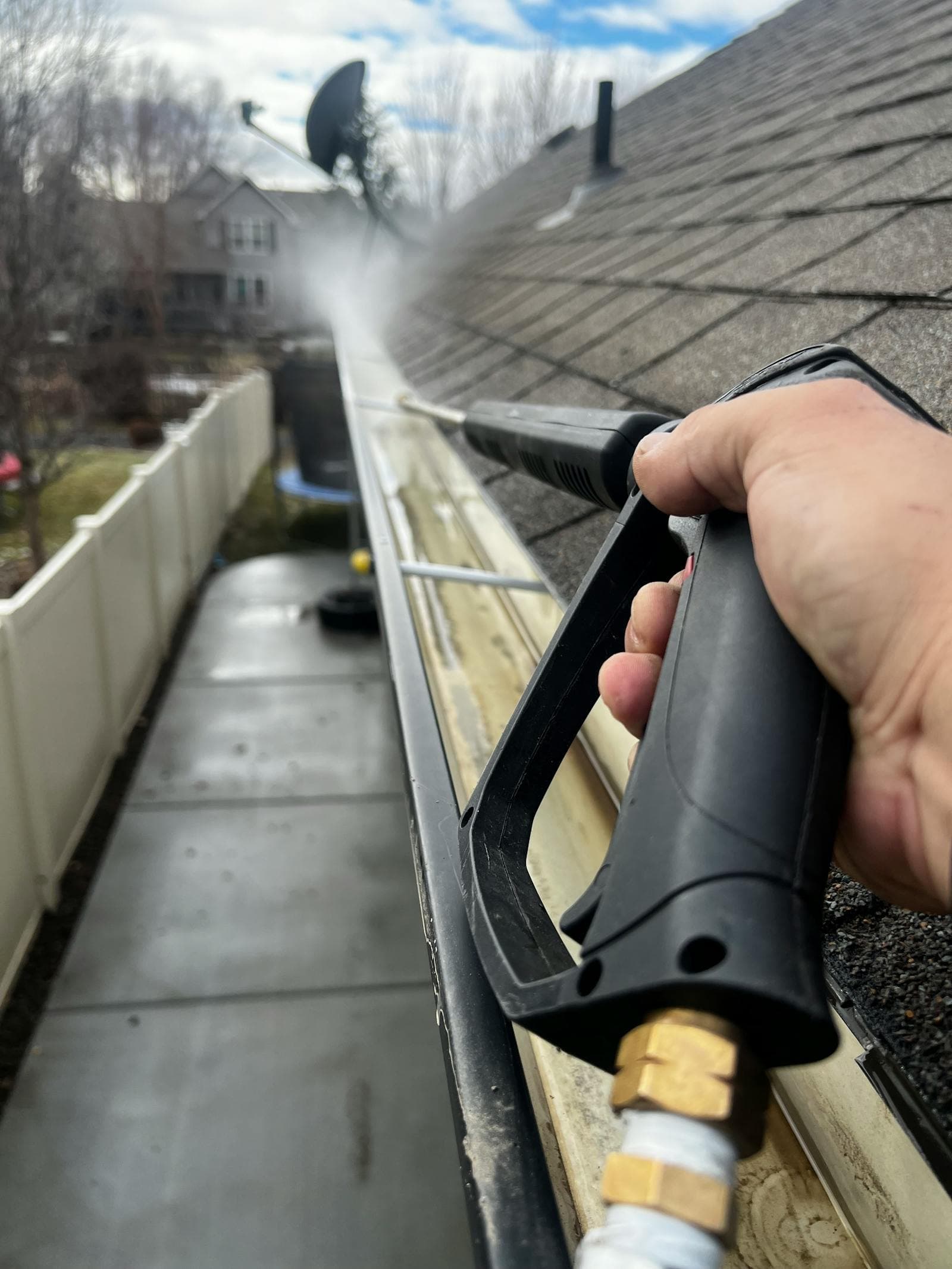
Our spring visit specifically targets this catkin bio-sludge. Air-blowing the gutter with a leaf blower doesn't work because the mat is too dense and too wet to lift on air alone. We use stiff-bristle scrapers to break the bond between the mat and the gutter floor, then we flush the entire run with low-pressure water to clear the broken material toward the downspout. The flush also lets us watch each downspout outlet for free flow, because a catkin mass can pack into the elbow at the bottom of the downspout and create a hidden clog that nobody sees from the gutter side.
In Old Seminole Heights and Tampa Heights where the bungalows are pressed close together and the oak canopies overlap across property lines, we'll sometimes find one homeowner's gutter is full of catkins that fell off the neighbor's oak. So we always check both sides of a property and we walk the route with the homeowner if there's a clear cross-lot debris pattern. That's a quiet differentiator between the older Tampa neighborhoods and the newer Carrollwood and Westchase subdivisions where the canopy is younger and the catkin load is lighter.
Salt Crust Buildup in Bayfront and Davis Islands Gutters
Move the conversation from Seminole Heights down to Bayshore Boulevard and the debris story changes. Bayfront gutters don't see the same volume of organic material that an inland tree-canopy home does. What they see instead is salt. Onshore breezes off Hillsborough Bay carry chloride aerosol inland a half mile or more, and that salt settles on every horizontal surface including the inside of the gutter trough. Mixed with humidity and dew, it forms a fine white-grey crust that bonds to the aluminum and pulls the protective oxide layer off the metal over time.
We call our bayfront service the Bayshore Salt-Flush, and it's a different process from a standard inland cleaning. Standard cleaning removes leaves and catkins from the trough. The Salt-Flush also removes the chloride crust before it has time to eat into the aluminum or corrode the bracket screws. The process uses a non-acid neutralizing solution that breaks the bond between the salt and the metal, followed by a fresh-water flush that carries the dissolved chloride out through the downspouts. On homes specced with our Type 304 surgical-grade stainless fasteners or copper brackets, the Salt-Flush extends the service life of the gutter system into the 25-plus year range.
We run the Salt-Flush on every Bayshore, Davis Islands, Harbour Island, and Ballast Point home we service, and we recommend it twice a year minimum on any address within a half mile of open water. The Davis Islands homes on the eastern edge that face the open bay take the heaviest salt load, followed by the Bayshore mansions south of Bay to Bay Boulevard, then Harbour Island and the bayfront edges of Westshore. Inland homes don't need the Salt-Flush, but they do benefit from a periodic fresh-water flush after a long dry spell when ordinary dust and pollen have built up on the gutter walls.
There's a second reason the Bayshore Salt-Flush matters. Fasteners are the failure point we see most often on coastal gutters, not the gutter channel itself. A salt-encrusted screw head loses its grip on the fascia at a rate three to five times faster than a clean screw head, and the bracket pulls through the fascia long before the gutter looks tired from the street. Our Salt-Flush includes a fastener inspection where the crew runs a gloved hand along every bracket and tightens or replaces any screw that's showing corrosion. That single touch has kept Bayshore gutters attached through every named storm since Idalia.
Post-Milton Gutter Cleanup Across Tampa Neighborhoods
Hurricane Milton came through on October 9, 2024 as a Category 3 with the eye passing near Siesta Key, and the wind field over Tampa sent everything that wasn't bolted down into the closest horizontal surface. Gutters caught most of it. We're still pulling Milton debris out of bungalow troughs in Seminole Heights and Tampa Heights eight months later, and we'll keep pulling it through the end of this year. The debris mix is unlike anything a routine seasonal cleaning produces, because it isn't organic material that came down on its own. It's projectile material that landed there because the wind put it there.
Post-Milton gutter cleanup in Tampa runs a different process from a spring or fall visit. The debris load is heavier per linear foot, the mix is unpredictable, and we routinely find structural material wedged into the channel. We've pulled chunks of pool screen frame, sections of vinyl fence, palm frond stems three feet long, broken roof tiles from the neighbor's house, and once an intact realtor sign from two streets over. The mix matters because rigid material can crack a gutter seam or punch a hole in the trough bottom if it lands at the wrong angle and stays under the next storm rain.
Our post-storm process starts with a debris assessment from the ground, continues with a full manual clear-out where every piece is bagged and carried down rather than just blown back into the yard, and ends with a flow test on every downspout. We also do a hanger inspection, because Milton-force gusts pulled gutter sections loose on hundreds of Tampa homes and the homeowner often doesn't notice until the next thunderstorm sends a sheet of water down the wall. Loose sections get re-hung with new fasteners during the same visit, and we document everything for the homeowner's insurance file.
If a Tampa homeowner is reading this and hasn't had a post-Milton cleaning yet, the trough is almost certainly carrying compacted debris that's been there since October 2024 and growing every storm since. We can usually fit a post-storm visit inside a week, and we'll bring the right gear for whatever the trough is holding. After that we put the home on the regular calendar so the same backlog doesn't build up again.
What We Pull Out of Tampa Gutters
After thousands of cleaning visits across Tampa, the debris menu by neighborhood has become predictable. Seminole Heights and Hyde Park bungalows under heavy live oak canopy give us catkin bio-sludge in spring, then a steady drip of acorns, oak leaves, and small twigs through the rest of the year. Davis Islands and Bayshore homes give us salt crust, palm fronds, and the occasional Australian pine needle from the bayfront landscaping. Westshore homes under newer canopy give us a mix of crape myrtle seed pods and magnolia leaves with very little catkin pressure. Carrollwood and New Tampa give us pine straw from the older slash pines and the occasional acorn from the white oak transplants.
Then there's the granule wear we pull from every asphalt shingle Tampa home. The gutter is the first place a roof tells you it's aging, because granules shed at a steady rate and pile up as a fine black sediment along the gutter floor. A 10-year-old roof drops a noticeable layer between cleanings. A 15-year-old roof drops a heavier layer that needs scooping rather than flushing. A 20-year-old roof drops so much granule that we can see the asphalt mat on the shingle face from the ground. That tells the homeowner the roof is past mid-life and a replacement conversation is coming, which we mention at the visit so nobody gets surprised.
Tile roofs in Hyde Park and parts of Davis Islands shed almost nothing into the gutter, but they do drop the occasional cracked tile fragment that we flag for follow-up. Metal roofs shed nothing at all under normal conditions, but the seams and fasteners can lose sealant that washes into the gutter as small dried flakes. We log what we find in the customer file so we can compare next visit and watch for changes that signal the roof needs a closer look.
Surprises we've pulled out of Tampa gutters include tennis balls from the courts on Davis Islands, baseball-sized chunks of stucco that fell off historic fascia trim in Hyde Park, an intact Buccaneers helmet sticker, frog skeletons, lizard skeletons, half of a discarded yard sign from the last election, and on one memorable Bayshore call a full set of plastic cocktail umbrellas that had blown over from a houseboat party three blocks away. None of those are jokes. The gutter collects whatever falls or blows by, and what's in there matters less than the fact that anything in there at all blocks the water flow the home was designed to direct away from the foundation.
Cleaning Two-Story Bungalows and Bayfront Stilt Homes
A single-story Seminole Heights bungalow is a relatively low-risk cleaning. The eave sits roughly 9 to 11 feet off the ground, the ladder set-up is straightforward, and the entire gutter run is accessible from a six-foot stepladder with a stabilizer. Two-story bungalows in Tampa Heights and Old Seminole Heights are a different job. The roof pitch is steeper, the eave sits 18 to 22 feet off the ground, and the fall distance is roughly twice that of a single-story house. Impact energy in a fall scales with the square of the height, which means a two-story fall carries roughly four times the energy of a one-story fall.
Bayfront stilt homes on Davis Islands and the southern edge of Bayshore raise the bar again. The first floor of a stilt home sits on engineered concrete pilings that lift the structure 10 to 12 feet above grade for flood compliance, which puts the second-floor eave at 28 to 32 feet off the ground. We don't free-climb those gutters. Our crews use OSHA-rated harness systems anchored to a ridge tie-back, ladder stabilizers that prevent the kick-out that causes most ladder falls, and a two-person buddy team on every visit. The homeowner watches the crew work from inside the house and gets photo proof of each clean section as it goes.
The Tampa neighborhoods with the most two-story and stilt cleaning work are Davis Islands, Harbour Island, Bayshore Boulevard south of Bay to Bay, and the bayfront edges of Westshore. We've also seen growing demand in Tampa Heights where developers have been building two-story modern infill on lots that used to hold single-story bungalows. The cleaning process is the same regardless of the year the home was built. Hanger inspection, debris removal, downspout flush, hose test, and photo documentation. The difference is the gear we bring and the time we budget per linear foot.
If a Tampa homeowner has been doing their own gutter cleaning on a two-story house, we'll say it directly. The risk-versus-savings math doesn't work. A single ER visit for a hip fracture or wrist fracture from a ladder fall runs north of $30,000 before any rehabilitation costs, and Florida homeowner policies typically exclude liability coverage for self-inflicted injuries during roof work. A few hundred dollars on a professional cleaning is the cheaper option by an order of magnitude, and that's before counting the time and stress of recovery.
Bundling Gutter Cleaning With Roof Inspection in Tampa
We're already on the roof during a gutter cleaning visit. The ladder's set, the harness is on, and the crew has eyes on the surface. So most of our Tampa gutter customers also bundle a visual roof inspection into the same visit. It's the most efficient way to catch small roof problems before they grow into expensive leaks, and the inspection cost is a fraction of a standalone visit because we're already covering the access cost with the gutter work.
The visual inspection covers the shingle field on asphalt roofs, looking for any lifting, cracking, missing tabs, or granule loss patterns. We check ridge cap adhesion, pipe boot rubber condition (these crack and split in Tampa UV faster than the shingles around them), valley flashing for any rust or sealant failure, drip edge alignment, and any visible nail pops or fastener back-out. On tile roofs in Hyde Park and Davis Islands we check for cracked or slipped tiles, ridge mortar condition, and any underlayment exposure where a tile has been displaced by wind. On metal roofs in Westshore and New Tampa we look at panel seams, exposed fastener gaskets, and any seam separation.
If the visual inspection turns up something that needs follow-up, the homeowner gets photos and a written summary. We're not selling repairs that don't need doing, and a clean inspection report is a clean report. But when we do find a problem during a gutter cleaning visit, the most common find is a cracked pipe boot, followed by lifted ridge cap shingles and loose valley flashing. Each of those is a $200 to $500 repair caught early. The same problem ignored for six months becomes a $4,000 ceiling drywall replacement after the next thunderstorm finds its way inside.
For Tampa homeowners on a two-visit gutter schedule, bundling an annual visual inspection with one of those two visits means the roof gets a quick check at least once a year on top of any post-storm work. That cadence is what we recommend to keep small problems from becoming large ones, and it's what we run on the homes we've serviced longest across Hyde Park, Seminole Heights, and the bayfront blocks.
More in this area
Other roofing services in Tampa
FAQ
Frequently Asked Questions
How often should I get my gutters cleaned in Tampa?
+
What is the catkin bio-sludge problem in Seminole Heights and Hyde Park?
+
What is the Bayshore Salt-Flush and which Tampa homes need it?
+
Can you still clean Milton storm debris out of my Tampa gutters?
+
Should I clean two-story bungalow gutters in Tampa Heights myself?
+
From the Blog
Stay informed about roofing in Florida.

Gutters for Florida Homes: Seamless vs Sectional Guide
Seattle gets 38 inches of rain a year and runs 5-inch gutters. Tampa gets 52.6 and overflows, because 30 of those inches fall in four months and mostly in short bursts. Gutters are sized on inches per hour, not inches per year. Here is the sizing math, what seamless actually buys you, and the two spec lines that matter more than the word seamless in a hurricane state.
Read Article
Salt Air Roof Damage in Tampa Bay: Coastal FL Guide
Coastal roofs almost never fail because the covering wore out. They fail because the metal holding the covering down corroded, let go, and the wind found the loose edge.
Read Article
Box Gutter Solutions for Commercial Roofs in Central Florida
Complete guide to box gutter systems for commercial flat roofs in Central Florida. Types, materials, sizing for Florida rainfall, common problems, repair costs, and maintenance. Call (352) 605-0696.
Read ArticleReady When You Are
Get your free roof inspection today.
No-pressure, written estimate. Same-week scheduling across Hernando County. Call us now or request a visit online.