Tampa, FL
Gutter Installation in Tampa, FL
Seamless gutter installation in Tampa, FL. Aluminum, copper, downspouts sized for Tampa rainfall. Call (352) 605-0696.
Call (352) 605-0696A proper gutter installation in Tampa, FL is the single cheapest way to protect a stucco wall, a wood porch, or a 1920s brick chimney from the next sideways summer storm. We've walked plenty of Hyde Park bungalows, Davis Islands stucco homes, and Seminole Heights Craftsman properties where the original builder skipped gutters and the homeowner's now paying for it in stained siding, rotted fascia, and termite-friendly soil at the slab edge. Protech Roofing forms seamless aluminum on-site, hangs copper for historic blocks, and runs PVDF-coated steel where bay salt's part of the equation. Call (352) 605-0696 for a free measurement and a written quote anywhere from Bayshore to New Tampa.
You Are Viewing
Gutter Installation for homeowners and businesses in Tampa, part of Hillsborough County, FL, Florida.
Why Tampa's Bungalow Belt and Bayfront Homes Need Real Gutters
Tampa's housing stock is unusually mixed for a Florida city, and that mix is exactly why gutters matter more here than in newer suburbs. The 1900 to 1930 bungalows in Hyde Park, the Craftsman cottages along Florida Avenue in Seminole Heights, the 1920s Mediterranean stucco homes on Davis Islands, and the mid-century block ranches in Westshore all share one thing. The original builders treated rainfall as a sheet that ran off the eave and disappeared into a yard. That assumption held up fine when lots were larger, soils were more permeable, and the city hadn't yet paved the perimeter of every block.
Today the picture is different. A Hyde Park bungalow drips runoff straight onto a brick walkway that bounces water back at the porch column. A Seminole Heights Craftsman dumps a slope's worth of water into a planting bed pressed against original heart pine siding. A Davis Islands stucco home sheets water down a low-slope eave and the rebound stains the stucco 18 inches up the wall. None of these issues are dramatic on any single rainfall. They're slow grinders that show up two or three years in as siding rot, stucco shadow bands, and termite mud tubes at the slab.
A correctly sized seamless gutter system catches every drop off the eave, channels it through downspouts placed where they will not block walkways, and dumps the water at least 4 to 6 feet from the foundation. On a 90 year old bungalow with original heart pine fascia, that one change buys back another decade of life on the wood. On a bayfront stucco home, it stops the salt-laden splash that hammers the wall during every storm. And on a New Tampa stucco-and-concrete-block home built in the 1990s, it keeps the perimeter dry enough that termite barriers stay where they belong.
We also see a quiet benefit on insurance inspections. Adjusters working Tampa renewals after Milton and Helene have started flagging chronic water staining at fascia and at the base of stucco walls as homeowner-maintenance issues, which can stall a claim or push toward non-renewal. A clean perimeter with a working gutter system reads correctly to the inspector and keeps that conversation off the table.
Aluminum vs Copper vs PVDF-Coated Steel for Tampa Properties
Material choice in Tampa isn't the same conversation it is in inland Florida. Three things drive the difference. Bay salt corrodes bare aluminum faster on Davis Islands, Bayshore, and Harbour Island than it does in Brandon. Humidity sits around 70 to 80 percent for most of the year, which keeps any metal damp for longer cycles than a desert climate. And 130 mph design wind on the code means the bracket-to-fascia attachment has to carry real load during a hurricane gust. For the majority of Tampa homes outside the salt zone, we install seamless aluminum in either 5-inch K-style or 6-inch K-style, and the reason is simple. Aluminum doesn't rust, brake-forms on-site into one continuous run with no field seams, and stays in a price range that works for most homeowners.
Seamless aluminum runs roughly $8 to $14 per linear foot installed for standard 5-inch profiles with downspouts, hangers, and splashblocks. The 6-inch upgrade adds about $2 to $3 per linear foot but doubles the carrying capacity, which matters on Tampa's larger homes and on any slope facing a steady summer thunderstorm. We standardize on .032-gauge aluminum on every Tampa install because thinner .027 stock oil-cans in the heat cycle and starts to wave within a few summers. On bayfront addresses we go further and spec .040 aluminum with stainless screws because the corrosion margin is slimmer.
Copper is the premium answer, and we install it on Hyde Park, Davis Islands, and Bayshore homes where the architecture wants it. Copper holds up almost indefinitely, develops the green patina you'll see on Tampa Bay Hotel and the older Bayshore mansions, and never needs paint. Cost runs $28 to $45 per linear foot installed depending on profile and miter count. For homes inside a historic district like Hyde Park, copper often gets reviewed by the Architectural Review Commission because it visibly changes the elevation, so we always check that paperwork before we order materials.
PVDF-coated steel is the third option, and it's the one most Tampa homeowners don't know exists. PVDF, sometimes sold under the Kynar 500 name, is a fluoropolymer paint system that resists salt corrosion and UV chalking far better than standard polyester or polyurethane coatings on galvanized steel. On a bayfront home where the owner wants the strength and look of steel without the corrosion timeline, PVDF-coated steel runs $14 to $22 per linear foot installed. That's the middle ground between aluminum and copper on coastal jobs. We use it most often on homes along Bayshore Boulevard south of Bay to Bay and on the eastern edge of Davis Islands where wind and salt loads peak. Bare galvanized steel gets a hard no from us in Tampa because chloride deposits eat the coating within 8 to 12 years on coastal addresses.
Sizing Downspouts for Tampa's Sub-Tropical Rainfall Intensity
Tampa averages about 46 inches of rain per year, but the number that matters for gutter design isn't the annual total. It's the peak rainfall intensity during a summer thunderstorm or a tropical system. The National Weather Service Tampa office has logged short-duration bursts of 3 to 5 inches per hour during the worst of the August afternoon cycle. Hurricane Milton put down 9 to 12 inches across the city on October 9, 2024 in less than 18 hours. Your gutter system's got to handle those peaks without overflowing into the soffit, the wall, or the lanai.
Standard 2x3-inch downspouts handle modest runs on smaller Tampa homes. Anything above about 30 linear feet of gutter per downspout, any run feeding a steep South Tampa hip roof, or any home with a single long fascia like the Davis Islands ranches gets 3x4-inch downspouts as a minimum. The peak Tampa thunderstorm will overwhelm a 2x3 inside the first ten minutes and back the channel up over the fascia and into the soffit. We size downspouts per slope, not per house, and we map discharge points before we cut anything.
Discharge matters as much as size. On a Hyde Park bungalow with a narrow side yard, we often tie the downspout into a 4-inch corrugated PVC drain that runs underground to a daylight discharge at the curb. On a Seminole Heights Craftsman with a wide front lawn, a concrete splashblock sloped away from the house does the job and doesn't cost much at all. On a Bayshore home with a heavy oak tree close to the slab, we route the drain underground to keep the root zone dry. The right answer changes block by block, and we walk it with the homeowner before we set bracket placement.
One Tampa-specific note on overflow. Stormwater on Tampa city streets ties into the municipal storm sewer, which has been overwhelmed during major events like Milton when the bay surge backed water up through the system. Routing a downspout into an aboveground splashblock that drains into the swale is more reliable than a buried direct hookup, because surge water can't back up through a splashblock the way it can through a tied-in pipe. We default to splashblock or daylight discharge unless the homeowner specifically wants a buried line.
Tampa Construction Services Permits and HOA Review for Gutter Work
Gutter installation as a standalone scope generally doesn't require a building permit through the City of Tampa Construction Services Center at 2555 E. Hanna Avenue. The exception is when the gutter work is part of a larger re-roof or includes structural fascia replacement, in which case the project falls under the roof permit and the fascia repair has to meet current code. Hillsborough County unincorporated areas follow similar rules through the Hillsborough County Development Services office, and we check the address against the city limits before we quote because addresses around Town N Country, Carrollwood, and Citrus Park fall under different jurisdictions.
Historic districts are where the conversation gets longer. The Hyde Park Historic District, the Tampa Heights Historic District, and the Seminole Heights local historic districts all carry design review through the City of Tampa Architectural Review Commission. White or bronze aluminum gutters are usually a staff-level approval that doesn't require a full Commission hearing. Copper, dark patina finishes, or any profile change that visibly alters the elevation from the street can trigger formal review. We handle the application, take the elevation photos, and submit the packet with the homeowner's signature so the install schedule does not stall waiting for paperwork.
Modern HOAs in Tampa Palms, Westchase, New Tampa, and the Cory Lake Isles area also review exterior color changes. Most of these HOAs pre-approve white aluminum and a small palette of bronze or dark brown. Anything outside that palette goes to the ARC. We have a folder of approved color swatches for the larger Tampa HOAs and we bring it to the estimate visit so the homeowner picks a finish that does not require a review cycle.
Salt Air Corrosion Realities on Bayshore and Davis Islands Gutters
A home within a half mile of Hillsborough Bay sits in what the coatings industry classifies as a marine exposure zone. Chloride salt deposits travel inland on every onshore breeze, settle on every metal surface, and react with the protective oxide layer that keeps standard galvanized and standard aluminum stable. What you'll see is white pitting on aluminum, rust streaking on galvanized, and accelerated failure at every fastener and joint. The invisible result is fastener corrosion that loosens brackets long before the gutter itself looks tired.
On Bayshore Boulevard, Davis Islands, Harbour Island, and the bayfront edges of Westshore and Ballast Point, we run a tighter specification than we do inland. We default to .040 aluminum instead of .032, which gives more material between the salt and the structural integrity. We swap standard zinc-plated bracket screws for stainless or copper, because the screw head is the first thing to corrode and the first thing to lose its grip on the fascia. We seal every joint with a polyurethane sealant rated for marine exposure, not the basic roof cement that holds up in Brandon but fails on Bayshore in two years.
Copper is the long-term answer on a bayfront home that can carry the cost. Copper develops a protective patina that actually improves over time in salt exposure, and a properly hung copper gutter system on Bayshore can outlast the next roof. PVDF-coated steel is the middle ground, with the corrosion-resistant fluoropolymer paint carrying most of the salt load and the steel structure delivering more rigidity than aluminum at the same wall thickness. Either choice costs more up front than aluminum, but neither needs replacement within the timeline of a typical Tampa mortgage cycle, and that's the real cost calculation on a bayfront address.
One thing we tell every coastal homeowner. The bracket-to-fascia attachment's the failure point we see most often, not the gutter itself. A perfectly intact aluminum channel will fall off a Davis Islands fascia in a 90 mph gust if the screws holding the brackets have corroded to the point where they pull through the fascia board. Spec the fastener like the gutter is going to outlive your tenure, and the install holds up through every storm.
What a Gutter Installation Day Looks Like in Tampa
Most Tampa gutter installs wrap inside a single day. A bungalow in Seminole Heights or Hyde Park with 90 to 130 linear feet of gutter, two or three downspouts, and standard splashblocks runs about 5 to 7 hours start to finish. A larger Tampa Palms or Westshore home with 180 to 260 linear feet, four to six downspouts, or a 6-inch K-style upgrade can stretch to a day and a half. Coastal homes with full PVDF-coated steel or copper installs run longer because the heavier material and the tighter fastener spec slow the bracket work.
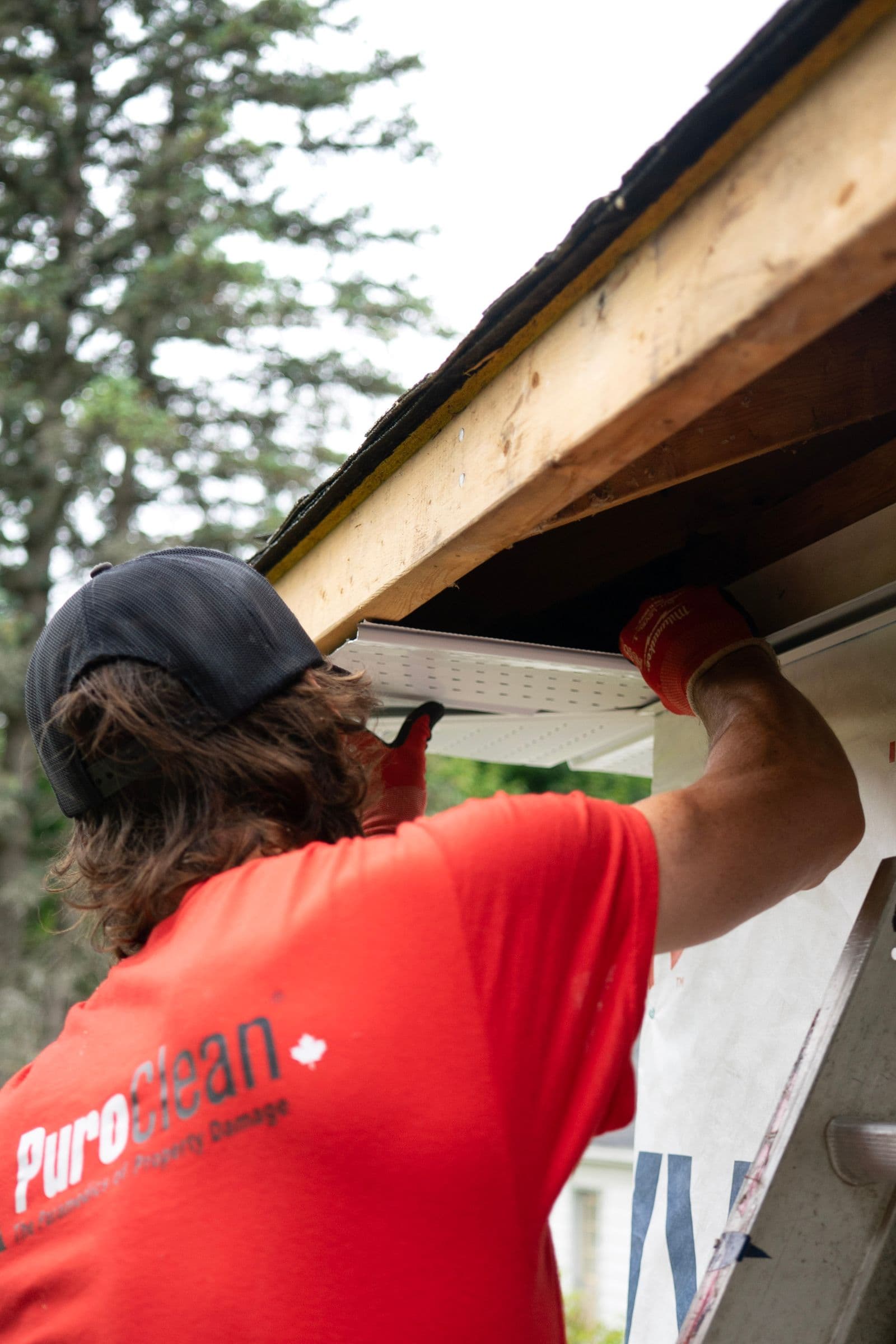
The crew arrives between 7:30 and 8:30 in the morning. First step is a perimeter walk with the homeowner to confirm every downspout location, every miter angle, and every splashblock or drain endpoint. We mark the discharge points on the driveway with chalk so there are no surprises after the install. The brake machine then gets set up in the driveway and the aluminum or coated-steel coil gets loaded onto the feeder. The brake forms each continuous run on-site, which is what makes these gutters seamless. A 50 foot run comes off the machine as one piece, two crew members carry it to the eave, and it gets hung in place before any end cuts happen.
Hangers go in every 24 to 30 inches into solid sub-fascia, not into the soft outer fascia board alone. We don't use the spike-and-ferrule hangers you'll still see on older Tampa homes because they loosen in the heat cycle within five years. Hidden hangers with internal screws sit inside the gutter, hold the channel against the fascia, support the full water load during a storm, and do not show from the street. On bayfront addresses we use stainless screws on every hanger. On historic district homes we paint-match the bracket heads to the fascia color so nothing visually breaks the line of the eave.
Final step is the hose test. We run water through every run, watch every downspout for free flow, and walk the perimeter with the homeowner to confirm no drips, no overflow points, and no places where the slope reads wrong. If anything needs adjustment, we'll fix it before we pack up. The homeowner gets a written warranty document that covers material defects and installation issues for a defined period, plus a care guide that explains when to schedule cleaning and what to check before each hurricane season.
Cost Ranges for Gutter Installation in the Tampa Market
Tampa pricing carries a small premium over inland Hillsborough because of access challenges in older neighborhoods, salt-zone material upgrades on bayfront addresses, and a tighter labor market across Tampa Bay since the 2024 storm season. Here is what we typically quote.
A basic seamless aluminum install on a Seminole Heights bungalow or a Hyde Park cottage with 90 to 130 linear feet of 5-inch K-style gutter, two or three downspouts, and standard splashblocks lands between $1,100 and $2,200 all in. That is the most common job we do across Tampa, and it covers a wide swath of the city's older single-story housing stock. A larger Tampa Palms, Westshore, or New Tampa home with 180 to 280 linear feet, four to six downspouts, and a 6-inch K-style upgrade runs between $2,400 and $4,400.
Bayfront homes with the salt-zone specification run higher. A Bayshore or Davis Islands install with .040 aluminum, stainless fasteners, and marine-grade sealant runs $3,200 to $5,800 for a typical home. PVDF-coated steel on the same home adds another $1,500 to $3,500. A full copper system on a Hyde Park historic home or a Bayshore mansion runs $7,500 to $14,000 just for the copper, plus any ARC review costs and the heavier bracket and downspout work that copper requires. We do a handful of copper jobs each year in Tampa, mostly on homes where the homeowner wants the system to be a visual feature rather than a service utility.
Buried drain lines instead of splashblocks add $15 to $25 per linear foot for the PVC and the trenching. Gutter guards installed at the same time as the new gutter run another $5 to $10 per linear foot depending on the guard system the homeowner picks. We won't bid a Tampa job without seeing the house, because fascia condition, access around mature oaks in Seminole Heights, and salt exposure on bayfront addresses all change the final number. A free estimate visit takes about 30 minutes and the homeowner walks away with a written quote, color samples, and a target install date. After Milton, our schedule fills up fast through the spring, so the earlier in the dry season we get on the calendar the more flexibility there is.
More in this area
Other roofing services in Tampa
FAQ
Frequently Asked Questions
Do I need a permit for gutter installation in Tampa, FL?
+
What gutter material works best on a bayfront Tampa home?
+
How big should the downspouts be on a Tampa home?
+
Will my Hyde Park or Tampa Heights HOA approve copper gutters?
+
How long does a Tampa gutter installation take?
+
From the Blog
Stay informed about roofing in Florida.
Skylights in Florida: Install, Leaks and Hurricane Ratings
A skylight is a deliberate hole in the one assembly built to keep water out. Florida code puts it through a 9 pound 2x4 at 34 mph and 9,000 pressure cycles. Here is what that means for specifying one, why they leak here, and what replacement runs in 2026.
Read Article
Gutters for Florida Homes: Seamless vs Sectional Guide
Seattle gets 38 inches of rain a year and runs 5-inch gutters. Tampa gets 52.6 and overflows, because 30 of those inches fall in four months and mostly in short bursts. Gutters are sized on inches per hour, not inches per year. Here is the sizing math, what seamless actually buys you, and the two spec lines that matter more than the word seamless in a hurricane state.
Read Article
Salt Air Roof Damage in Tampa Bay: Coastal FL Guide
Coastal roofs almost never fail because the covering wore out. They fail because the metal holding the covering down corroded, let go, and the wind found the loose edge.
Read ArticleReady When You Are
Get your free roof inspection today.
No-pressure, written estimate. Same-week scheduling across Hernando County. Call us now or request a visit online.