Blog
Hurricane Season 2026 Pre-Season Prep: The Roof Checklist Florida Homeowners Should Run Now
Call (352) 605-0696Hurricane season in Florida runs from June 1 through November 30, with peak activity from mid-August through October. NOAA's 2026 forecast calls for an above-average season, with 17 to 21 named storms and 4 to 7 major hurricanes. If your roof is more than 10 years old, has any visible damage, or has never had a professional wind mitigation inspection, the next 90 days are when you want to act, not after a storm watch is issued and every contractor in Central Florida has a 6-week waiting list.
This is the pre-season prep checklist Protech Roofing's field crews use when they walk a homeowner's property in late spring. It covers the roof, the surrounding structure, your documentation, and what to do if a storm forms in the Gulf. Following this list will not stop a hurricane, but it will dramatically reduce the chance you end up filing a $40,000 claim instead of a $3,000 one.
Why Pre-Season Prep Matters
After every major Florida storm, our phones ring off the hook for two weeks straight. The problem is that emergency roof repair, even from a reputable contractor, costs 40 to 80 percent more during a post-storm surge than during the off-season. Materials are short, crews are working overtime, and tarp installations are scheduled in 4-hour windows because demand is so high.
Homeowners who did pre-season prep have three advantages: their roof is more likely to survive without damage, their insurance claim is easier to file because their documentation is clean, and they have a contractor relationship already established who will prioritize them after a storm.
The Roof Pre-Season Checklist
Walk your property with this list, ideally in May or early June. Better yet, schedule a free professional inspection so you have a documented baseline.
1. Inspect Shingles from the Ground
Stand back and look at each face of the roof. You are looking for missing shingles, lifted edges, granule loss patches that look bald or dark, and any shingles that appear to be folded or curled at the corners. If you can see your roof from a second-story window of a neighboring home, get that angle too. Many homeowners only check the front-facing side and miss damage on the back.
2. Check Flashing Around Vents, Chimneys, and Skylights
Flashing is the most common roof leak point. Look for rust, separation from the surrounding shingles, or any visible gaps. The sealant around skylights and vents should be intact, not cracked or pulled away.
3. Clear Debris From Valleys and Gutters
Pine needles, leaves, and shingle granules collect in roof valleys and gutters. Water cannot drain properly when valleys are clogged, and standing water during a heavy rain finds the smallest crack in your underlayment. Clean valleys with a leaf blower (from the ground if possible) and clear gutters with a hand scoop or pressure washer.
4. Trim Tree Branches Back 6 to 10 Feet
Wind-driven tree limbs cause more roof damage than direct wind in many storms. Any branch within 10 feet of your roof line is a hazard. Cut back oak, magnolia, and other heavy branches at least 6 feet from the roof. If the tree itself is structurally compromised (rotted base, leaning, dead crown), have it removed before June 1.
5. Check Soffit and Fascia for Rot or Loose Boards
Soffit vents pulled loose during a storm become entry points for wind-driven rain that floods your attic. Loose fascia boards rip off and become projectiles. Walk under the eaves and push gently on each panel and board. Anything that moves needs to be re-secured before June 1.
6. Inspect Roof-to-Wall Connections in the Attic
Climb into the attic with a flashlight and look at where the roof rafters meet the wall plates. You should see metal hurricane straps or clips connecting them. Older Florida homes (pre-2002) often have only single straps or just nails. If you cannot see any visible connection, this is the single highest-value upgrade you can make for hurricane prep, and it qualifies for both the My Safe Florida Home grant and a significant insurance discount.
7. Examine the Roof Deck for Water Stains
Look at the underside of the roof deck from inside the attic. Any dark stain, soft spot, or visible mold indicates a current or past leak. A leak that is barely a drip in dry weather becomes a flood during a hurricane.
8. Test the Garage Door
Stand inside the closed garage and apply gentle pressure to the bottom and middle of the door panels. The door should not flex more than a few inches. A garage door that bows under pressure will fail under 100-plus mph winds, and once the garage door fails, internal pressure inside the home increases dramatically and is one of the leading causes of roof loss in hurricanes. Impact-rated garage doors qualify for the MSFH grant.
9. Confirm Opening Protection Is Functional
Check that hurricane shutters can be deployed in the time you have available (a working pair should take less than an hour to install all sides of the home). Locate the hardware, mark the panels so you know which goes where, and store everything in one place that is accessible without ladders. Impact-rated windows do not need shutters but should be inspected for any visible damage to the glass coating or frame.
10. Review the Age and Condition of Your Roof Honestly
Asphalt shingle roofs in Florida have an effective life of 15 to 20 years, less in coastal salt air. Tile and metal go 25 to 50 years if installed properly. If your roof is over 15 years old and you have not had a professional inspection in the last 2 years, get one now. Insurance carriers in Florida have started declining to renew policies on roofs older than 20 years, and a pre-season inspection report can be the difference between renewal and non-renewal.
Documentation Prep
What you document in May matters when you file a claim in August.
- Walk every face of your home with a phone camera. Take video of every wall, every face of the roof, the soffit and fascia, the gutters, and the surrounding landscape. Save this video to cloud storage where you can access it after a storm.
- Photograph the inside of every room, every appliance, and every closet. Include serial numbers of high-value items.
- Pull your current homeowners insurance declarations page and save a digital copy. Confirm dwelling coverage, contents coverage, deductible (hurricane deductibles in Florida are typically 2 to 10 percent of the dwelling value), and the named storm sub-limits.
- Locate your roof installation paperwork if available. The age and installer of your roof is something every adjuster will ask about.
- If you have an existing wind mitigation inspection on file, save the OIR-B1-1802 form digitally. Adjusters use this form when calculating your settlement.
Insurance Review
Call your agent in May. Ask three specific questions:
- Is my hurricane deductible 2 percent, 5 percent, or 10 percent? On a $400,000 home, that is the difference between an $8,000 deductible and a $40,000 deductible. Many homeowners discover after a storm that their deductible quietly increased on renewal.
- Are my named storm sub-limits adequate? Roof, screen enclosure, and pool cage often have separate lower limits that surprise homeowners.
- Have you applied my latest wind mitigation discount? If your home has been retrofitted recently, the discount may not have been re-applied at renewal.
Emergency Supplies for the Home
The Florida Department of Emergency Management recommends 7 days of supplies. Beyond food and water, the roofing-specific items that matter:
- Two heavy-duty tarps sized at least 20 by 30 feet, with 6-inch nails and lumber strips for emergency tarping. Better is to schedule a real tarp install from a roofer, but a homeowner tarp can be enough to prevent water damage for the 24 to 48 hours before professional help arrives.
- Roof patching sealant (a roll of self-adhering peel-and-stick membrane or a tube of high-quality roofing cement) for emergency patches on shingles that lift.
- A battery-powered work light strong enough to inspect the roof from a ladder at night.
- Phone chargers and a battery bank that can keep your phone charged for 3 to 5 days without power.
What to Do When a Storm Is Forming
Once the National Hurricane Center is tracking a system that could impact Florida, the timeline matters.
5 to 7 Days Out (Storm in the Atlantic)
Confirm your insurance policy is active and paid. Photograph or video your entire home if you have not already. Locate your hurricane shutters and check the hardware.
3 to 5 Days Out (Storm Path Includes Florida)
Top up fuel for vehicles and any generator. Confirm cash on hand. Charge phones and battery banks. Trim any final tree branches that look threatening. Pull patio furniture, grills, and lawn decorations into the garage or secure them with straps.
48 Hours Out (Hurricane Warning Issued)
Install hurricane shutters or board windows. Move vehicles to the highest ground accessible. Park away from trees. Fill bathtubs with water. Wash all dishes and laundry.
24 Hours Out (Storm Imminent)
Final walk-around to secure anything loose. Move important documents to a waterproof container in the highest interior room. Charge everything.
After the Storm: First 48 Hours
The most expensive mistakes happen in the first two days after landfall. Avoid these:
- Do not climb onto a wet or damaged roof. Many post-storm injuries are roof falls. Inspect from the ground with binoculars.
- Do not sign anything with a door-to-door contractor in the first week. After every storm in Florida, out-of-state crews show up offering immediate work, take deposits, and disappear. Use only licensed Florida contractors with verifiable local addresses.
- Photograph and video all damage before any cleanup. Insurance carriers need to see the original condition.
- Call your insurance carrier within 48 hours to open a claim, even if you do not yet know the extent of the damage.
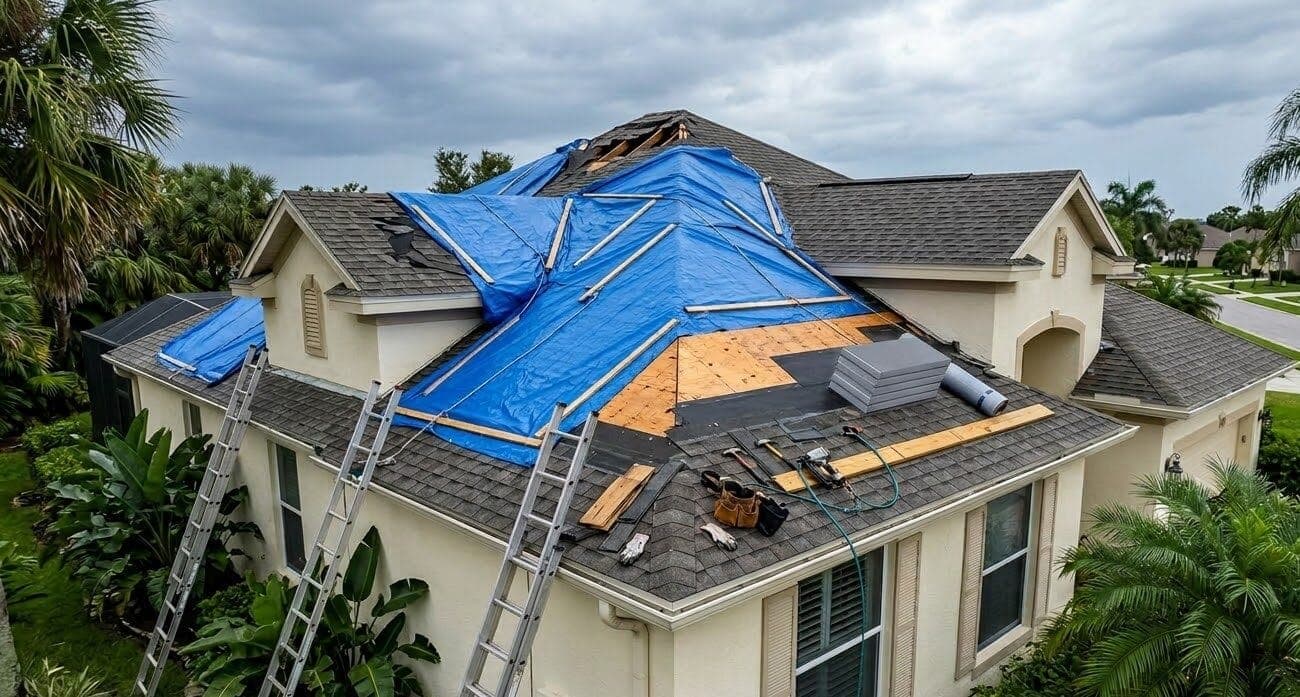
- If you have any active leak, a temporary tarp is your priority. A roofer can install a proper tarp in 1 to 3 hours (we cover this in detail in our emergency roof repair services). Many homeowners insurance policies cover the cost of emergency tarping if you save the receipt.
Common Pre-Season Prep Mistakes
- Waiting until July or August. Reputable contractors fill their inspection schedule in May. By August, you are competing with everyone else who waited.
- Skipping the attic inspection. The roof can look perfect from the ground while the deck is rotting from the inside.
- Trusting an old wind mitigation inspection. If your inspection is more than 5 years old, the rating may not match your current insurance discount eligibility. A new inspection often discovers improvements that qualify for additional savings.
- Not pulling your insurance declarations. Surprise is the worst feeling when filing a claim. Know your deductible, sub-limits, and coverage limits before the storm.
- Ignoring tree work because it is expensive. Removing a tree costs $800 to $3,000. Replacing a roof crushed by a fallen tree costs $20,000 to $40,000. The math is not subtle.
Schedule a Free Pre-Season Inspection
Protech Roofing offers free, no-obligation pre-season roof inspections across Hernando, Citrus, Pasco, Sumter, Marion, and Lake counties through the end of July. Our crews document the roof condition, identify any storm vulnerabilities, and give you a written report you can keep for insurance and resale purposes. Call (352) 605-0696 or schedule online at hernandoroofer.com.
FAQ
Frequently Asked Questions
When does Florida hurricane season start in 2026?
+
How much does emergency roof repair cost during hurricane season?
+
Should I inspect my roof from the ground or get a professional inspection?
+
How far back should I trim trees from my roof?
+
What is the most common hurricane roof damage in Central Florida?
+
Does homeowners insurance cover emergency tarping after a storm?
+
How quickly should I file an insurance claim after a hurricane?
+
Can I file a claim months after a storm if I find damage later?
+
Related Articles
More guides for Florida homeowners
Hurricane Season 2026: The Complete Pre-Season Prep Checklist for Florida Homeowners
A comprehensive 2026 hurricane prep checklist for Florida homeowners — roof inspection, shutters, flood insurance, emergency supplies, evacuation zones, and post-storm steps. Don't wait for a named storm to act.
Read ArticleFlat Roof Repair & Replacement in Florida: TPO, Leaks & Overlays
2026 guide to flat roof repair, replacement, and TPO overlay systems for Florida commercial buildings. Real costs, the most common failure points, and when overlays save 30 to 40 percent vs. full tear-off.
Read Article
Commercial Roofing in Hernando County, FL: 2026 Systems & Cost Guide
2026 guide to commercial roofing in Hernando County. TPO, PVC, modified bitumen, metal, and built-up systems compared with real per-square-foot costs, lifespans, repair vs. replacement decisions, and the most common Florida failure points.
Read ArticleReady When You Are
Get your free roof inspection today.
No-pressure, written estimate. Same-week scheduling across Hernando County. Call us now or request a visit online.