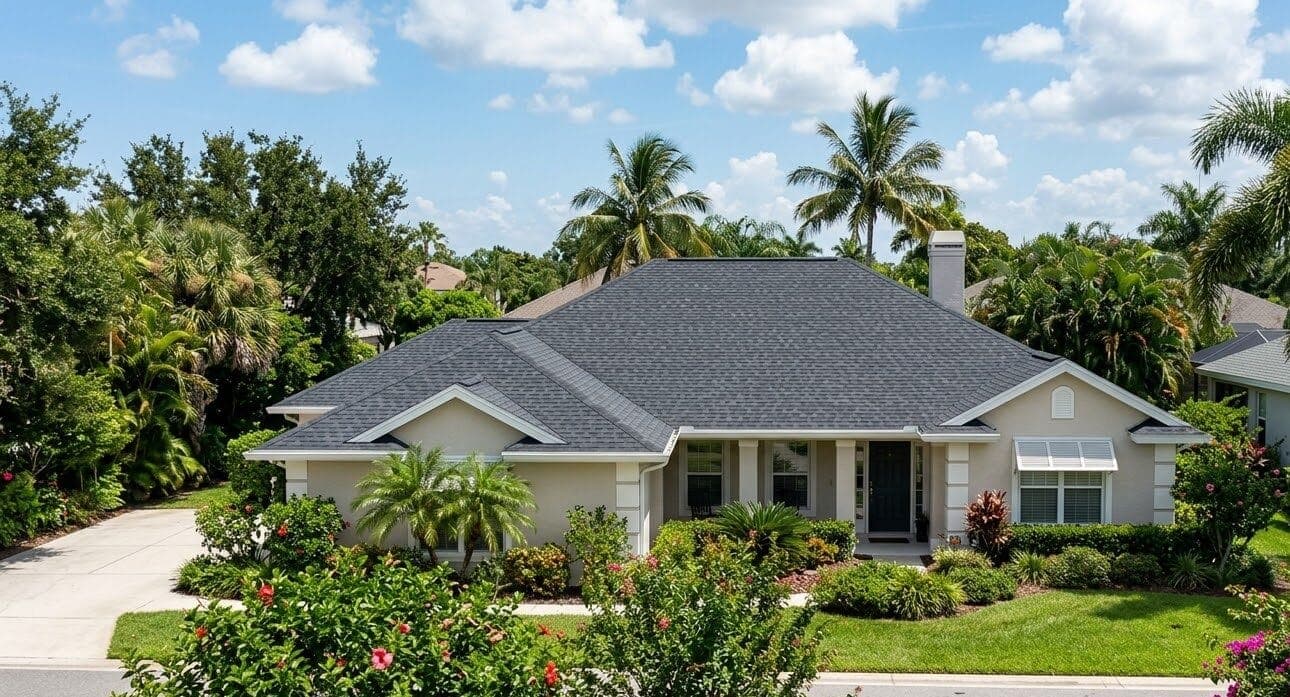
Citrus County, FL
Roofing in Citrus Springs, FL
Roofing contractor serving Citrus Springs, FL. Repair, replacement, inspection, storm damage, and the Citrus County permit handled. Call (352) 605-0696.
Call (352) 605-0696Roofing in Citrus Springs, From a Crew That Works Citrus County Every Week
Citrus Springs is a census designated place, not an incorporated city. It covers about 21.15 square miles in the northwest corner of Citrus County, sits at roughly 98 feet of elevation, and was laid out by the Mackle brothers through The Deltona Corporation as a subdivision of more than 34,000 lots. Inverness, the county seat, is about 15 miles away. Dunnellon is about 3 miles off. That geography has a direct effect on your roof project, and not the one most people expect. Because Citrus Springs has no municipal government of its own, there is no city building department in the chain. Every permit, every inspection, and every piece of closeout paperwork on your roof goes through Citrus County.
Protech Roofing Services covers Citrus Springs from our headquarters at 9035 Jayson Dr in Brooksville. Citrus County is part of the territory we work continuously, alongside Hernando, Pasco, Sumter, Polk, Hillsborough, and Pinellas. Working the same counties year after year means we know how each building department wants its documentation, which is the difference between a roof that closes out cleanly and one that sits open. We are rated 4.9 on Google. The detail that matters more day to day is simpler: we pull the permit on your job and we conduct the final inspection. It is included in the work. It is not a task we hand back to the homeowner after the last truck leaves.
We are a full roofing contractor, not a single trick operation. On a Citrus Springs address we handle:
- Roof repair and leak detection and repair
- Total roof replacement and roof inspection
- Shingle roof installation, metal roofing systems, stone coated steel tile, and tile repairs
- Storm damage restoration, emergency roof repair, and insurance claims assistance
- Gutter installation, gutter protection, and gutter cleaning
- Regular maintenance, roof coating, and the My Safe Florida Home program
- Commercial roofing, commercial flat roofing, multi-family roofing, and new construction
If you are comparing options across the county, our Inverness and Crystal River pages cover those markets. Citrus Springs has its own conditions, and this page is about those.
What We Actually See on Citrus Springs Roofs
The median year of construction for homes in Citrus Springs is 1998, and a meaningful share of the housing stock is older than that, going back to the Deltona build out that started in the 1970s. That spread is the single most useful thing to know about roofing here. You are not working in a neighborhood where every house went up in the same two year window with the same roof system. On one street you can find an original build from the Deltona era, a late nineties home on its first or second roof covering, and a more recent infill house built under a much newer version of the Florida Building Code. Three different roofs, three different conversations.
What that means in practice is that the age of the house tells us less than the age and history of the roof covering. A home built in 1998 may have been re-roofed twice since. Another one may still be carrying its original system with patchwork repairs layered over the problem areas. We do not guess at this. Before we quote anything on a replacement, we look at what is actually on the deck and what the permit record shows was done to it.
Our full roof inspection evaluates the condition of your shingles or tiles, the integrity of the underlayment, the condition of the flashing at every penetration point, the health of the decking, and the effectiveness of your ventilation system. Those five things fail in different ways and on different timelines. Shingles announce themselves: granule loss in the gutters, lifted or missing tabs, cupping at the edges. Flashing is quieter, and it is where a large share of the leaks we chase actually originate, usually at a valley, a pipe boot, or a wall transition rather than out in the open field of the roof. Decking is the one homeowners never see, because the covering hides it until tear off. Ventilation is the one that shortens the life of everything above it when it is wrong.
The practical consequence for a Citrus Springs owner is that a visual look from the driveway is not an assessment. Two roofs that look identical from the street can be in completely different condition once you get on them and into the attic. We would rather tell you that your roof has real service left in it than sell you a system you did not need, and the only way to say that honestly is to go look.
How a Citrus County Re-Roof Permit Actually Works
Florida is strict about who is allowed to touch a roof, and Citrus County is specific about what it wants to see before it signs off. Both of those are worth understanding before you hire anyone.
Under Florida Statute 489.113, roofing work can only be performed by a contractor holding state certification or registration in the roofing category under Chapter 489. The exceptions are narrow and do not apply to a normal homeowner project: they cover warranty repair of wood or asphalt shingle on new construction that the general contractor built. If someone is offering to re-roof your Citrus Springs house without a roofing license, the problem is not just quality. The work itself is not permitted to happen that way.
On the county side, a Citrus County re-roofing permit has to be pulled by a licensed General, Building, Residential, or Roofing contractor, or by an individual certified under F.S. 468. The county requires a signed and notarized inspection affidavit after the sheathing, fastener, and roofing inspection, and it requires photographs, the NOC, and product approval documentation submitted through the contractor portal. That is a real chain of custody, not a formality. The product approval piece in particular means the materials on your roof have to be documented as approved for the application, which is a quiet but meaningful consumer protection.
We handle all of it. We pull the permit, we schedule the inspections, we prepare the affidavit and the photo documentation, and we carry the job through the final inspection. You do not need a contractor portal login and you do not need to chase an inspector. This is the same way we work commercial projects, where the permit fees, plan preparation, and inspection coordination are included in our project pricing rather than billed as a surprise at the end.
One more approval question comes up constantly in Citrus Springs, so it is worth answering plainly. Citrus Springs is a deed restricted community, with restrictions dating from the original Deltona plat in the late 1960s and 1970s. It does not have a mandatory homeowners association and there is no HOA fee. The Citrus Springs Civic Association is a voluntary nonprofit, and there is an ongoing legal question about its authority to enforce restrictions, charge permit fees, or issue fines. We are roofers and not attorneys, so we will not tell you how that question resolves. What we can tell you is how we operate: the approval we obtain and close out is the Citrus County building permit, which is the one required to do the work. If you have a private agreement or a document on your deed you want to comply with on color or material, tell us at the estimate and we will spec inside it.
The Code Requirements That Change What Goes on Your Roof
Three code items drive most of the cost and scope decisions on a Citrus Springs roof. Knowing them ahead of time makes it much easier to read a proposal and see whether a contractor is quoting the real job.
The secondary water barrier is not optional
Under the Florida Building Code, 8th Edition (2023), whenever the roof covering is removed and replaced, a secondary water barrier is required: a self adhering underlayment over the deck, per Section R905.1.1 and Section 1518.2. This is the layer that keeps water out of the house when the covering above it is compromised, which is exactly the scenario a wind event creates. If you are comparing two replacement quotes and one is noticeably cheaper, this is one of the first line items to check. A tear off that does not include a compliant secondary water barrier is not a code compliant re-roof.
Wind design speed varies inside Citrus County
The official Florida Building Code wind speed maps place Citrus County in design ranges between 100 mph and 120 mph, with wind zone transition lines running through the county so the applicable number varies by area. This is not a detail to assume. The design wind speed that applies to your address determines the fastening pattern, the attachment method, and which products are approved for the installation. We confirm the applicable design speed before we spec a system rather than quoting a generic assembly and correcting it later.
The 25 percent rule changed, and it changed in your favor
Florida's so called 25 percent rule used to mean that if a quarter or more of your roof area needed repair or replacement, the entire roof had to be brought to current code. That has been amended. On a roof that already complies with the 2007 Florida Building Code or a later edition, if 25 percent or more of the area needs repair or replacement, only the repaired portion has to meet current code. Full roof replacement is no longer mandated in that situation.
The qualifier matters in a neighborhood with a median build year of 1998, because the exception turns on whether the existing roof was built to the 2007 code or later. For a house from the nineties, that usually comes down to whether it has been re-roofed since. This is precisely why we look at the permit history on the property before telling you whether a partial repair will satisfy the county. Getting that answer right is the difference between a targeted repair and a full replacement, and it is not a judgment call we make from the ground.
Repair or Replace, and How We Find the Leak First
Most people call us because of a specific symptom: a stain on a ceiling, a drip during a hard rain, a few shingles in the yard after a windy night. The instinct is to ask for a price on a new roof. The better first question is where the water is actually coming in, because the entry point is frequently nowhere near the stain.
We schedule an on-site inspection and start with a thorough visual examination of the roof. We also inspect the attic when it is accessible, looking for daylight penetration, water staining on decking, and moisture in the insulation. When the visual work does not isolate the source, we escalate. Thermal imaging identifies suspect areas by temperature difference, then we press a moisture meter directly against decking, insulation, and framing to get precise moisture content readings rather than an impression. When thermal imaging and moisture readings point to a general zone but we need the exact penetration point, we run a controlled water test: one technician sprays specific areas of the roof in a systematic pattern while a second monitors the attic from inside. That sequence finds the entry point instead of guessing at it.
We save the images from that process as part of your permanent inspection record. That record is useful well beyond the immediate repair. It is the documentation that supports an insurance conversation later, and it is the baseline that tells us whether a problem area is stable or progressing the next time we are out.
The repair versus replacement decision then comes down to a short list of honest questions. Is the failure isolated to a detail, such as a flashing or a boot, or is the covering failing across the field? Is the decking sound underneath, or is it saturated and soft? Does the existing roof qualify for a partial repair under the amended 25 percent rule, based on its permit history? Is there a second or third layer up there that limits what a repair can accomplish? We would rather answer those questions in front of you, with photographs, than send a number with no explanation behind it.
Storm Season When You Are Inland
The Atlantic hurricane season runs from June 1 to November 30, with the climatological peak on September 10. Most of the activity, including nearly all of the major hurricanes, falls between the middle of August and the middle of October. That is a predictable window, and predictable windows are worth planning around.
Citrus Springs has a real advantage over coastal parts of the county on one axis. According to the First Street Foundation risk model, about 9.1 percent of properties in Citrus Springs currently face flood risk, compared with 30.3 percent across Citrus County as a whole. The inland position and the elevation are doing work there. What that lower flood exposure does not do is reduce wind exposure. Wind driven rain does not care how far you are from the Gulf. A lifted shingle, a failed boot, or an open ridge detail lets water into an inland house exactly as readily as a coastal one, and the design wind speeds on the county map apply to your address regardless of where the flood lines run.
The practical recommendation we give, and the one our own storm pages give, is straightforward: schedule a roof inspection ahead of the season rather than after an event. Before the season, an inspection is a calm conversation about flashing, fasteners, and sealant. After an event, every roofer in the county is booked and you are one of many. Getting ahead of it is the cheapest advantage available.
When a storm does hit, we provide a storm damage inspection at no charge, because having an accurate picture of the damage from day one changes how the rest of the claim goes. Many of our customers ask us to be present during the adjuster's inspection, and we recommend it. When we meet the adjuster at your property, we point out every area of concern documented in our inspection report so nothing gets overlooked. We check shingles for wind lift and hail bruising, examine flashing around penetrations and valleys, assess soffit and fascia for wind damage, and look for signs of water intrusion in the attic space. Our insurance claims assistance page covers that process in more detail.
One step homeowners routinely miss: after we complete a roof replacement, we recommend scheduling a wind mitigation inspection right away. A new roof built to current Florida Building Code standards will typically qualify for the highest available credits, and those credits do nothing for you until an inspection documents them.
Roof Systems We Install in Citrus Springs
There is no single correct roof for this area. There is a correct roof for your structure, your wind zone, your budget, and how long you plan to own the house. Here is how the main options actually differ.
Asphalt shingle
Shingle remains the most common residential choice, and the important variable is not the color. It is the wind rating of the specific product against the design speed that applies to your address, and the fastening pattern used to install it. A shingle system is only as good as its attachment, which is exactly why the county inspects sheathing and fasteners as their own step before the covering goes on.
Metal
Metal roofing comes up constantly in conversations about wind performance and longevity. It is a different system with different detailing requirements, particularly at penetrations and transitions, and it needs to be specified against the same wind map. It is worth pricing as a real alternative rather than assuming it is out of reach.
Tile and stone coated steel
We handle tile repairs on existing tile roofs, and we install stone coated steel tile for owners who want the appearance of tile with a steel substrate. On an existing tile roof, the underlayment usually fails long before the tile does, which is why a tile roof can look intact from the street while leaking steadily.
Flat and commercial systems
For commercial buildings in this region our general recommendation is TPO for general use and PVC for restaurants, chemical environments, or owners who want the longest available warranty. Commercial work adds inspection steps: a deck inspection after tear off, an insulation and fastener inspection before the membrane goes on, and a final inspection after completion. We handle the entire permitting and inspection process on those projects, and we prepare the complete permit documentation package for building department review.
Coating and maintenance
Roof coating and regular maintenance are the least glamorous items on the list and often the highest return. Paired with gutter cleaning and functioning gutter protection, maintenance is what keeps a sound roof from becoming a replacement conversation early.
My Safe Florida Home and the Citrus Springs Housing Stock
The My Safe Florida Home program is unusually relevant in Citrus Springs, and the reason is that 1998 median build year. One of the program's eligibility requirements is that the home's building permit was issued before January 1, 2008. A large share of this neighborhood was permitted well before that date.
The full eligibility picture, per the program, is specific. The home must be single family, site built, and owner occupied, with a homestead exemption, and with an insured value up to $700,000, which can be waived for low income applicants. The state matches $2 for every $1 the homeowner spends, up to $10,000. On the roofing side, the covering must be Class 4 or higher and compatible with the local wind zone, which ties directly back to the Citrus County wind map. And there is one rule that catches people: a partial roof repair or patch is not eligible. The program requires replacing the entire sloped or flat roof.
That last point is the one worth thinking through before you commit to a plan. If your roof is a candidate for a targeted repair under the amended 25 percent rule, and it is also a candidate for a program funded full replacement, those are two genuinely different paths with different costs and different outcomes. We will lay out both rather than steering you toward the larger job by default. Our My Safe Florida Home page goes through the requirements in detail.
Getting Started on a Citrus Springs Roof
The first step is an inspection, not a price. We come out, get on the roof, check the attic where it is accessible, photograph what we find, and tell you what condition the system is actually in. If the honest answer is that you have service life left and the right move is a repair and a maintenance plan, that is what we will say.
If a replacement is the right call, you get a written estimate that breaks down the components so you can see exactly what you are buying: the tear off, any deck repairs, the secondary water barrier required by the 2023 code, the covering and its wind rating, the flashing details, the permit, and the warranty terms. Line items you can compare against another proposal are the point. A single number at the bottom of a page tells you nothing about whether two contractors are quoting the same work.
From there we pull the Citrus County permit, schedule the inspections, prepare the notarized affidavit and the photo documentation the county requires, and close the permit out with the final inspection. You do not manage that process. We do.
Call (352) 605-0696 to schedule a roof inspection in Citrus Springs, or to have us come look at a leak, a storm damaged area, or a roof you are simply unsure about. We work this county continuously, the office is at 9035 Jayson Dr in Brooksville, and we are rated 4.9 on Google.
Our Services
Some of the roofing services we offer in Roofing in Citrus Springs
Roofing By Area
Roofing services near Roofing in Citrus Springs
FAQ
Frequently Asked Questions
Do you serve Citrus Springs?
+
Who issues the roofing permit for a Citrus Springs home?
+
Does a new roof in Citrus Springs need a secondary water barrier?
+
If 25 percent of my roof is damaged, do I have to replace the whole thing?
+
Does an HOA have to approve my roof color or material in Citrus Springs?
+
From the Blog
Stay informed about roofing in Florida.

Ready When You Are
Get your free roof inspection today.
No-pressure, written estimate. Same-week scheduling across Hernando County. Call us now or request a visit online.