Blog
Pinellas County Roofing in Flood Zones: Why the Threshold Is 49 Percent, Not 50, and What Counts Toward It
Call (352) 605-0696If you own a home in a Pinellas County flood zone and you are pricing a roof, you have almost certainly been told about the FEMA 50 percent rule. The number is wrong for most of this county. Unincorporated Pinellas enforces 49 percent, several municipalities set their own, and the percentage is measured against a value most homeowners calculate incorrectly. Getting this wrong does not produce a fine, it produces a demand to elevate the house. Here is the actual arithmetic, what counts toward it, where a re-roof lands in that math, and the two situations where permits still get added together even in a jurisdiction that repealed its lookback period.
The Number in Pinellas Is 49 Percent, Not 50
Every article written about flood zone construction in Florida calls it the FEMA 50 percent rule. In unincorporated Pinellas County, the number that actually governs your permit is 49 percent.
That is not a rounding difference or a typo in somebody else's blog post. Pinellas County states it plainly on its own Substantial Damage page: if the cost to repair the home is 49 percent or more of its value without the land, the home is considered substantially damaged. FEMA sets 50 percent as the national floor under the National Flood Insurance Program, and communities are free to adopt a stricter standard. Pinellas did.
One percentage point sounds trivial until you put a real number on it. On a structure the property appraiser values at $280,000, the FEMA floor gives you $140,000 of work before compliance is triggered. The Pinellas rule gives you $137,200. That $2,800 gap is roughly the difference between a mid grade shingle package and an upgraded underlayment on an average St. Petersburg roof. If your estimate was built against the wrong percentage, you can walk into a permit application believing you have room and find out you do not.
And 49 is not universal inside the county either. Pinellas has 24 municipalities, and each one administers its own floodplain ordinance. St. Pete Beach uses 50 percent. Your address, not your county, decides the number. Before anything else, confirm which jurisdiction issues your permit and which threshold that jurisdiction adopted.
What the Percentage Is a Percentage Of
The second thing homeowners get wrong is the denominator. The threshold is not measured against what you paid for the house, what Zillow says it is worth, or what your neighbor sold for last spring. It is measured against the market value of the structure alone, with the land excluded.
In Pinellas that value can come from two places, and the difference between them is worth real money:
- The Property Appraiser's just value for improvements. The Pinellas County Property Appraiser publishes a FEMA letter for each parcel showing the structure value the county will accept. This is the free path and the default.
- An independent appraisal at actual cash value. Pinellas defines this as like kind replacement cost depreciated for age, wear and tear, neglect, and quality of construction, determined by a qualified independent appraiser. You pay for it, and you use it when you believe the appraiser's number is low.
Waterfront parcels on the Pinellas beaches are exactly where this matters. On a barrier island lot, land can be the majority of the parcel value, which means the structure value that anchors your 49 percent can be far smaller than the number in your head. A homeowner who mentally divides a $900,000 property value in half and concludes they have $450,000 of headroom may actually be working against a structure value of $260,000 and a ceiling near $127,000.
If your project is anywhere near the line, order the independent appraisal before you order the roof. An appraisal costs several hundred dollars. Being told mid project that your house is now substantially improved costs a foundation.
What Counts Toward the Threshold, According to Pinellas
Pinellas publishes its inclusion list, which is unusually helpful because most of the arguments in this area are about scope. The county counts:
- Materials and labor cost, including donated or discounted materials and owner or volunteer completed labor
- Structural elements
- Demolition and debris disposal
- Contractor overhead and profit
- Utility and service equipment
- Elevation or floodproofing
- Site preparation
- Costs associated with complying with regulations or code requirements
- Interior and exterior finishes
Read the first and the eighth items again, because they are the two that surprise people.
Donated and volunteer labor counts at market rate. The county is not measuring what left your bank account, it is measuring the value of the work performed. St. Pete Beach's development director put it directly at a 2024 commission meeting: if you do it yourself, the city still has to input the market rate of your labor into the calculation. A homeowner who frames a room themselves to save money does not save a single dollar against this threshold.
Code compliance costs count too. This one runs against intuition, because the work is not optional. Secondary water barrier, upgraded fasteners, and the other requirements that a modern re-roof in Florida triggers are all included in the numerator, even though the code is what forced you to do them. There is no line item on this list labeled "but the state made me."
Where a Re-Roof Lands in That Math
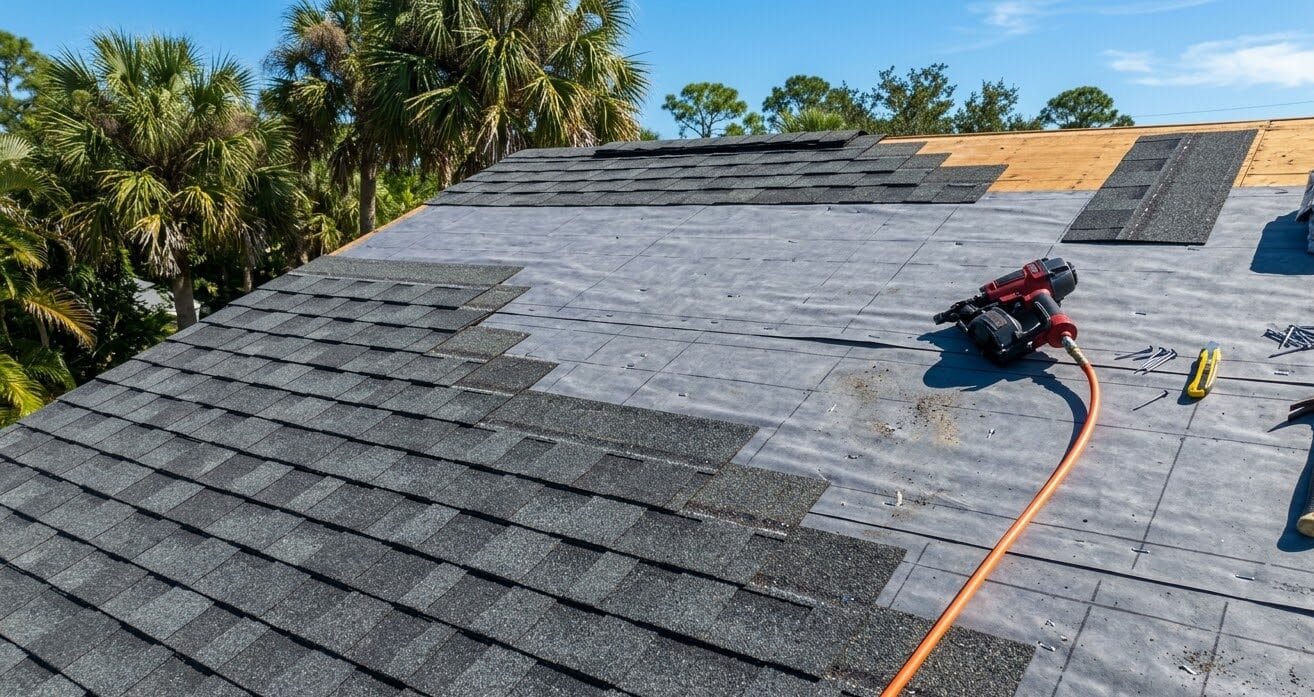
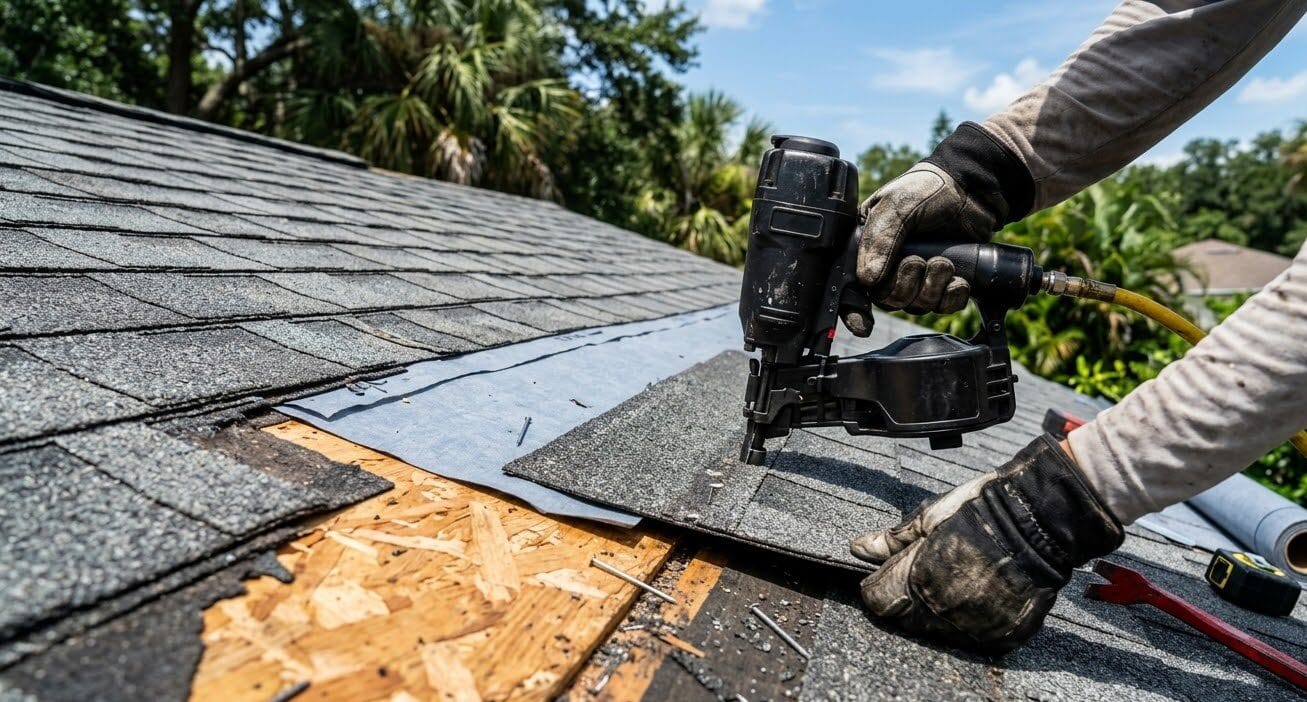
A full roof replacement is one of the largest single line items a Florida homeowner ever permits, which is exactly why it deserves attention in this calculation rather than a shrug.
Work the arithmetic on a representative Pinellas house. A 2,000 square foot single story home with a simple hip roof and about 2,400 square feet of roof area. Structure value on the FEMA letter: $260,000. The 49 percent ceiling is $127,400. An architectural shingle replacement with tear off, new underlayment, and code required upgrades lands in the range of $16,000 to $24,000 in this market. That is roughly 6 to 9 percent of the threshold.
On its own, a re-roof does not come close to tripping the rule. That is the honest answer, and it is the one most Pinellas homeowners need to hear before they talk themselves out of a roof they need.
The re-roof becomes dangerous in combination. Post Helene and post Milton, thousands of Pinellas homes are running interior restoration, electrical, mechanical, kitchen, and flooring work at the same time as the roof. Stack drywall and flooring on a flooded first floor at $45,000, a kitchen at $38,000, mechanical and electrical at $22,000, and a roof at $20,000, and you are at $125,000 against a $127,400 ceiling. The roof did not cause that. The roof was the last $20,000 that closed the gap.
This is why the sequencing conversation belongs at the estimate stage, not at the inspection stage. Get a roof inspection in St. Petersburg that produces a written scope and a real number, then put that number next to everything else you have permitted this year before you sign anything.
The Lookback Rule Changed Three Times in Four Years
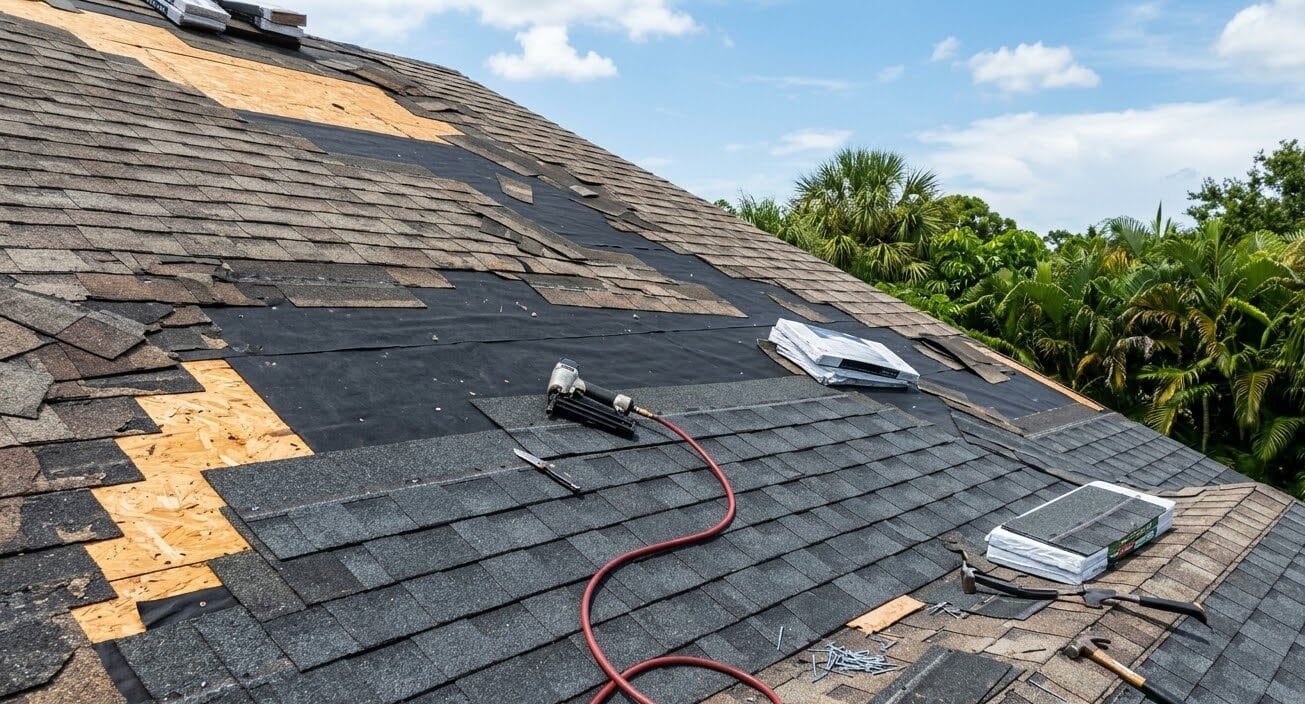
If aggregation is the danger, then the rule that decides how far back the aggregation reaches is the rule that matters most. On St. Pete Beach, that rule has been rewritten three times since 2021, and homeowners are still working from whichever version they heard about first.
The timeline, from the city's own ordinance record:
- Mid 2021: St. Pete Beach adopts a five year cumulative lookback. Permits pulled over a rolling five year window are added together against the threshold.
- November 2024: after Helene and Milton, the city reduces the lookback from five years to a rolling one year period.
- Ordinance 2025-01: noticed for adoption at the February 11, 2025 commission meeting, this ordinance repeals the one year cumulative lookback entirely. The city's stated purpose was to give owners greater discretion for repairing structures in the wake of Helene and Milton while remaining compliant with NFIP standards.
So a homeowner who researched this in 2023 learned a five year rule. One who researched in December 2024 learned a one year rule. Both are now out of date for that city, and neither ever applied in unincorporated Pinellas or in the other 23 municipalities, which set their own.
The practical instruction is not to memorize a number. It is to call the floodplain administrator for the jurisdiction that will issue your permit and ask two questions: what is the threshold percentage, and what is the lookback period as of today. Write down the answers and the date you got them.
Zero Lookback Does Not Mean Zero Aggregation
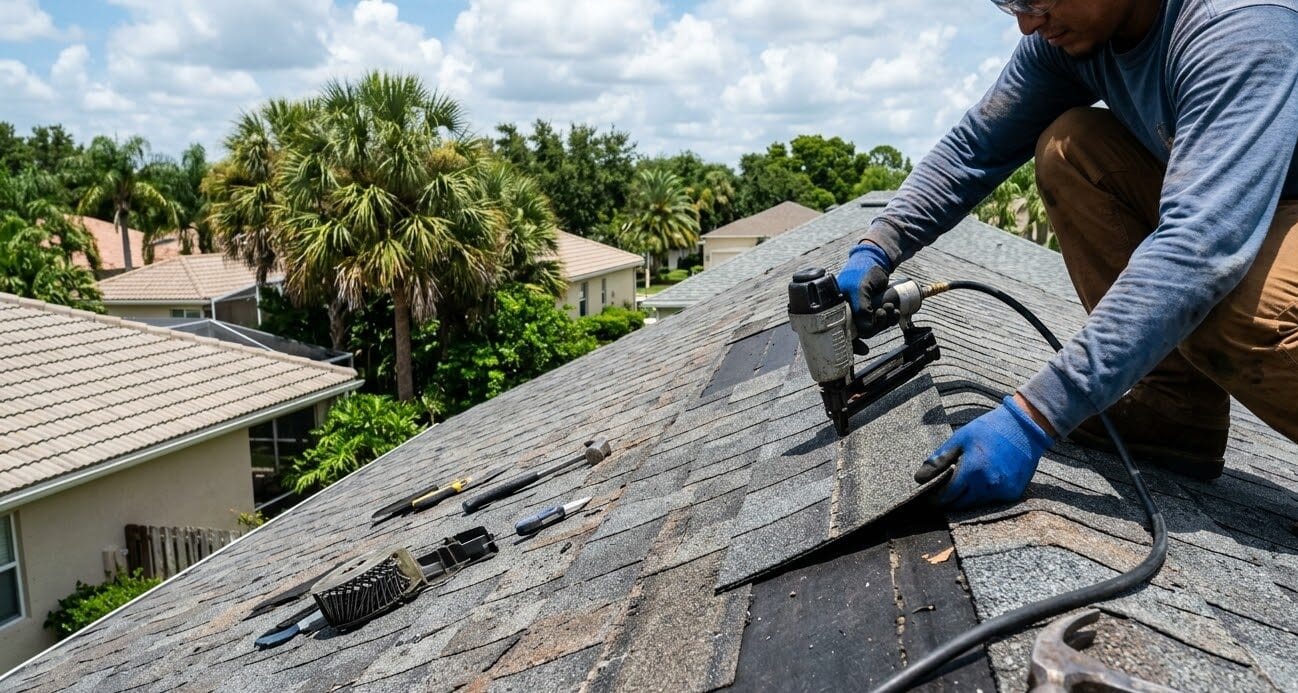
Here is the part that gets skipped in the celebration, and it is the part that touches roofing directly.
The St. Pete Beach ordinance record is explicit that even with the cumulative lookback repealed, two categories of work still get calculated together, because the NFIP minimum standards require it. Permits that are open simultaneously must be added together. And any permits necessary to restore a structure to its pre damaged condition following a damaging event must be added together.
Both of those describe the exact situation a storm damaged Pinellas home is in.
If your roof permit and your interior restoration permit are open at the same time, they are one calculation, lookback or no lookback. If both permits exist because the same hurricane damaged the same house, they are one calculation. Repealing the lookback protects the homeowner who re-roofed in 2023 and wants to remodel a bathroom in 2026 as an unrelated project. It does not protect the homeowner running four trades at once on one storm claim.
There is a legitimate planning move buried in this, and it is sequencing rather than gaming. If your total scope sits above the threshold and the jurisdiction has no lookback, closing out one permit and finishing that work before opening the next is a materially different application than filing all of it in one week. Talk to the floodplain administrator about it in the open. Do not let a contractor tell you to split a scope quietly, because phasing to evade the threshold is what jurisdictions watch for, and several Pinellas ordinances address it directly.
Substantial Damage and Substantial Improvement Are Two Doors to the Same Room
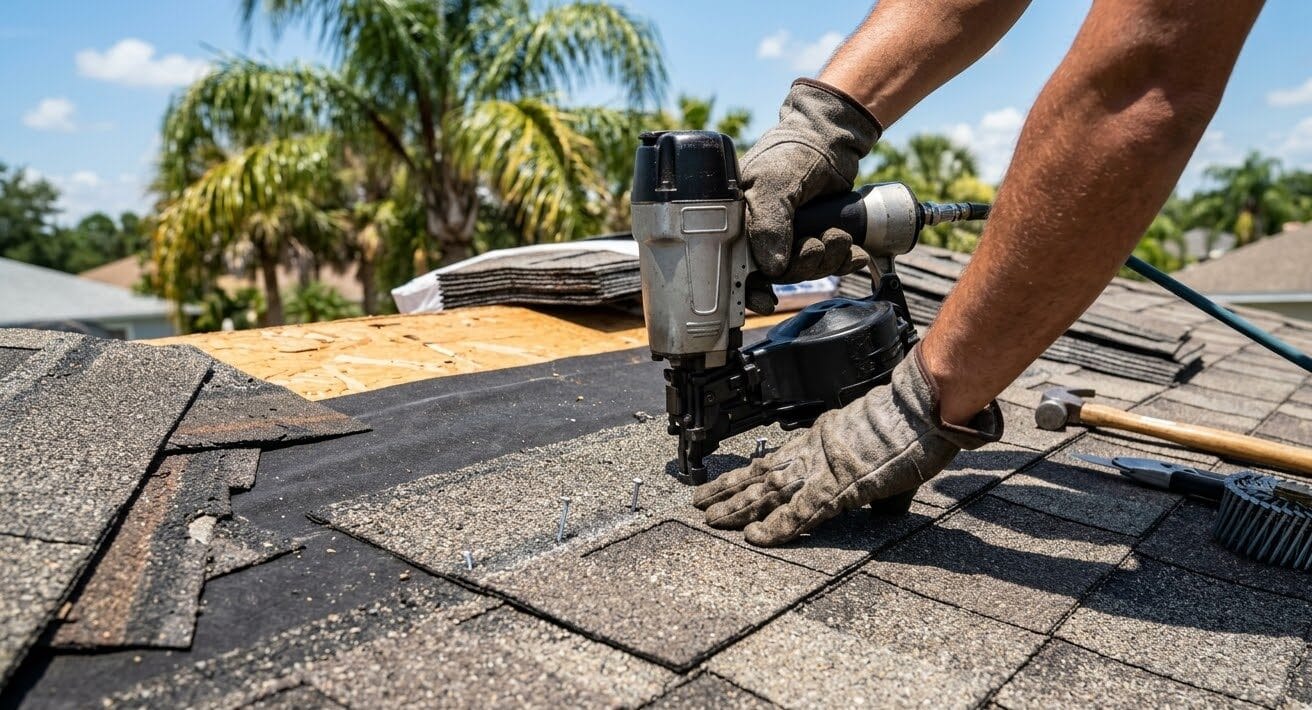
The terms get used interchangeably and they are not the same trigger, though they land you in the same place.
- Substantial damage is involuntary. A storm hits, and the cost to restore the building to its pre damage condition meets or exceeds the threshold. The community makes a determination whether you asked for one or not.
- Substantial improvement is voluntary. You choose to remodel, add on, or upgrade, and the cost of that work crosses the threshold.
The consequence is identical either way. The structure must be brought into compliance with current floodplain management requirements for new construction, which on a Pinellas coastal parcel means elevating the lowest floor to or above base flood elevation plus the required freeboard, and using flood resistant materials below that line.
The reason to keep them separate in your head is timing and paperwork. A substantial damage determination generates a letter, and that letter is what unlocks a specific pot of insurance money discussed further down. A substantial improvement determination generates no such letter and no such money, because no flood claim triggered it. Voluntary work that crosses the line is entirely on you.
The 25 Percent Roof Rule Is a Different Rule Entirely
Nearly every Florida homeowner researching this topic collides with two percentages and merges them. They are unrelated, they come from different bodies of law, and they do different things.
The 25 percent rule lives in the Florida Building Code and Florida Statute 553.844. In broad terms, when more than 25 percent of a roof section is repaired, replaced, or recovered within a 12 month period, the entire roof section has to be brought up to current code. It is a construction standard about the roof. It has nothing to do with flood zones, nothing to do with elevation, and it applies in Ocala and Brooksville exactly as it applies on the beach.
The 49 or 50 percent rule lives in the floodplain ordinance and comes from the NFIP. It is a land use standard about the whole building, and it can require you to lift the structure.
You can trip the 25 percent rule with a roof and owe nothing but a code compliant roof. You can trip the 49 percent rule with a kitchen and owe an elevation. Our breakdown of the 2026 Florida Building Code roof changes covers what the code side now requires, and it is worth reading alongside this, because those code driven upgrades are a cost that counts toward the flood threshold.
What Crossing the Line Actually Costs
Once a Pinellas structure is determined substantially damaged or substantially improved, the compliance obligation is not a fee or a form. It is elevation.
Published figures for lifting an existing Florida home vary widely by foundation type, and slab on grade is the expensive case. The structural lift alone commonly runs into six figures, and making the house functional again afterward, including stairs, utilities, and finishing the newly exposed foundation, frequently doubles that. Reporting on full lift projects in the Pinellas market puts complete costs on a 2,000 to 3,000 square foot home in a range that competes with the value of the house itself.
Against that, the NFIP offers Increased Cost of Compliance coverage. If you carry an NFIP policy, ICC pays up to $30,000 toward bringing a substantially or repetitively damaged building into compliance. Three conditions gate it: you must have flood damage, you must obtain a substantial damage letter from your floodplain administrator, and you must file that letter with your flood insurance agent. Elevation work must be completed within four years of the community's substantial damage declaration.
Two things follow from that $30,000 figure. First, it is real money and every eligible homeowner should claim it. Second, it is not close to the cost of an elevation, so nobody should treat crossing the threshold as a financially neutral event that insurance absorbs. And note the middle condition carefully: the letter is required. A homeowner who repairs without ever requesting a determination has no letter to file, and no ICC claim.
Get the Determination Before You Sign a Contract
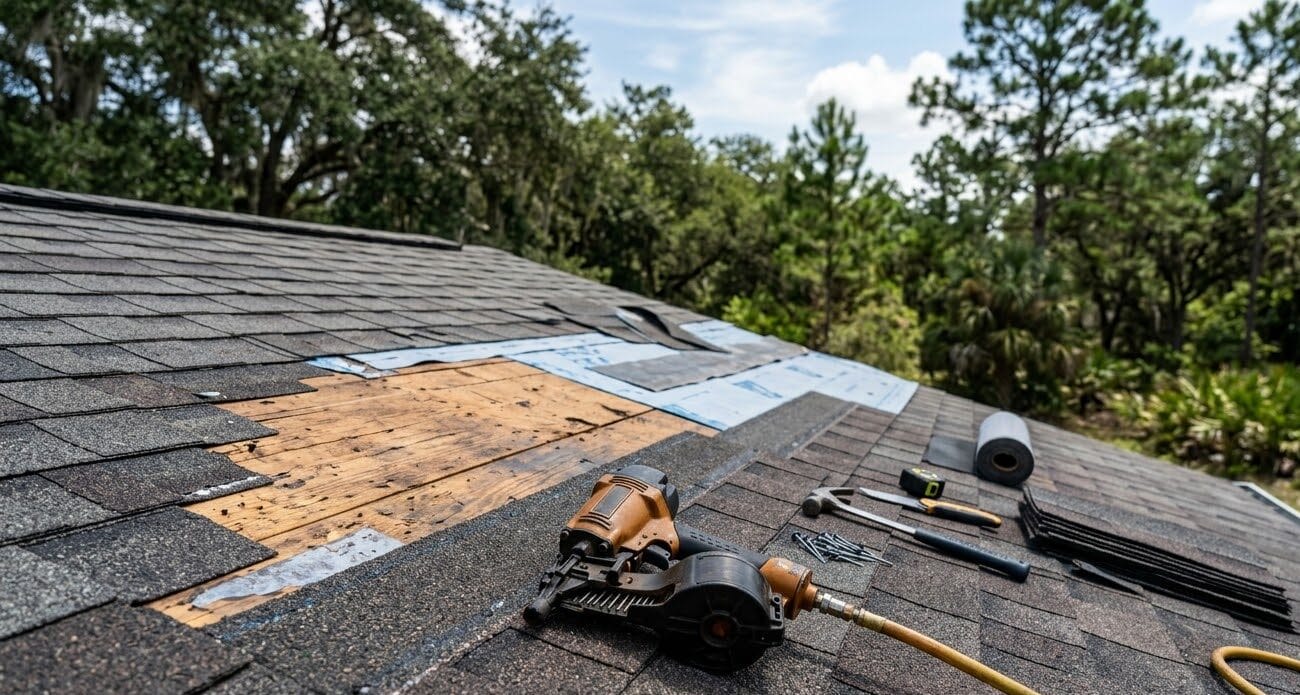
Pinellas allows you to apply for permits before receiving a county determination, provided you have repair estimate documentation showing costs below the 49 percent threshold. That is a useful accommodation and it is also a trap for anyone whose documentation is a verbal number from a contractor.
The sequence that protects a homeowner looks like this:
- Pull your structure value first. Get the FEMA letter for your parcel from the Pinellas County Property Appraiser, or commission an independent actual cash value appraisal. Multiply by your jurisdiction's threshold. That is your ceiling, and it is a hard number.
- Get written, itemized estimates for the entire project. Not the roof alone. Everything you intend to permit, including trades you have not hired yet, estimated honestly and including contractor overhead and profit.
- Add any work already permitted in the applicable lookback window, if your jurisdiction still has one, and any permit that is currently open.
- Compare the total to your ceiling. If you are inside it by a comfortable margin, proceed and keep the documentation. If you are within roughly 10 percent of the ceiling, stop and request a formal determination before signing anything.
- Request the determination in writing and keep the response. Pinellas County Building and Development Review Services can be reached at (727) 464-3888, permit questions go to buildingpermits@pinellas.gov, and substantial damage inspections are handled at sdinspection@pinellas.gov. If your address is inside a municipality, the equivalent office in that city is the one that governs.
That 10 percent buffer is not a rule anybody publishes. It is a working margin, because change orders are real, hidden rot behind a soffit is real, and a project that pencils at 47 percent on paper has a way of arriving at 51 percent by the time the last inspection passes.
The Paperwork a Roofer Should Hand You
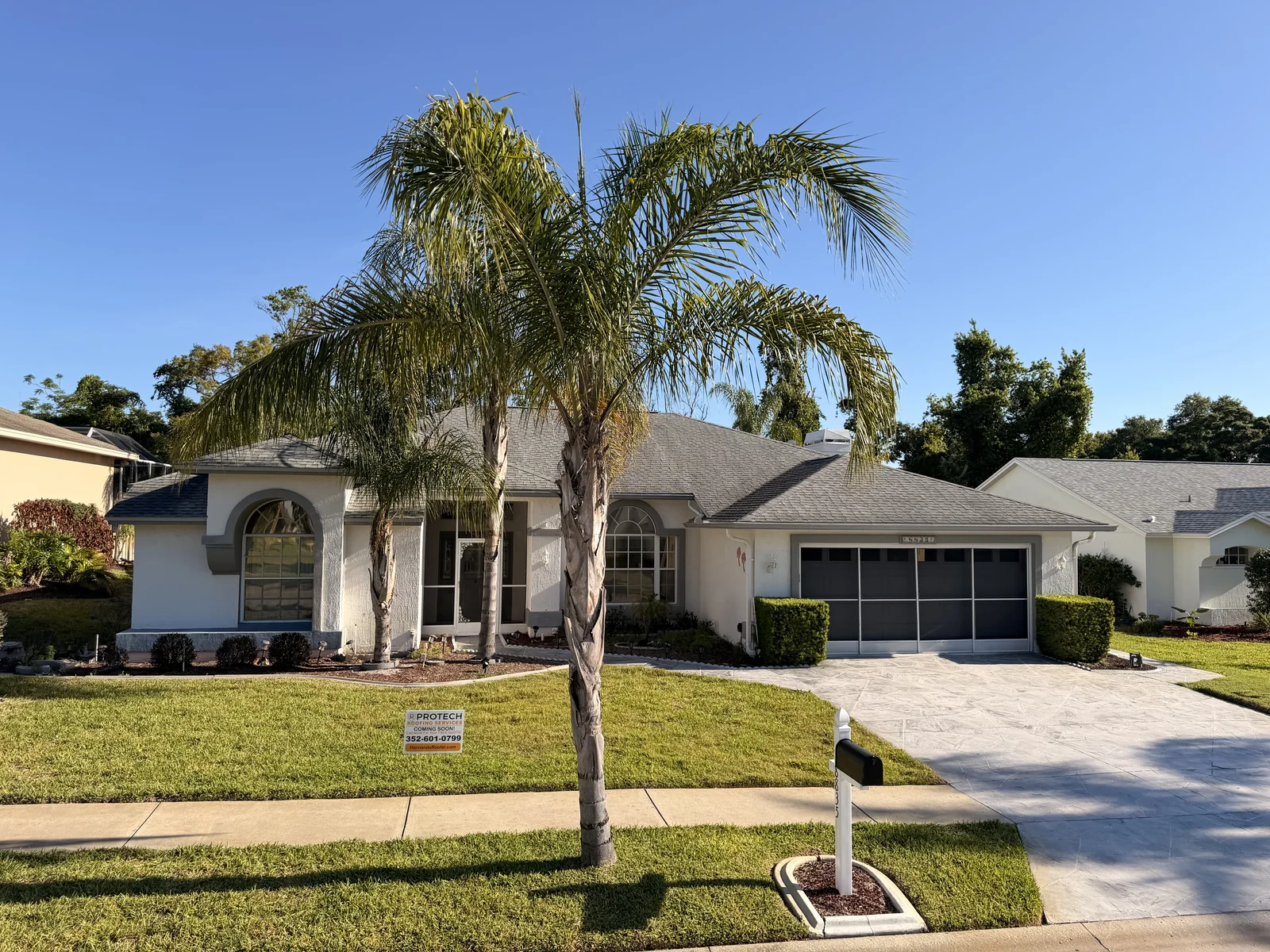
A roofing contractor is not your floodplain consultant, and any contractor who tells you with certainty that your project is fine without seeing your parcel value is guessing. What a competent contractor should give you, without being asked, is documentation good enough to survive the calculation:
- An itemized estimate that separates materials, labor, and overhead and profit, rather than a single lump number
- The permit application and the permit number, so the work has a traceable record and a close out date
- Product approval numbers for the roof system, which the permit requires and which also document that the work met code
- A written scope stating what is being replaced versus repaired, because that distinction shapes how the work is characterized
- A completion date and final inspection record, which is what proves a permit is closed rather than open
That last item is the one worth insisting on in a flood zone. An open permit is not a finished project in the eyes of a floodplain administrator, and open permits are what aggregate. A roof that was installed in March but never received a final inspection is still an open permit in September.
Our team works across Pinellas County, including Gulfport and Clearwater, and when a home is in a special flood hazard area we document scope this way as a matter of course. If a storm claim is also in play, our insurance claims assistance team coordinates the paperwork so that the claim file and the permit file tell the same story, and our guide to Florida roof insurance claims covers the claim side in more detail.
What This Means for a Pinellas Homeowner in 2026
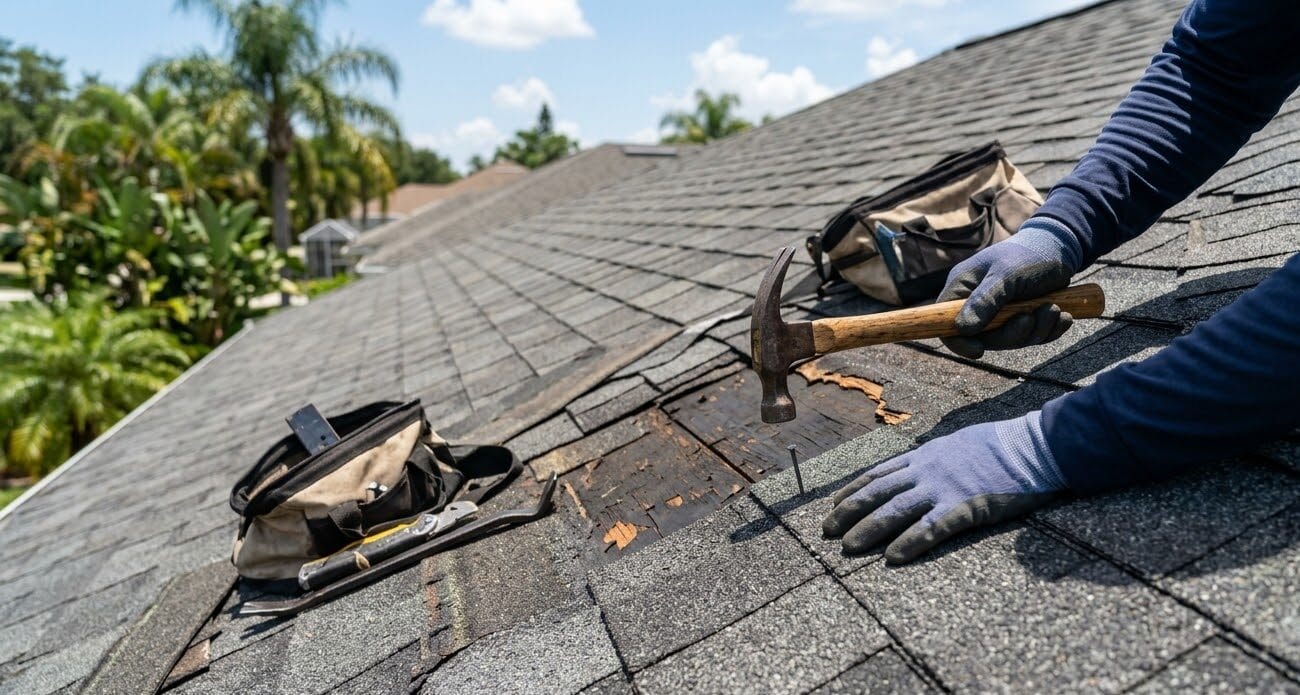
Strip the acronyms out and five things remain true.
The threshold in unincorporated Pinellas is 49 percent, and your municipality may use a different one, so confirm yours rather than trusting a national article. The percentage applies to the structure value without land, which on a waterfront parcel is far smaller than the property value. A re-roof by itself almost never trips the rule, but a re-roof stacked onto storm restoration frequently does. The lookback rules have moved repeatedly since 2021, and even where the cumulative lookback is gone, simultaneous permits and permits restoring one storm event still aggregate under NFIP minimums. And if you do cross the line, ICC pays up to $30,000 against an elevation that costs many multiples of that, and only if you obtained the determination letter.
None of this is a reason to defer a roof you need. A failing roof in a flood zone is a compounding problem, because water that gets in from above does the same damage to drywall and flooring that water from below does, and it does it without a flood claim attached. The point is to do the arithmetic once, in writing, before the first contract is signed. Call our team at (352) 605-0696 and we will put a real number on the roof so you can put it next to everything else.
FAQ
Frequently Asked Questions
Is the FEMA rule 50 percent or 49 percent in Pinellas County?
+
Does replacing my roof count toward the 50 percent rule?
+
What value is the percentage calculated against?
+
How far back does Pinellas look when adding up my permits?
+
What happens if my project exceeds the threshold?
+
Is the 25 percent roof rule the same thing?
+
Related Articles
More guides for Florida homeowners
Roofing Warranties in Florida: What Voids Them
A new Florida roof usually carries two warranties: one from the manufacturer for the product and one from the contractor for the installation. Here is what each covers, what quietly voids them and how to keep your coverage.
Read ArticleSolar Roofing in Florida: Solar Shingles vs Panels (2026)
Every solar system on a Florida roof is either bolted to the roof or is the roof. Here is how panels and solar shingles compare in 2026, what changed with the federal credit, and why the cheapest solar project often starts with a re-roof.
Read Article
The Villages Roof Rules: ARC Color and Material Guide
In The Villages, the Architectural Review Committee is not a courtesy step you handle after the permit. Sumter County lists ARC approval on its own re-roof submittal requirements, which means the deed restriction and the building department are wired together. Here is the packet, the calendar, and the order to do it in.
Read ArticleReady When You Are
Get your free roof inspection today.
No-pressure, written estimate. Same-week scheduling across Hernando County. Call us now or request a visit online.