Blog
Solar Roofing in Florida: Solar Shingles vs Panels and Why to Re-Roof Before You Go Solar
Call (352) 605-0696Every solar system on a Florida roof is either bolted to the roof or is the roof, and that makes solar a roofing decision before it is an energy decision. Panels are cheap per watt in Florida in 2026, solar shingles cost several times more and suit a narrow set of homes, and the 30 percent federal credit for homeowner-owned systems ended with 2025. The biggest money in the whole project is the question most solar quotes skip: whether your roof will outlast the array. Here is how panels and solar shingles compare, what Florida incentives remain, and why the cheapest solar project often starts with a re-roof.
Solar Roofing Is a Roofing Decision First and an Energy Decision Second
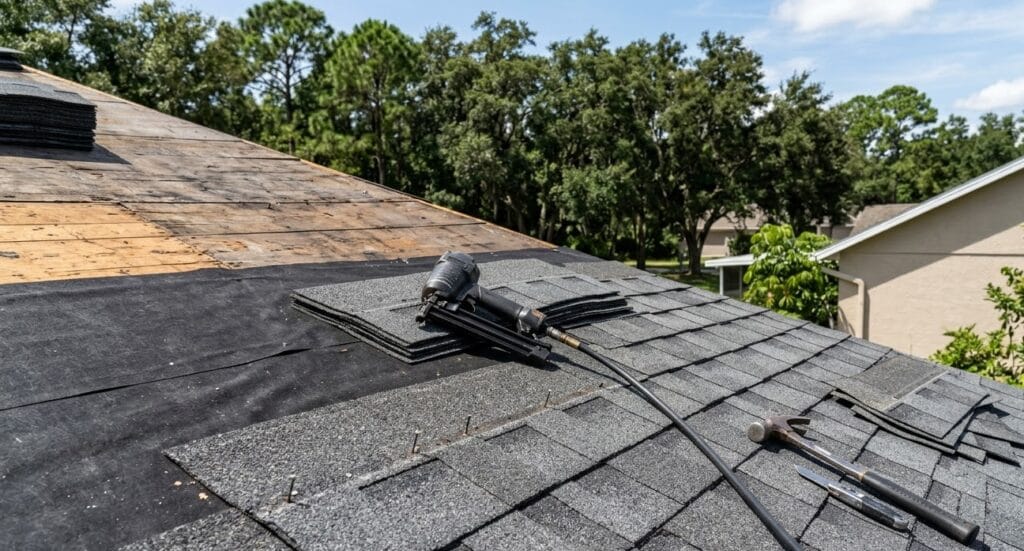
Most Florida homeowners start the solar conversation with a solar salesperson, and the salesperson starts with your electric bill. That is backwards for one simple reason: every solar system on a residential roof in Florida is either attached to the roof or is the roof. Whatever you decide about panels, shingles, batteries or financing, the thing under the array has to keep water out and stay attached in a hurricane for as long as the array is up there. That is 25 years or more for most panel warranties.
We are a roofing company, not a solar installer, so this guide is written from the side of the house that has to live under the equipment. It covers the two ways to put solar on a Florida roof, what each one costs in 2026, what changed on the federal tax side at the end of 2025, and the question that saves more money than any rebate: whether your current roof will outlast the system you are about to bolt onto it.
The short version, for people who want it up front. Solar panels on a sound roof are the lower-cost way to generate power in Florida by a wide margin. Solar shingles make sense in a narrow set of cases, mostly when you need a new roof anyway, you care a great deal about appearance, and you accept a higher cost per watt. And in almost every case, if your roof is more than about ten years into its life, the cheapest solar project is the one that starts with a re-roof.
Solar Panels vs Solar Shingles: How the Two Systems Actually Work
The words get blurred in marketing, so it helps to separate them by what they do to your roof.
- Rack-mounted solar panels sit on top of the roof. Aluminum rails are fastened through the roof covering into the rafters or the deck with engineered attachments, and the panels clamp to the rails a few inches above the surface. The roof underneath stays a complete roof. Every attachment point is a penetration that has to be flashed and sealed, and a typical residential array has dozens of them.
- Solar shingles are the roof covering in the area they cover. Products like GAF Timberline Solar are installed in courses, nailed down like conventional shingles and wired together under the surface. Tesla Solar Roof uses glass tiles, some active and some inactive, that replace the roof covering entirely. There are no rails and far fewer penetrations, but the solar product now has to do the roofing job too, including shedding water and resisting wind uplift.
- Hybrid and integrated systems sit in between. Some manufacturers offer in-roof mounting that replaces a section of shingles with a flashed pan and a low-profile panel. These are less common in our part of Florida, and service availability is the first question to ask about them.
That difference in what the product has to do drives almost every other difference: cost, repair, insurance, and who you call when something goes wrong fifteen years from now.
What Solar Roofing Costs in Florida in 2026

Here are the numbers we could verify for 2026, with the caveat that quotes vary with roof size, pitch, shading and electrical work.
| System | Typical 2026 cost | Notes |
|---|---|---|
| Rack-mounted solar panels | About $2.12 per watt installed, Florida average | EnergySage data for September 2026. A 14.51 kW system averaged $30,718 before incentives, with a range of roughly $26,110 to $35,326. Tampa averaged $2.05 per watt and Orlando $2.08. |
| Solar shingles (nailable, asphalt-style) | Commonly quoted at several times the per-watt cost of panels | Cost per watt depends heavily on how much of the roof is active. Whole-project quotes in 2026 guides land in the tens of thousands of dollars before incentives. |
| Glass solar tile roof | Typically the highest cost option | The price includes a full roof replacement. National 2026 guides put typical projects in the $50,000 to $75,000 range and up for an average home. |
| Detach and reset panels for a later re-roof | Commonly $200 to $400 per panel | This is the cost you avoid by re-roofing first. A 20-panel system often lands in the $5,500 to $8,500 range once disconnect, storage, reinstall and inspection are counted. |
Two things stand out. First, panels are cheap per watt in Florida right now, cheaper than the national average in most markets. Second, the detach and reset line is not a small number. If you install panels on a roof that needs replacing in six years, you have already agreed to pay that bill, on top of the roof itself.
Solar shingle pricing is also harder to pin down than panel pricing, because far fewer contractors install them and quotes are rarely published. When you compare a shingle quote with a panel quote, compare the cost per watt of generating capacity and, separately, what the roof portion would have cost as a conventional re-roof. That split is the only honest way to see what you are paying for the solar.
The 2026 Tax Credit Change Every Florida Homeowner Should Know
Many solar proposals in circulation still show a 30 percent federal tax credit. For homeowners who buy their own system, that credit is gone for new work. The One Big Beautiful Bill Act, signed July 4, 2025, ended the Section 25D Residential Clean Energy Credit for expenditures made after December 31, 2025. Under the IRS rules, the property also had to be installed by that date, so a system paid for in December 2025 but installed in 2026 does not qualify.
What remains is narrower. Homeowners who installed a qualifying system in 2025 or earlier can still carry forward unused credit. Third-party-owned systems, meaning leases and power purchase agreements, fall under different business-side federal provisions, which is why you are now seeing more lease offers in Florida. A lease can make sense, but read the roof clauses carefully: who pays for detach and reset if the roof needs work, and what happens to the agreement if you sell.
If a proposal you received in 2026 shows the 30 percent residential credit as a line item for a system you would own, ask the salesperson to rewrite the numbers without it. That single correction changes the payback math on most Florida systems by years.
Florida Incentives That Still Apply in 2026

The state-level picture is steadier than the federal one. These were in place for 2026:
- Net metering with investor-owned utilities. Florida Public Service Commission Rule 25-6.065 still governs net metering for Duke Energy Florida, Florida Power and Light and Tampa Electric. Excess power you export is credited on your bill at the retail rate, and no statewide phase-down was scheduled for 2026.
- Co-op and municipal utilities set their own policies. Much of Hernando and Pasco counties is served by Withlacoochee River Electric Cooperative rather than Duke. Cooperatives and municipal utilities are not bound by the PSC rule in the same way and set their own net metering terms under state law, so confirm your utility and its current policy before you size a system.
- Sales tax exemption. Solar energy equipment is exempt from Florida sales tax.
- Property tax exemption. The added value a residential solar system brings to your home is excluded from your property tax assessment.
- HOAs cannot ban solar. Section 163.04 of the Florida Statutes prevents homeowners associations from prohibiting solar collectors. An HOA can have a say on placement within limits, but the statute protects your right to install. In deed-restricted communities, that still means submitting the paperwork.
Why You Should Re-Roof Before Going Solar in Florida
This is the part of the conversation that belongs to a roofer, and it is where most of the money is. An asphalt shingle roof in Florida heat, UV and storm exposure commonly lasts well short of the 25 to 30 years of a typical panel warranty. We explain the real-world numbers in our guide to how long a roof lasts in Florida heat and hurricanes. If your shingles are already ten or twelve years old, an array installed today will very likely outlive the roof under it.
When that happens, you pay twice. First for the detach and reset of the whole array so the roof can be replaced, and second in lost production for the weeks the system is down. Some installers will not warranty their penetrations after another contractor has worked around them, so you can also lose coverage on the attachments.
The alternative is to replace the roof first and install solar on a new roof with a warranty that runs close to the life of the array. The roof work and the solar work can be coordinated so the attachment layout is planned before the new roof goes down, and the installer can flash into fresh material instead of old. If you are weighing the cost, our full roof replacement service page explains how we scope and price a re-roof, and the 2026 Florida roof replacement cost guide has the current ranges by material.
Here is a practical rule we use with homeowners. If the roof has less than about 15 years of realistic life left, re-roof first. If it is under five years old and was installed correctly, solar can go on it now. In between, get a professional roof inspection before you sign the solar contract, not after.
Which Roof Types Work Best Under Solar Panels in Florida
Not every roofing material is equally good as a base for a 25-year array. Here is how the common Florida roof types compare from the attachment side.
| Roof type | Solar compatibility | What to watch |
|---|---|---|
| Architectural asphalt shingle | Good, and the most common base for panels | Service life in Florida is often shorter than the array. Use flashed attachments, not sealant-only mounts. |
| Standing seam metal | Excellent | Panels clamp to the seams with no roof penetrations at all. Long service life matches the array well. |
| Exposed fastener metal | Good with the right hardware | Attachments fasten through the ribs and must be sealed with purpose-made brackets. |
| Concrete or clay tile | Possible, but more labor | Tiles are removed or cut to reach the deck, and broken tile is common. Replacement tile availability matters for older roofs. |
| Low-slope and flat roofs | Possible with ballasted or attached racking | Drainage around the array and membrane protection under the racking need planning. |
Standing seam metal deserves special mention for Florida homeowners planning solar. Because panels attach with clamps that grip the seams, the array adds no holes in the roof, and a quality metal roof is built for a service life in the same range as the panels. If you are replacing your roof and solar is in your future, a standing seam metal roof system is worth pricing alongside shingles.
Wind, Code and Insurance: The Florida-Specific Part
Florida is not a normal solar market, because the roof has to survive wind loads that most of the country never sees. A rooftop array adds uplift forces to the roof structure, and the attachments have to be engineered for your wind zone and exposure. That is why solar permits in Florida include structural review, and why the attachment spacing on a Florida plan set is often tighter than the manufacturer default.
The Florida Building Code is also about to change. The 9th Edition takes effect December 31, 2026, so roof and solar work permitted near that date should be checked for which edition applies. Ask your contractor which edition your permit falls under.
Insurance is the other Florida variable. Insurers look hard at roof age and condition, and a new roof can help with coverage and premiums in ways a 12-year-old roof with an array on top cannot. Wind mitigation credits depend on how the roof deck and roof-to-wall connections were built and documented. Before you schedule solar, call your agent and ask two questions: how the array changes your coverage, and whether a roof replacement first would change your premium or eligibility.
Solar Shingles in Florida: When They Make Sense and When They Do Not

Solar shingles have a real place, but it is smaller than the marketing suggests.
- They make sense when you need a new roof anyway. Because the product is the roof covering, part of the cost replaces money you would have spent on conventional shingles. Comparing a solar shingle quote against panels alone is misleading. Compare it against a new roof plus panels.
- They make sense when appearance is the top priority. In some deed-restricted communities, and on homes where the owner simply does not want visible racking, a low-profile roof-integrated system is the only option they will accept.
- They make less sense when the roof is new. Tearing off a sound roof to install a solar roof is expensive in a way that rarely pays back.
- Service and supply are a real risk. The solar shingle market is small and has been volatile. GAF Energy closed its San Jose manufacturing and R&D site in late 2025, laying off 138 workers, and consolidated production at its Texas plant. The product continues, but the episode is a reminder to ask who will service the roof, and where replacement parts come from, in year 12.
One more practical point. When a panel on a rack fails, a solar technician unclips it and replaces it. When a solar shingle fails, the repair is part roofing and part electrical, on a roof where every active piece is wired to its neighbors. Ask any solar shingle installer to explain, in writing, who handles leak repairs and who handles electrical faults, and whether one call covers both.
A Step-by-Step Plan for Solar on a Florida Roof
The order matters more than the brand. This is the sequence that keeps you from paying for the same roof twice.
- Step 1: Get the roof inspected. Before any solar quote, find out how much life the roof actually has, including the deck, flashing and ventilation. Attic ventilation also affects shingle life under an array, which is part of any honest roof inspection.
- Step 2: Decide on the roof first. If the roof has less than 15 years left, schedule the replacement and choose a material that suits solar, ideally with the attachment plan in mind.
- Step 3: Get solar quotes that reflect 2026 rules. No residential 25D credit for new owned systems, net metering terms from your actual utility, and structural design for your wind zone.
- Step 4: Coordinate the attachment plan. The roofer and the solar installer should agree on flashing method, attachment count and who warranties the penetrations before work starts.
- Step 5: Document everything. Keep the roof permit, the solar permit, attachment specifications and both warranties in one file. Insurers and future buyers will ask for them.
Talk to a Roofer Before You Sign a Solar Contract

Protech Roofing works across Hernando, Pasco, Citrus, Marion, Polk, Pinellas and Hillsborough counties, and more of our re-roof calls every year start with a homeowner who has a solar proposal in hand. We do not sell solar. We tell you how much life your roof has, whether it should be replaced before panels go on, and what the right roof is for an array that will be up there for decades.
Call (352) 605-0696 or get in touch to schedule an inspection. Homeowners planning solar in Spring Hill and Brooksville can usually be seen the same week, and we will put the roof side of the math in writing so you can compare solar offers with real numbers.
FAQ
Frequently Asked Questions
Are solar shingles better than solar panels in Florida?
+
Is there still a federal solar tax credit in 2026?
+
Should I replace my roof before installing solar panels?
+
Does Florida still have net metering?
+
Can my HOA stop me from installing solar in Florida?
+
What is the best roof type to put solar panels on?
+
Related Articles
More guides for Florida homeowners
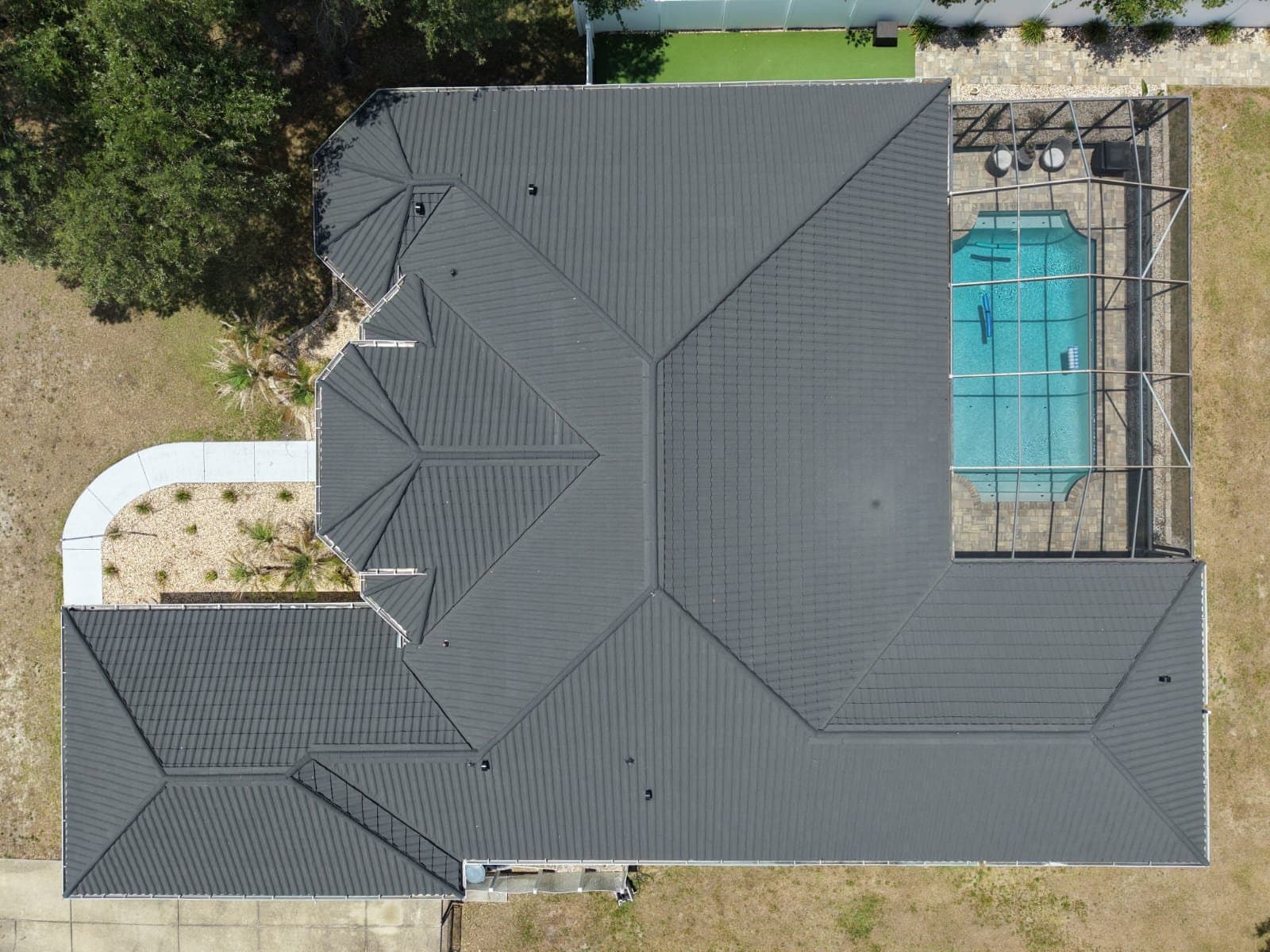
Metal Roof Cost in Florida 2026: Per-Sqft Guide
Metal roofs in Florida run about $8 to $23 per square foot installed, depending on the system. Here is what standing seam, stone coated steel and exposed fastener panels cost, what a typical home pays and how to compare quotes.
Read ArticleRoofing Warranties in Florida: What Voids Them
A new Florida roof usually carries two warranties: one from the manufacturer for the product and one from the contractor for the installation. Here is what each covers, what quietly voids them and how to keep your coverage.
Read Article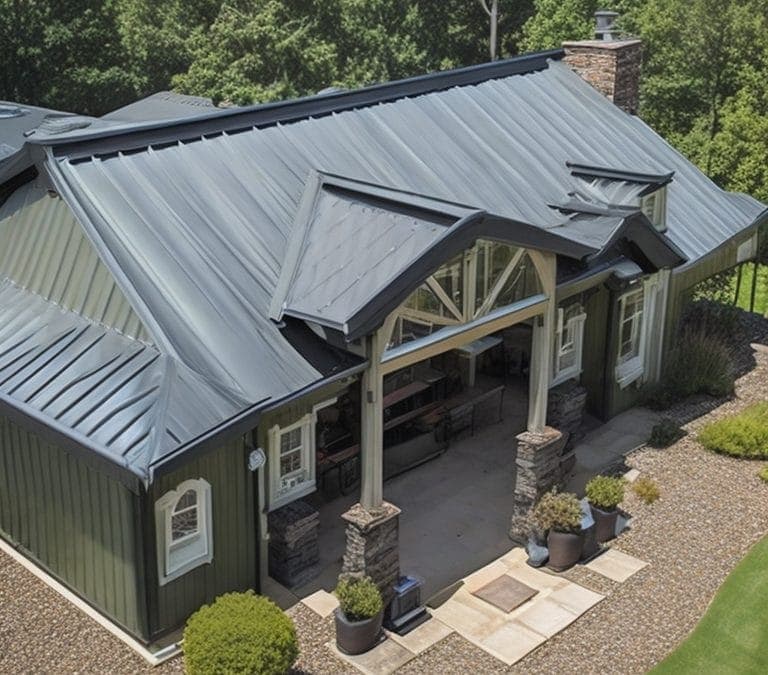
Best Roof Color for Florida Heat: Cool Roofs Explained
Florida test homes show a white shingle saves only 3 to 5 percent on cooling while reflective white metal or tile saves 18 to 26 percent. Here is how to choose a roof color that actually keeps your attic cooler.
Read ArticleReady When You Are
Get your free roof inspection today.
No-pressure, written estimate. Same-week scheduling across Hernando County. Call us now or request a visit online.