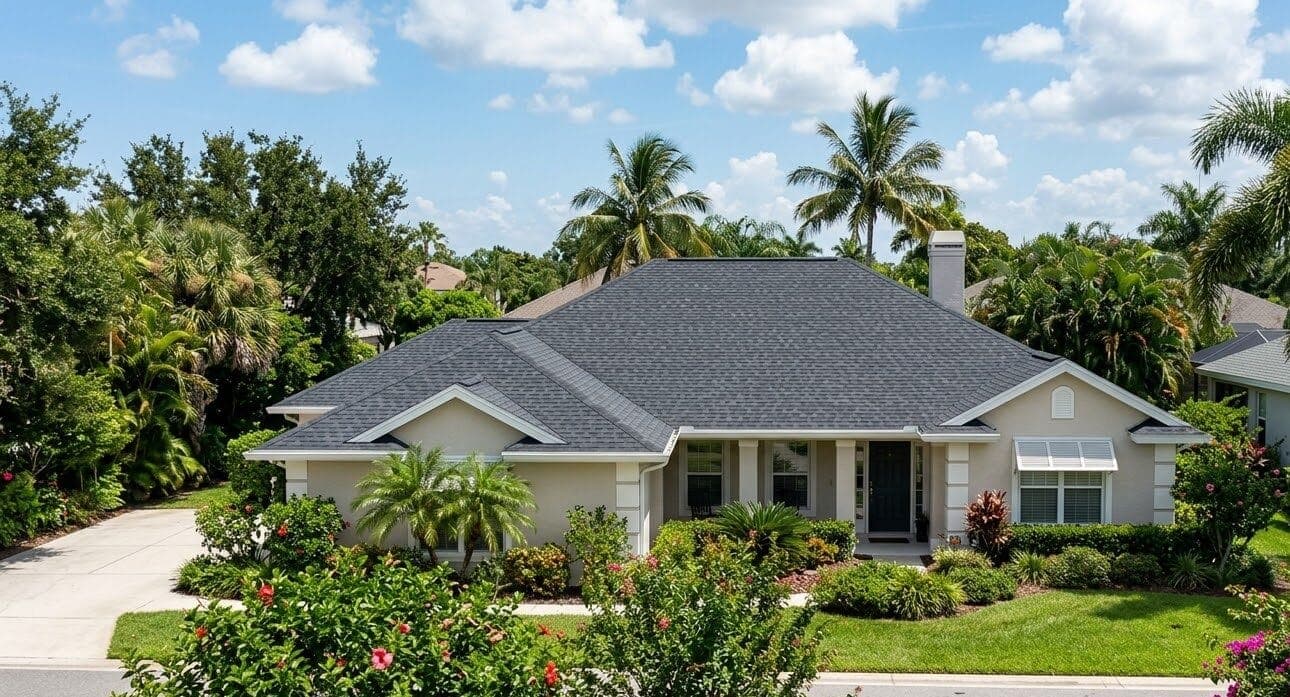
Citrus County, FL
Roofing in Lecanto, FL
Roofing contractor serving Lecanto, FL. Repair, replacement, inspection, storm damage, and Citrus County permits handled by us. Call (352) 605-0696.
Call (352) 605-0696The Permit for a Lecanto Roof Comes From Citrus County
Lecanto is in Citrus County, and that single fact changes more about a roofing project than most homeowners expect. Building departments in Florida run at the county level, with their own paperwork, their own inspection sequence, and their own local habits. A roofer who works mostly in Hernando or Marion County is not automatically fluent in how Citrus County handles a reroof. We work across Hernando, Citrus, Pasco, Sumter, Polk, Hillsborough, and Pinellas counties, and we treat each building department as its own process instead of assuming one set of habits covers all of them.
Here is the part that catches people this year. On July 1, 2026, Florida began exempting many residential projects valued under $7,500 from the permit requirement under HB 803. Roofing is not one of them. Roof replacement still requires a permit under the Florida Building Code regardless of how small the dollar value of the job is. If a contractor tells you your reroof is cheap enough to skip the permit, that is not a shortcut. It is unpermitted work that stays attached to the house, and it tends to surface at the worst possible moment, usually during a sale or an insurance claim.
Citrus County also has a document that surprises out of area contractors: a notarized reroofing affidavit. The county requires it to release the reroof permit, and it can only be signed after the sheathing inspection, the fastener inspection, and the covering inspection have taken place. That order is not negotiable and it cannot be filled in at the end from memory. It means the inspections have to be called while the roof is open, at the right stages, which is a scheduling discipline rather than a paperwork detail. A crew that tears off on Monday and dries in by Tuesday without calling the county has created a problem that costs real money to unwind.
We pull the permit and we carry the inspections through to final. That is part of the job, not something we hand back to you with the county's phone number. You should not be chasing an inspector for your own roof.
One more local requirement worth knowing: contractors working in Citrus County have to be licensed under Chapter 489 of the Florida Statutes, as required by the county Code of Ordinances, Chapter 18, Article II. When you ask a roofer for a license number, you are not being difficult. You are asking the one question that determines whether the county will let the work be permitted at all.
What Lecanto Weather Actually Does to a Roof
Lecanto sits inland, between the Gulf coast communities and the middle of the peninsula, and that position shapes the wear pattern we see. Three separate forces work on a roof here, and they fail roofs in different ways.
Daily summer storms
Florida's rainy season runs roughly June through September, driven by sea breezes off the Gulf and the Atlantic colliding over the peninsula in the afternoon. The practical result is a storm nearly every day for months, often heavy, often with wind behind it. Rain arriving that frequently finds every weakness you have. A flashing detail that lets in a cup of water per storm lets it in a hundred times in a season, and the damage shows up in the decking, the insulation, and the ceiling long before anything looks wrong from the driveway. Most of the leaks we chase in late summer were not created in late summer. They were created in April and watered every afternoon since.
Lightning
Central Florida is the most lightning prone region in the United States, and the state averages roughly 1.2 million cloud to ground strikes per year. Homeowners think of lightning as a fire risk, which it is. It matters for roofing in a quieter way too: the same convective storms that produce the strikes produce the downbursts that lift shingle tabs, crack tile, and throw branches onto roof planes that were perfectly sound that morning.
Hurricane season
The Atlantic hurricane season runs June 1 through November 30, with peak activity from mid August through the end of October. Citrus County has recent, documented experience with it. In 2024 the county was struck by Hurricane Debby, a category 1 storm that made landfall near Steinhatchee on August 5, and then by Hurricane Helene on September 27, which produced the largest storm surge ever recorded in the county over at Crystal River. Lecanto is inland, so surge is not the local story here. Wind, wind driven rain, and flying debris are.
What that adds up to is a calendar. The right time to deal with a marginal roof in Lecanto is spring, not September. An inspection before peak season costs you an appointment. The same roof failing in October costs you the interior of the house, and it does it at the exact moment every roofer in the county is booked.
Every Roofing Service We Bring to Lecanto
Protech is not a shingle only shop or a repair only shop. The full service line runs from a single cracked tile to a complete commercial membrane system, and every one of these is available at a Lecanto address.
Roof repair and replacement
- Roof repair for isolated damage, failed flashing, and wind lifted sections
- Total roof replacement when the system has reached the end of its service life
- Shingle roof installation
- Tile roof repairs
- Metal roofing systems
- Stone coated steel tile
Water, leaks, and storms
- Leak detection and repair
- Emergency roof repair for active intrusion and storm openings
- Storm damage restoration
- Roof coating
Inspection, maintenance, and drainage
- Roof inspection
- Regular roof maintenance
- Gutter installation
- Gutter cleaning
- Gutter protection systems
Insurance and state programs
Commercial and larger buildings
- Commercial roofing
- Commercial flat roofing, including TPO and PVC membrane systems
- Multi-family roofing
- New construction roofing
If you are not sure which category your problem falls into, that is normal and it is not your job to know. A stain on a ceiling can be a ten minute flashing repair or the visible end of a decking problem that has been growing for two years. The inspection is what tells the two apart.
Repair or Replace: How the Decision Actually Gets Made
Homeowners usually want a rule of thumb, and there is not an honest one. What there is instead is a short list of things we look at, and any one of them can move the answer.
Where the water is getting in. Roofs rarely fail across the field. They fail at transitions: valleys, penetrations for plumbing vents and exhaust, chimney and wall flashing, and the edges. A roof with a sound field and a bad set of penetration details is a repair. A roof losing granules across whole planes is not.
The condition of the decking. This is the one that changes scope after the job starts, and any roofer who tells you otherwise has not opened many roofs. Decking damage is invisible until tear off. Years of small leaks under a failing flashing detail will soften plywood in a way nothing on the surface reveals. We inspect the deck once it is exposed, and in Citrus County that inspection is part of the permitted sequence anyway.
The underlayment and the fasteners. The covering gets all the attention and the underlayment does a great deal of the actual work. A roof whose surface looks tired but whose underlayment and fastening are intact is a different project from one where the secondary layer has gone brittle.
Ventilation. An attic that cannot breathe cooks the underside of the roof and shortens the life of everything above it. Replacing a covering without fixing the ventilation that killed the last one is how a homeowner buys the same roof twice.
Your insurance situation. This is not a technical factor, but it is a real one. If your carrier is already asking questions about roof age, a series of repairs may not keep the policy in force, and the money is better spent once. We cover that in the next section.
Our inspection evaluates the condition of the shingles or tiles, the integrity of the underlayment, the condition of the flashing at every penetration point, the health of the decking, and the effectiveness of the ventilation system. When we are hunting a leak rather than assessing a whole roof, we use thermal imaging to find suspect areas, press a moisture meter against decking, insulation, and framing for actual readings, and run controlled water testing in a systematic pattern while a second technician watches the attic from inside. We save those images as part of your permanent inspection record, which matters more than people expect the first time a carrier asks for documentation.
Deed Restricted Communities and HOA Approval in Lecanto
Lecanto has gated and deed restricted communities run by homeowner associations. Black Diamond Ranch, with its Tom Fazio golf courses and guarded entrance, and the villages of Citrus Hills are the two best known. If your address sits inside one of them, the association oversees exterior standards and the maintenance of the homes, which means your roof is not purely your decision. If it does not, the only approval that matters is the county's. It is worth settling that question early, because the answer changes the timeline of the project far more than it changes the work on the roof.
In practice this affects three things.
Material. An association may restrict what you can install. A community built around tile will often have language about keeping tile, or about approved profiles if you want to move to stone coated steel, which reads as tile from the street while behaving like metal in a windstorm. That is frequently the compromise that satisfies both the architectural committee and the homeowner who is tired of cracked tile.
Color. Approved color palettes are common and they are enforced. Ordering a covering before approval is the single most expensive mistake in an HOA community, because special order roofing material is not a returnable item.
Timing and access. Gated communities have their own rules about contractor access, dumpster placement, work hours, and staging. None of it is difficult, all of it needs to be arranged before the trucks arrive rather than at the gate on the first morning.
We will supply the product data, the color samples, and the manufacturer documentation an architectural review committee asks for, and we will wait for the approval before anything is ordered. If your association requires a submittal package, tell us at the inspection and we will build the estimate around that timeline rather than around ours.
Insurance, the 15 Year Roof Rule, and Wind Mitigation Credits
Roofing and homeowners insurance are tangled together in Florida in a way they are not in most states, and Lecanto homeowners feel it directly. Lecanto skews older, with a median age of 52 as of the 2020 Census and a population that has grown from 5,882 in 2010 to 6,301 in 2020. Many of those are long term owners in homes they have held for years, which means roofs that have crossed insurance thresholds while the owner was thinking about other things.
The 15 year rule
Under Florida Statute 627.7011, an insurer cannot refuse to issue or refuse to renew a homeowners policy solely because the roof is less than 15 years old. Once a roof passes 15 years, the owner can have it inspected and submit a report showing at least five years of remaining useful life to keep coverage in place. Since HB 1611 took effect in July 2024, licensed roofing contractors can serve as authorized inspectors for that report. If your carrier has sent you a letter about roof age, the inspection is the response, and it is frequently a cheaper response than a replacement you did not need yet.
Wind mitigation credits
Florida Statute 627.0629(1) requires every residential insurer to give a windstorm premium discount based on a standardized wind mitigation inspection, documented on the official OIR-B1-1802 form. That inspection looks at roof shape, roof deck attachment, roof to wall connections, and the secondary water barrier. Those are roofing features, which is why a new roof built to current code standards typically qualifies for the highest available credits. After we complete a replacement we recommend scheduling the wind mitigation inspection right away rather than waiting for the next renewal, because the credit only applies once someone documents it.
Storm damage claims
When the damage comes from a storm, the documentation created in the first days is what the claim rests on. Protech provides the storm damage inspection at no charge, and many of our customers ask us to be present when the adjuster comes out. When we meet the adjuster at your property, we walk through every area of concern documented in our inspection report so nothing gets missed. We check shingles for wind lift and hail bruising, examine flashing around penetrations and valleys, assess soffit and fascia for wind damage, and look for signs of water intrusion in the attic. Full details are on our insurance claims assistance page.
My Safe Florida Home Grants for Lecanto Homeowners
The My Safe Florida Home program offers a free wind mitigation inspection and a grant of up to $10,000 toward eligible hardening improvements. The roofing related improvements it covers are the ones that matter most in a wind event: roof to wall attachment, roof deck attachment, and secondary water resistance. Moderate income households contribute a match; low income households can receive the full grant amount.
Eligibility is specific, and it is worth checking before you get attached to the idea. The home has to be a single family, site built residence, occupied by the owner, with a homestead exemption. Manufactured housing does not qualify under those terms, and neither does a property you rent out.
For a Lecanto owner already looking at roof work, the sequence matters. Secondary water resistance, for example, is applied to the deck during a reroof. It is straightforward while the covering is off and effectively impossible afterward without redoing the job. If you think you may qualify, tell us before we schedule, not after. Our My Safe Florida Home page walks through the eligibility criteria in full.
The broader point holds even if you do not qualify: the parts of a roof that decide whether it survives a hurricane are mostly invisible once the job is done. Nobody admires your roof to wall straps. They are still the reason the roof is there in November.
What Working With Protech Looks Like, Start to Finish
The process is deliberately boring, because a roofing project that surprises you is a roofing project that went wrong somewhere.
The inspection. We come out, we go on the roof, and we look in the attic if it is accessible, checking for daylight penetration, staining on the decking, and moisture in the insulation. You get a real assessment of condition, not a sales pitch delivered from the driveway.
The proposal. We put it in writing and we break out the components, so you can see what you are paying for rather than one number at the bottom of a page. If the scope has a known unknown in it, such as decking that cannot be evaluated until tear off, we say so up front instead of discovering it in front of you on day two.
The permit. We pull it from Citrus County. This is ours, not yours.
The work. Tear off, deck evaluation and any repairs, underlayment, flashing details, covering, and cleanup. The inspections get called at the stages the county requires, in order, while the roof is at the stage each inspection is supposed to see.
The close out. The reroof affidavit gets notarized after the sheathing, fastener, and covering inspections. The final inspection gets scheduled and carried through to closure. You end up with a closed permit and warranty documentation in hand, which is the paperwork that proves the work was done correctly when you sell the house or file a claim.
After. If you want the roof to reach its service life, the maintenance is not complicated: keep the gutters clear through the rainy season, get an inspection after any significant storm, and do not wait on small flashing issues. Our regular maintenance and gutter cleaning services exist for exactly this, and given that Lecanto gets a storm most afternoons from June to September, gutter capacity is not a cosmetic issue here.
Serving Lecanto and the Rest of Citrus County
Protech Roofing Services works Lecanto from our headquarters at 9035 Jayson Dr, Brooksville, FL 34613. We are rated 4.9 on Google, and our service area covers Hernando, Citrus, Pasco, Sumter, Polk, Hillsborough, and Pinellas counties. Citrus County is not an occasional trip for us. It is a county we hold licensing for and whose building division process we run regularly.
If your address is elsewhere in the county, we have pages for our neighbors as well: Inverness on the east side and Crystal River on the coast. The county rules are the same in all three. The exposure is not, which is why we write about each one separately.
With the median owner occupied home in Lecanto valued around $316,900 according to Census estimates, a roof is one of the larger single decisions attached to the property. It is worth getting a real assessment before you decide anything. Call (352) 605-0696 to schedule a roof inspection in Lecanto, or to have us look at a leak that has already started.
Roofing By Area
Roofing services near Roofing in Lecanto
FAQ
Frequently Asked Questions
Do you serve Lecanto, FL?
+
Who issues the roofing permit for a home in Lecanto?
+
Florida exempted small residential jobs from permits. Does that apply to my roof?
+
I live in Black Diamond Ranch. Do I need HOA approval before reroofing?
+
My insurance company says my roof is too old. What are my options?
+
From the Blog
Stay informed about roofing in Florida.

Florida Tile Roof Problems: Repair vs Re-Roof (2026)
Tile lasts for decades, the underlayment under it does not. Here are the tile roof problems Florida homeowners see most, what each repair costs in 2026, and how to tell when a repair is enough and when it is time to re-roof.
Read Article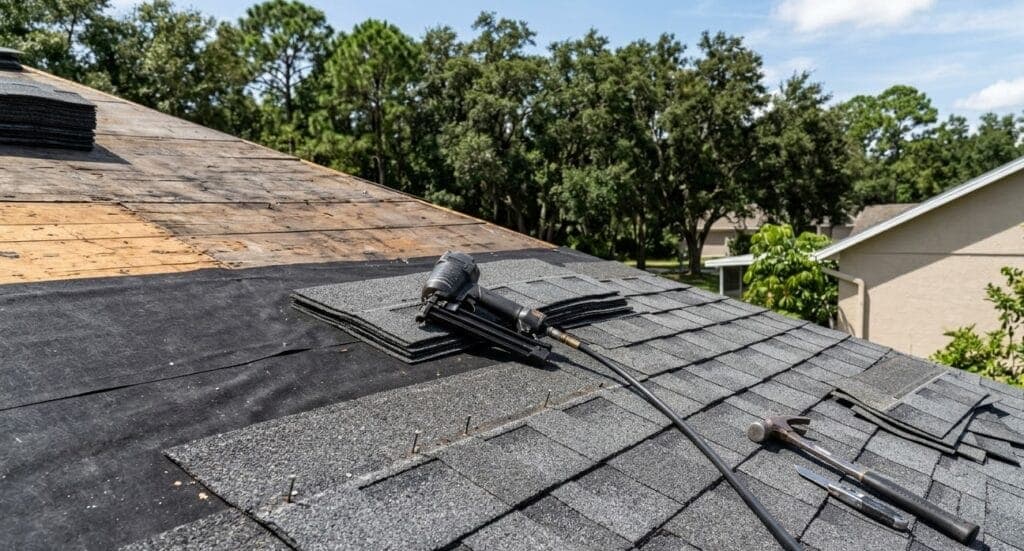
Solar Roofing in Florida: Solar Shingles vs Panels (2026)
Every solar system on a Florida roof is either bolted to the roof or is the roof. Here is how panels and solar shingles compare in 2026, what changed with the federal credit, and why the cheapest solar project often starts with a re-roof.
Read Article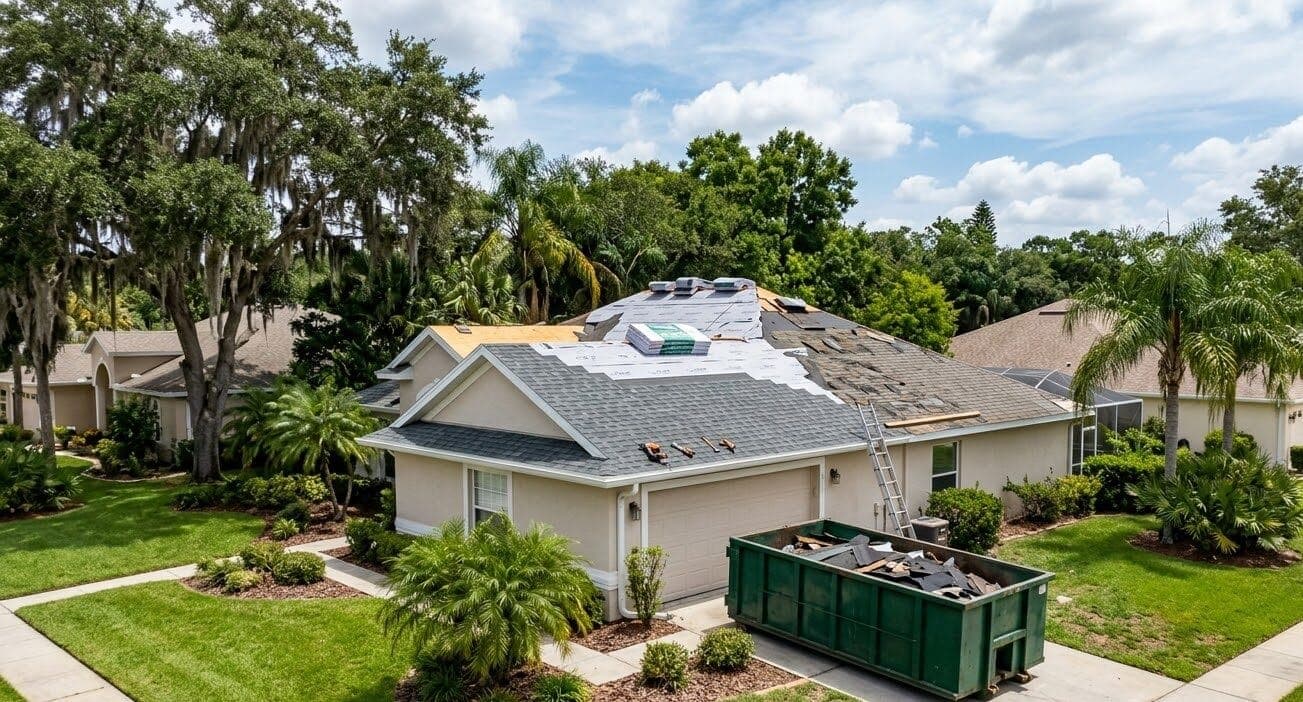
Chimney Flashing Leaks in Florida: Find the Real Cause
Roofs do not leak in the field, they leak at the terminations, and the chimney is the hardest termination on the roof. Here is what Florida code requires, the five failures behind almost every chimney leak, and what a correct reflash costs in 2026.
Read ArticleReady When You Are
Get your free roof inspection today.
No-pressure, written estimate. Same-week scheduling across Hernando County. Call us now or request a visit online.