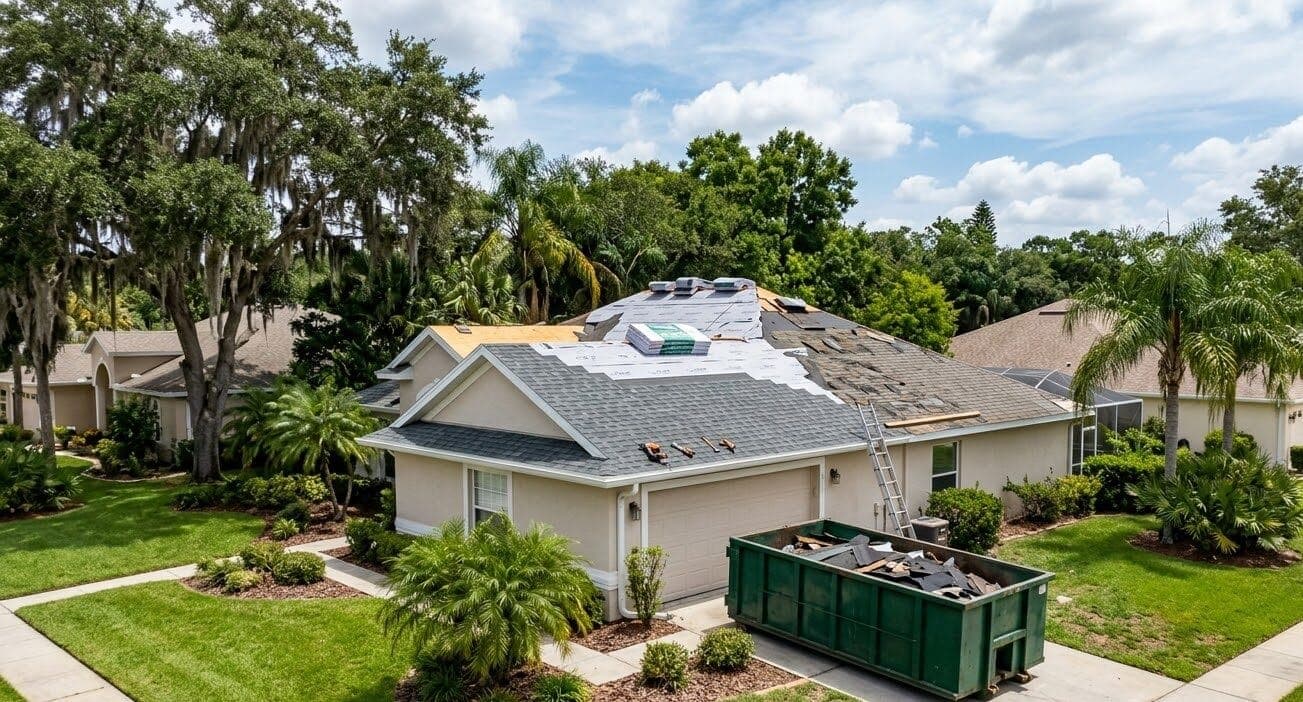
Roofs almost never fail in the middle of a slope. They fail where the slope stops, and the chimney is the hardest stop on the roof: a rectangular box sitting in the water's path, needing two independent metal systems that have to work as one lap, not one seal. Florida makes it harder. Wind-driven rain arrives sideways, ultraviolet eats sealant on a short clock, and most chimneys here are stucco-clad framed chases that hide their flashing behind a finish. Here is what the code actually requires, including the 30-inch cricket rule most wide chimneys were built to violate, the five failures behind nearly every chimney leak we are called to, how to tell a chimney leak from an impostor before you pay for the wrong repair, and what correct work costs in 2026.
Roofs Do Not Leak Where They Are Flat. They Leak Where They Stop.
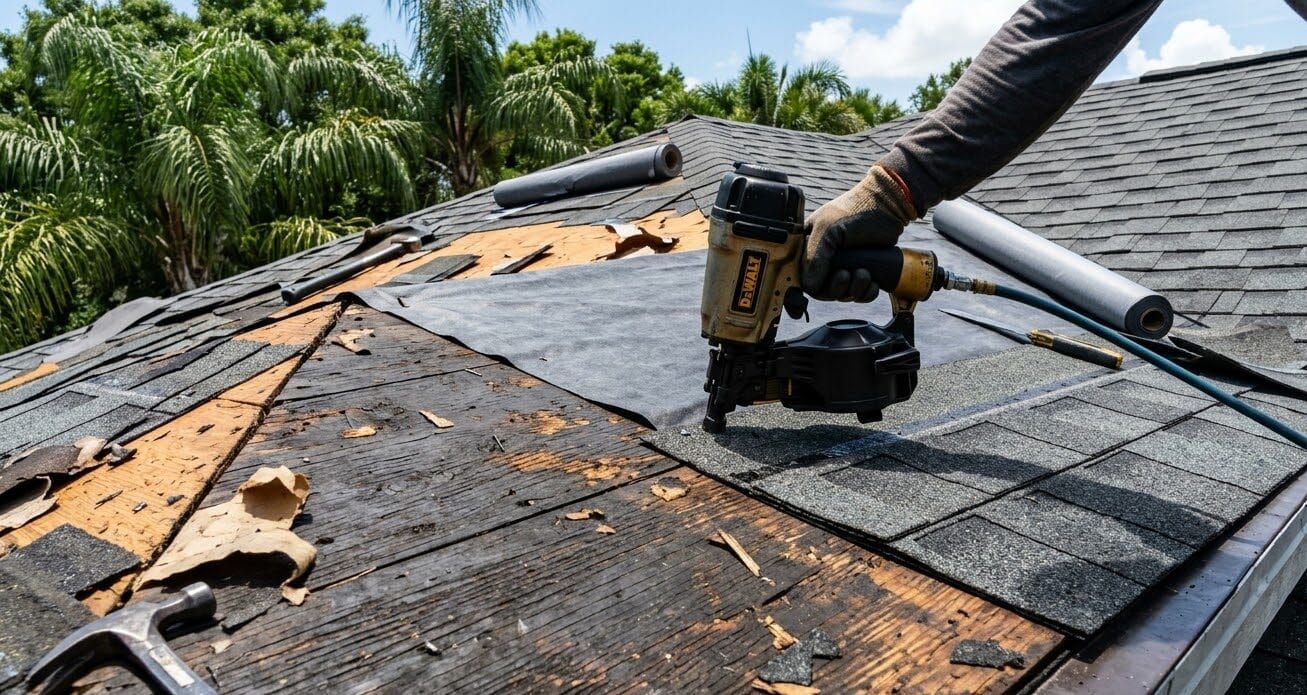
A shingle roof in the middle of a slope is a simple machine. Water lands on it, gravity pulls it down, each course laps the one below, and nothing has to be clever. Every leak we chase on a Florida home starts where that simple machine runs into something: a wall, a pipe, a skylight, a valley, or a chimney. The field of the roof almost never fails first. The terminations do.
The chimney is the hardest of those terminations, and it is not close. A vent pipe is round and gets one boot. A skylight comes from the factory with a flashing kit engineered for it. A chimney is a rectangular masonry or framed box sitting in the middle of a slope, which means water arrives at it from the uphill side and has to be steered around four different geometries, with two independent metal systems that have to work as one. Get any part of that sequence wrong and the leak shows up years later, on the ceiling, four feet from where the water actually got in.
Florida has fewer chimneys than the roofs we photograph in trade magazines up north, but the ones it has are frequently the worst-detailed opening on the house. They are often stucco-clad framed chases rather than solid masonry, they were often flashed once by whoever was cheapest, and they sit on roofs that take wind-driven rain sideways for six months a year. This is the field guide: what code actually requires, the five ways the detail fails here, how to tell a chimney leak from something pretending to be one, and what a correct repair costs in 2026.
Step Flashing and Counterflashing: Two Systems, One Job
Almost every bad conversation about chimney leaks starts with the two words being used interchangeably. They are two separate pieces of metal that do two separate jobs, and a chimney needs both.
- Step flashing is the roof's piece. It is a set of L-shaped metal pieces, one per shingle course, woven into the shingles as they go up the side of the chimney. Each piece turns up the chimney wall and out onto the roof, and each one is lapped by the shingle course above it. It is not one long strip. A single continuous piece of metal running up the side of a chimney on a shingle roof is a defect, not a shortcut, because there is no way to lap it correctly with the courses.
- Counterflashing is the chimney's piece. It is the metal that comes out of the chimney wall itself and laps down over the vertical leg of the step flashing. On masonry, that means a reglet cut into the mortar joint, with the counterflashing set into the cut and sealed. On a framed and stucco-clad chase, it means metal integrated behind the weather barrier before the stucco goes on.
- Neither one is watertight by itself, and that is the point. Step flashing catches water running down the roof. Counterflashing catches water running down the face of the chimney and drops it onto the step flashing. The joint between them is a lap, not a seal. Water is supposed to get behind the counterflashing and be delivered back out on top of the step flashing. A system designed around laps survives movement. A system designed around sealant does not.
This is why the surface-mount counterflashing you see nailed to the face of a chimney and caulked along its top edge is a countdown, not a repair. It is a horizontal joint, exposed to sun, holding back water with a bead of sealant. In Central Florida UV that bead has a working life measured in a few years, and the day it opens, every drop running down the chimney face goes behind the metal instead of over it.
What the Florida Building Code Actually Requires
Two sections of the Florida Building Code, Residential do the work here, and both are worth knowing by number because they end arguments with contractors fast.
Section R905.2.8.3 covers sidewall flashing for asphalt shingles. Base flashing against a vertical sidewall must be continuous or step flashing, not less than 4 inches in height and 4 inches in width, and it must direct water away from the vertical wall onto the roof or into the gutter. Where anchored masonry veneer is on that vertical wall, the base flashing is installed per that section and the counterflashing is provided per Section R703.8.2.2. That is the code saying, in its own language, exactly what the paragraph above says: two pieces, both required.
The same code also puts a hard dimensional rule on the uphill side. A cricket or saddle is required on the ridge side of any chimney or penetration more than 30 inches wide as measured perpendicular to the slope. Chapter 10 states it from the chimney's side of the fence in Section R1003.20: chimneys must be provided with crickets where the dimension parallel to the ridgeline is greater than 30 inches and the chimney does not intersect the ridgeline, and the intersection of the cricket and the chimney must be flashed and counterflashed the same way the normal roof-to-chimney intersections are.
Those two descriptions sound different and describe the same measurement. Perpendicular to the slope and parallel to the ridgeline are the same direction. It is the width of the chimney as the water sees it coming down the roof. If that face is wider than 30 inches and there is roof above it, code requires a built structure to split the water around the chimney. Not a bead of sealant. Not a wider piece of metal. A framed and sheathed diverter, flashed on both of its own slopes.
Worth noting on timing, since permit dates decide which book you are judged under: the 8th Edition, 2023, is the code in force for work permitted now, and the 9th Edition takes effect on December 31, 2026. We wrote up what actually changes and what does not in the guide to the 2026 Florida Building Code roof changes. The flashing fundamentals above are not where the new edition is doing its rewriting.
The 30-Inch Rule Is Where Most Florida Chimneys Were Born Leaking
Here is the practical consequence of that rule, and it is the single most useful thing in this article. Walk around the house and look at the chimney from the side, the way the roof looks at it. If the face pointed uphill is wider than about two and a half feet and there is roof slope above it, there should be a small peaked structure behind it, splitting water left and right like the bow of a boat. If instead the shingles just run flat into the back of the chimney, you have a bathtub.
What happens in that bathtub is predictable. Water coming down the slope hits a wall and stops. It spreads sideways looking for an exit and, while it looks, it sits. Leaves, pine needles, shingle granules and roof grit collect in the same spot because water carried them there, and now the debris holds moisture against the detail for days after the storm. Every freeze-thaw article you have read about this is irrelevant in Florida, but the rot mechanism is not: constant wetting of decking and of the base of the chimney, with no drying window during the summer rain season, does the same damage more slowly and with less drama.
Retrofitting a cricket on a roof that never had one is real work, not a patch. It means opening the deck behind the chimney, framing the diverter, sheathing it, underlaying it, flashing both of its slopes, cutting new counterflashing into the chimney and reworking the shingle courses around it. It is almost always done as part of a reroof for that reason. When a homeowner calls us about a chimney leak on a wide chimney with no cricket, the honest conversation is usually about whether the roof has enough life left to justify doing the retrofit alone or whether the repair should wait and be rolled into the roof replacement already on the horizon.
Why Florida Chimneys Fail Differently
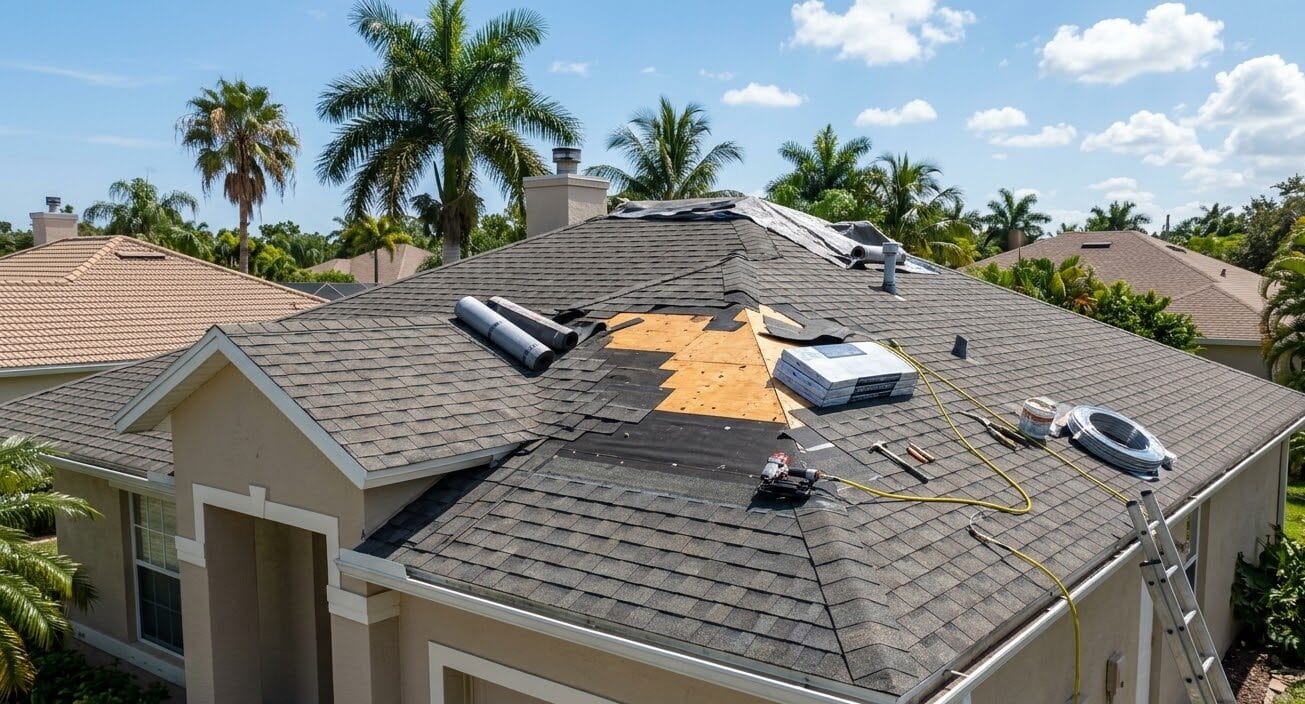
Most chimney flashing content on the internet was written for a climate Florida does not have. Ice dams, freeze-thaw spalling of brick, snow load on the cricket: none of that is your problem. What replaces it is a different set of stressors that are, if anything, harder on the same details.
- Wind-driven rain arrives sideways. Flashing is designed for water running down. In a Gulf-side squall, rain hits the chimney face horizontally and is pushed up under laps that gravity alone would never challenge. This is the mechanism that finds a counterflashing lapped too short, and it is why lap dimension matters more here than the minimums suggest.
- Ultraviolet exposure eats sealant on a Florida clock. A sealed joint that lasts a decade in Ohio is being cooked here. Any detail whose watertightness depends on sealant rather than on geometry is on a much shorter maintenance interval than the person who installed it assumed.
- Stucco chases are the dominant Florida chimney, and they hide their flashing. A framed chase clad in stucco has its counterflashing buried behind the stucco, tied to the weather barrier. When it was done wrong, you cannot see it, and the fix involves cutting stucco. This is why so many Florida chimney repairs get misdiagnosed and recaulked for years.
- Prefab metal chase covers rust and pond. The flat metal lid on top of a framed chase is frequently galvanized steel that was never sloped enough to drain. It holds a puddle, corrodes through at the low point, and sends water straight down the inside of the chase. That leak looks exactly like a flashing leak from the ceiling and is not one.
- Thermal cycling works the reglet loose. Masonry expands and contracts every single day here, by more degrees of daily swing than most people assume. Counterflashing set in a mortar joint with nothing but sealant at the top gets worked loose over years of that cycle.
- Hurricane uplift attacks the exposed edge. The outer edge of a counterflashing is the leading edge of a small airfoil in a design-wind event. Poorly fastened metal peels, and once it is standing off the wall the next rain does not need to be a hurricane.
The Five Failures We Actually Find, In Order
After enough leak calls the list stops being theoretical. Ranked by how often it is the answer, this is what is behind the water stain.
- Surface-mount counterflashing caulked to the chimney face. The original installer skipped cutting a reglet and glued the metal on instead. Once the top bead opens, the chimney face is a funnel pointed behind the flashing. This one is the most common by a wide margin because it is fast, it looks finished from the ground, and it passes a visual inspection for the first few years.
- No cricket on a chimney wider than 30 inches. Second on the list and first in severity, because it is a code deficiency and it damages the deck, not just the finish. You find the evidence inside the attic before you find it on the ceiling: dark staining on the sheathing directly behind the chimney.
- Step flashing replaced by one long continuous piece. A single strip of metal up the side of a chimney under a shingle roof cannot be woven into the courses. Water gets under the shingles above it and runs on top of the strip to whatever end it finds first.
- Reused flashing on a reroof. The tear-off crew left the old step flashing in place and shingled to it to save time and material. The metal is typically at the end of its life, the fastener holes are in the wrong courses for the new shingles, and the lap dimensions no longer line up. If your roof was replaced and the leak started within two years of a new roof, look here first.
- The chimney itself is the leak, not the flashing. A cracked crown, open mortar joints, a rusted or unsloped chase cover, or a missing rain cap lets water into the chimney from above. It travels down inside and emerges at the ceiling exactly where a flashing leak would. Replacing flashing here fixes nothing, and a contractor who does not check the top of the chimney before quoting flashing is guessing.
Why the Caulk Tube Makes It Worse
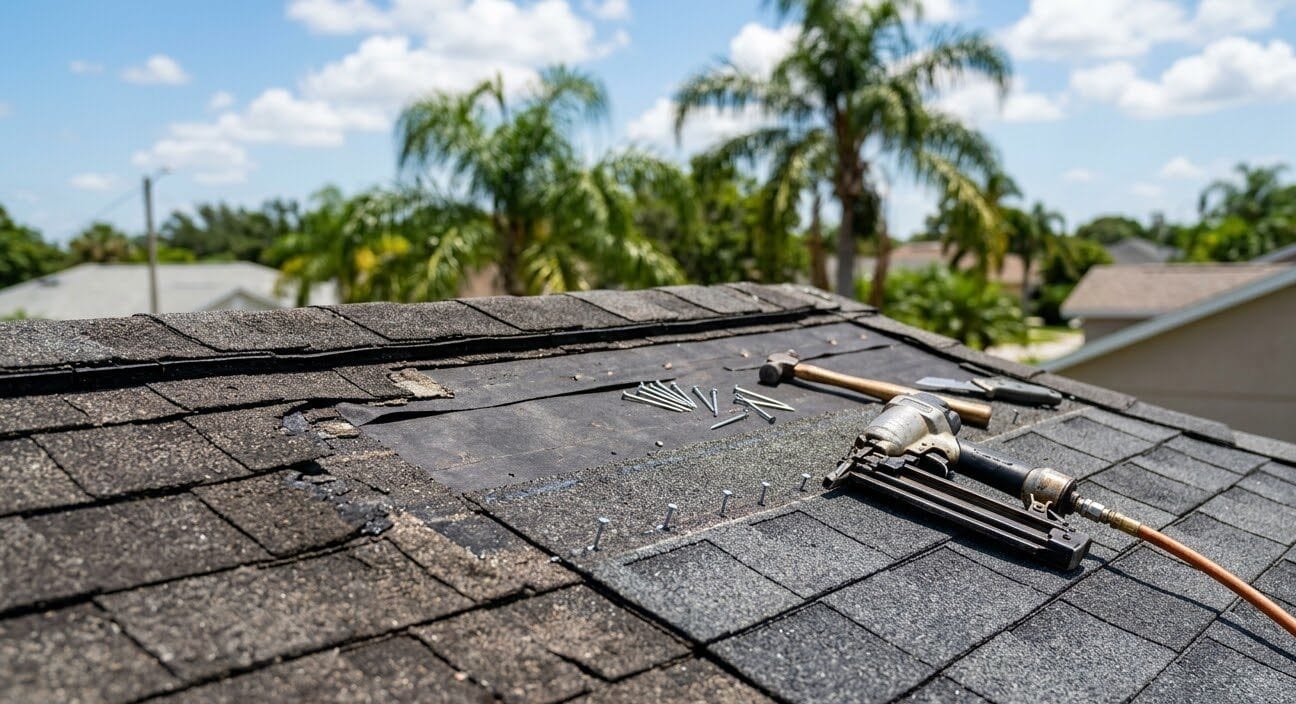
Nearly every chimney we are called to has been caulked at least once, usually by a handyman and usually more than once. It is worth being blunt about why that is not a cheap version of the right repair.
Sealant applied over a failing lap does not stop water, it redirects it. The water that used to run out at the bottom of the joint now backs up behind the bead and looks for the next opening, which is usually further inside the assembly. Meanwhile, the sealant hides the evidence. The next person on the roof cannot see the open reglet, the short lap or the reused metal under three generations of black goo, and the diagnostic clock resets.
There is a place for sealant in a correct chimney detail. It belongs at the top edge of a properly cut reglet, as a secondary defense behind a mechanically set piece of metal that would shed water without it. It does not belong as the thing holding the assembly together. The test is simple: if you removed every bit of sealant from the detail, would it still shed water by geometry alone? If the answer is no, what you have is not flashing.
Is It Really the Chimney? How to Tell Before You Pay for the Wrong Repair

Water travels. A stain on the ceiling is where gravity finally beat surface tension, not where the roof failed. Before anyone quotes chimney work, this sequence separates a chimney leak from an impostor.
- Does it leak in wind-driven rain but not in a calm soaker? That pattern points at a vertical detail, which the chimney is. A leak that shows up in any rain, wind or not, is more often a field or penetration failure.
- Does it leak when it is not raining at all? That is condensation, not a roof leak, and it is far more common in Florida attics than homeowners expect. The fix is airflow, not metal. We covered the mechanism in the guide to attic ventilation on Florida roofs.
- Go into the attic with a flashlight while it is dry. Follow the stain uphill. Water runs down rafters and along the top of ceiling joists before it drops. If the highest wet point is on the sheathing directly behind the chimney, you have a cricket or base flashing problem. If the highest wet point is inside the chase, the leak is coming in from the top of the chimney.
- Check whether there are other penetrations uphill. A failed pipe boot eight feet above the chimney produces a stain next to the chimney. Boots are a consumable item and they crack on a Florida sun schedule, so they get checked before anything expensive is proposed.
- Look at the top of the chimney, not just the bottom. Crown cracks and a corroded chase cover are visible from a ladder and account for a real share of what gets billed as flashing.
- Ask for a controlled water test. A hose, run in stages, starting low and working up, with someone in the attic watching. It converts opinion into fact in one visit and it is what a real leak detection and repair call looks like.
What a Correct Reflash Actually Involves
If the diagnosis lands on the flashing, here is the sequence a proper repair follows, so you can tell whether the crew on your roof is doing it or performing it.
- Shingles come off around the chimney. The courses on both sides and above are lifted or removed. Nobody reflashes a chimney without disturbing shingles, and a quote that promises otherwise is quoting caulk.
- Old metal comes out, all of it. Step flashing, apron, back pan. Reused metal is the fourth item on the failure list for a reason.
- The deck gets inspected while it is open. This is the moment to find the soft sheathing behind the chimney, and it is the reason repair scope sometimes grows on site. Rotten decking under new flashing is a new leak with a delay timer.
- New apron at the downhill face, new step flashing woven course by course up both sides, new back pan or cricket uphill. Each step piece lapped by the shingle above it, each with its own fastener placement out of the water path.
- A reglet is cut into the masonry, or the stucco is opened on a framed chase. New counterflashing is set into the cut, mechanically fastened, and lapped down over the step flashing. On a chase, the metal is tied back to the weather barrier before the stucco is patched.
- Shingle courses are rebuilt and the detail is left able to shed water without sealant. Sealant goes on last, as backup, at the reglet.
On a roof that is already near the end of its service life, doing all of that in isolation is money spent twice. That is a judgment call about remaining life, and it is the kind of thing a straight roof inspection answers before you commit to either path.
What It Costs in 2026
National cost data for 2026 puts chimney flashing repair or replacement at a $1,000 average, with most homeowners landing between $400 and $1,600. Work on oversized or stone chimneys runs past $2,000. Minor work such as sealing a small crack or re-securing a lifted edge falls in the $200 to $500 band, and full replacement on a large chimney reaches $1,800 or more. Labor is 60 to 70 percent of the total, which is why access, pitch and chimney size move the number more than material choice does.
| Scope | Typical 2026 range | What drives it |
|---|---|---|
| Minor sealing or re-securing lifted metal | $200 to $500 | A stopgap, not a repair. Appropriate only when the underlying geometry is sound. |
| Standard reflash, average chimney | $400 to $1,600 | Chimney size, roof pitch, access, whether a reglet must be cut, condition of shingles being disturbed |
| Large or stone chimney reflash | $1,800 to $2,000 plus | More linear feet of every component, harder reglet work, more shingle rework |
| Cricket retrofit on a chimney over 30 inches | Quoted with the reflash, not separately | Framing, sheathing, underlayment, two additional flashed slopes, deck repair found on opening |
| Deck repair found under the flashing | Added on discovery | Extent of rot, whether structural framing is involved |
Two things skew a Florida quote away from those national bands. Stucco chases add stucco repair to a roofing job, which means a second trade and a color match. And a chimney leak that has been recaulked for five years has usually been wetting the deck for five years, so the odds of finding sheathing repair on opening are much higher than on a leak caught in its first season. If price certainty matters to you, the honest move is to have it opened and diagnosed before signing a fixed number, not after.
When the Chimney Decides the Whole Roof

There are three situations where a chimney flashing problem stops being a repair question and becomes a roof question.
The first is age. If the shingles are past roughly 80 percent of their expected life, cutting them open around the chimney and rebuilding courses is work you will pay for again shortly. The flashing on a chimney is supposed to be replaced with the roof anyway, so the economics favor rolling it in.
The second is a missing cricket on a wide chimney. Since the retrofit means opening the deck and rebuilding courses regardless, there is very little marginal cost in doing it during a reroof and a lot of marginal cost in doing it twice. A crew that offers to add a cricket without removing shingles is not adding a cricket.
The third is an insurance claim. If a named storm peeled counterflashing or damaged the chimney, the flashing is part of the claim and needs to be documented as damage rather than as maintenance. That distinction is decided by how the loss is presented, which is why documentation and timing matter so much on Florida claims. The process is laid out in our guide to working with an adjuster, and the practical support side is insurance claims assistance.
What does not justify a whole roof: a single failed sealant bead on an otherwise correct, mechanically set flashing detail on a healthy roof. That is maintenance, it is cheap, and any contractor who escalates it to a replacement should be asked to show you the flashing geometry and explain what is wrong with it.
What to Ask Before You Hire Anyone for Chimney Work
- Are you cutting a reglet or surface-mounting the counterflashing? If the answer is surface-mount with sealant on a masonry chimney, you are buying the number one failure on the list.
- Is my chimney wider than 30 inches on the uphill face, and does it have a cricket? A roofer who has not measured this before quoting has not diagnosed anything.
- Will you remove the old step flashing or shingle over it? There is only one acceptable answer.
- Did you check the crown, the chase cover and the cap before quoting the flashing? If not, you may be buying the wrong repair entirely.
- What happens if the deck is rotten when you open it? You want that priced or at least ranged in writing, before the roof is open.
- Is the work permitted, and under which code edition? Repair scope drives the answer, and the 9th Edition takes effect December 31, 2026, so permit timing matters on work planned near that date.
Protech Roofing works Hernando, Pasco, Citrus, Marion, Polk, Pinellas and Hillsborough counties, and chimney flashing is one of the details we are called to most often after the third caulk job has failed. If you have a stain that shows up only in blowing rain, the fastest way to a real answer is eyes in the attic with water on the roof at the same time. Call (352) 605-0696 or get in touch and we will tell you whether you are buying flashing, a cricket, a chase cover, or nothing at all. Homeowners in Spring Hill and Brooksville can usually be seen the same week.
FAQ
Frequently Asked Questions
What is the difference between step flashing and counterflashing on a chimney?
+
Does Florida code require a cricket behind my chimney?
+
How much does chimney flashing repair cost in 2026?
+
Why does my chimney only leak when it is windy?
+
Can I just caulk the chimney flashing myself?
+
My roof was replaced two years ago and the chimney leaks. Is that normal?
+
How do I know the leak is the flashing and not the chimney itself?
+
Should chimney flashing be repaired on its own or with a roof replacement?
+
Related Articles
More guides for Florida homeowners
Roofing Warranties in Florida: What Voids Them
A new Florida roof usually carries two warranties: one from the manufacturer for the product and one from the contractor for the installation. Here is what each covers, what quietly voids them and how to keep your coverage.
Read Article
Best Roof Color for Florida Heat: Cool Roofs Explained
Florida test homes show a white shingle saves only 3 to 5 percent on cooling while reflective white metal or tile saves 18 to 26 percent. Here is how to choose a roof color that actually keeps your attic cooler.
Read Article
Roof Underlayment in Florida: The Hidden Layer Explained
Underlayment is the layer that decides what happens to your house when wind strips the shingles. Here is how felt, synthetic and peel-and-stick compare, what Florida code requires on a re-roof, and what each option costs in 2026.
Read ArticleReady When You Are
Get your free roof inspection today.
No-pressure, written estimate. Same-week scheduling across Hernando County. Call us now or request a visit online.