
Blog
Gutters for Florida Homes: Seamless vs Sectional and Sizing for a 50-Inch Rain Season
Call (352) 605-0696Seattle averages about 38 inches of rain a year and almost nobody there runs 6-inch gutters. Tampa averages 52.6 inches and 5-inch gutters overflow here constantly. The extra 14 inches is not the reason. Under the NOAA 1991 to 2020 normals, 30.3 of Tampa's inches arrive across June through September, most of them in convective cells that drop an inch in forty minutes. Gutters are sized on inches per hour, not inches per year, which is why a system that would be generously oversized in the Pacific Northwest is undersized on a Hernando County ranch. Here is the arithmetic that decides 5-inch versus 6-inch, what seamless really buys you, the two spec lines that matter more than seamless in a hurricane state, and how to read a quote so you can tell a real system from a color choice.
Your Gutters Are Not Failing Because of 52 Inches a Year

Seattle averages about 38 inches of rain a year and almost nobody there runs 6-inch gutters. Tampa averages 52.6 inches under the NOAA 1991 to 2020 climate normals, and 5-inch gutters overflow here constantly. The extra 14 inches is not the reason. The reason is when those inches arrive and how fast.
Look at how Tampa's year is actually distributed in those normals. June brings 7.4 inches, July 7.8, August 9.0 and September 6.1. That is 30.3 inches across four months, roughly 58 percent of the annual total, and most of it does not fall as all-day drizzle. It falls as an afternoon convective cell that dumps an inch or two in forty minutes and then moves off.
Gutters are not sized on inches per year. They are sized on inches per hour. A system that would be generously oversized in the Pacific Northwest is undersized on a Hernando County ranch, and the homeowner concludes gutters do not work in Florida when what actually happened is that the system was specified by annual rainfall, or more commonly, by whatever was on the truck.
This guide covers the arithmetic that decides 5-inch versus 6-inch, what seamless really buys you and what it does not, the two spec lines that matter more than seamless in a hurricane state, and how to read a gutter quote so you can tell a real system from a color choice.
Florida Code Does the Intensity Math, Just Not for Your House
There is a strange gap in how drainage gets regulated. If you build a commercial roof in Florida, Chapter 11 of the Florida Building Code, Plumbing, tells you to size vertical conductors, leaders, storm drains and horizontal branches from the 100-year hourly rainfall rate shown in Figure 1106.1, or from other rainfall rates determined from approved local weather data. Table 1106.7 for scuppers is published for a 5-inch-per-hour rate and is adjusted for a different local rate by multiplying the square footage by 5 and dividing by the local design rainfall rate.
In other words, the code's own method for a flat commercial roof is entirely intensity-driven, and the mechanism to scale it up for a wetter location is written into the table. Residential gutters get none of that. The Florida Building Code does not require gutters on a house at all. It requires drip edge, it regulates fascia and soffit fastening, but a gutter is an owner option.
That is why almost no residential gutter quote in this state contains a single calculation. There is no inspector asking for one. The code does say that gutters, if installed, must be securely fastened and correctly sloped so that water reaches the downspouts instead of overflowing and damaging the overhang or the wall system behind it, which is exactly the failure mode you see on half the homes in a subdivision.
The practical takeaway: nobody is going to do this math for you, so this is the one part of a roof project where an informed homeowner genuinely changes the outcome. If you are already planning work on the roof itself, it is worth sequencing the two together during a roof inspection so the edge details and the gutter get specified as one system.
5-Inch vs 6-Inch: The Numbers That Decide It
A 5-inch K-style gutter holds roughly 1.2 gallons per linear foot. A 6-inch K-style holds roughly 2.0 gallons per linear foot, about 67 percent more volume in a profile that looks only slightly larger from the street. On the standard drainage-capacity tables that translate to a 5-inch K-style serving on the order of 5,520 square feet of roof and a 6-inch K-style serving on the order of 7,960 square feet, at the intensity those tables assume.
Those square-foot figures move with rainfall intensity, which is the whole point. Run the same house through a Florida design intensity rather than a national average and the required capacity climbs past what the 5-inch profile can carry, while the 6-inch still has margin. One widely published worked example for an 800-square-foot Florida roof section lands at a required drainage capacity of 7,287 square feet once local intensity is applied, which the 5-inch profile at 5,520 cannot cover and the 6-inch at 7,960 can.
The honest version of this: 6-inch is the right default in Central Florida, not a universal requirement. A small single-story ranch with a simple gable, short runs and a downspout at each end is often fine in 5-inch. The homes that overflow are the ones with long runs feeding a single downspout, with valleys dumping concentrated flow into one gutter section, and with big roof planes over a lanai or an entry. Those are the sections to upsize, and you do not have to upsize the entire house to fix them.
The Downspout Is Usually the Real Bottleneck
Here is the upgrade that gets sold and then quietly cancelled out. A rectangular 2 by 3-inch downspout handles on the order of 600 square feet of roof. A 3 by 4-inch downspout handles about 1,200 square feet, roughly double. If you pay for 6-inch gutters and the crew hangs 2 by 3 downspouts on them, you bought a bigger reservoir feeding the same small drain, and most of the capacity increase never leaves the gutter.
This is the single most common quiet defect in Florida gutter work, and it is easy to check from the driveway without a ladder. Measure the downspout. If the gutter is 6 inches and the downspout is 2 by 3, the system is mismatched no matter how good the aluminum is.
Count them too. Divide the roof area draining into a given gutter run by the downspout capacity to see how many outlets that run actually needs. A 2,400-square-foot roof plane draining to one side needs materially more outlet area than a single 3 by 4 provides. Adding a second downspout is almost always cheaper than upsizing the whole run, and it also shortens the distance water has to travel inside the gutter, which is what causes the mid-run overflow you see during a hard cell.
The outlet opening itself matters as much as the downspout. A 3 by 4 downspout fed through a punched hole sized for a 2 by 3 outlet is still a 2 by 3 system. Ask what size outlet is being cut, not just what size pipe is being hung.
Seamless vs Sectional: What the Word Actually Buys
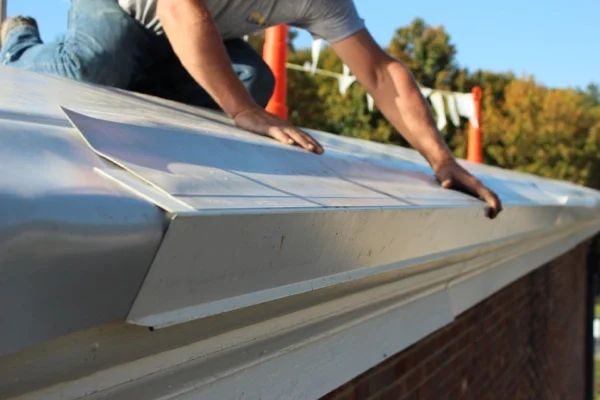
Sectional gutter comes in pre-formed lengths, typically 10 feet, that get joined on the house with connectors and sealant. That puts a sealed joint every 10 feet along every run. Seamless gutter is roll-formed on site from a coil, so a 40-foot run is one continuous piece of aluminum with no joint anywhere along its length.
Every one of those sectional joints is a maintenance item. The sealant is the part that fails, and Florida is unusually hard on it: full UV exposure, daily thermal cycling as aluminum expands and contracts under an afternoon sun, and a wet season that keeps the joint saturated for months. A leaking joint does not drip into the yard, it drips down the back of the gutter onto the fascia, which is where real money gets spent.
So seamless is genuinely better, and the reason is not aesthetics. But here is the part the sales pitch leaves out: seamless is not seamless. Every inside and outside corner is a miter, every end is a cap, and every downspout is an outlet cut into the trough. Those are all sealed joints, and in practice that is where the overwhelming majority of gutter leaks originate. Removing the joints along the straight runs removes most of the population of joints, not the ones that fail most often.
Which means the miter detail is worth asking about. A hand-mitered corner formed and sealed on site behaves differently over time than a factory box miter, and different installers have strong opinions in both directions. What matters is that whoever is quoting has one, can explain it, and warranties it. An installer who has never thought about their corners is telling you something.
Two Spec Lines That Matter More Than Seamless
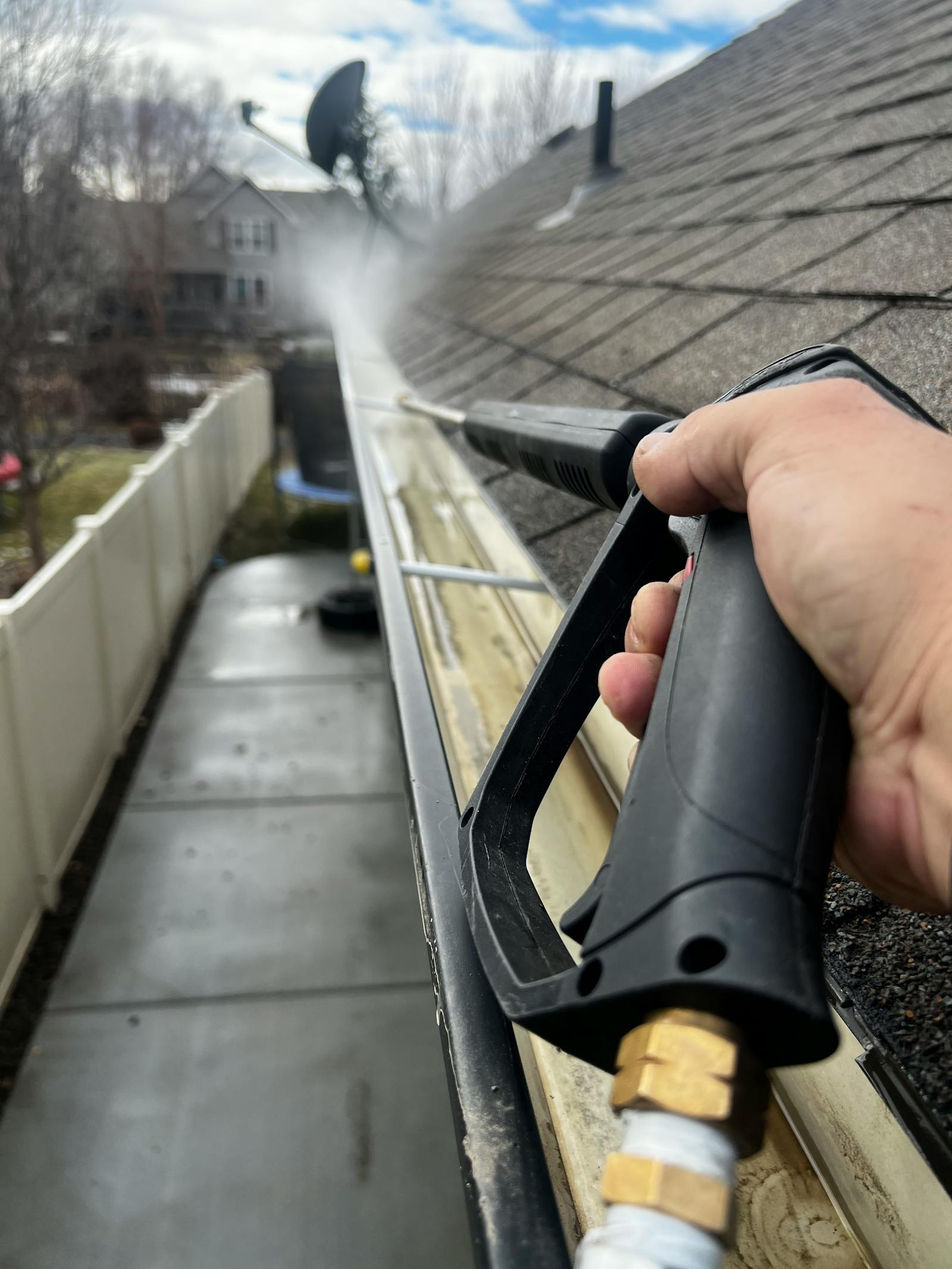
If you only get two things right on a Florida gutter job, make them the aluminum thickness and the hanger spacing. Both are invisible from the street and both are where price gets cut.
Aluminum coil comes in .027 and .032 as the common residential options. The .027 is builder grade and performs acceptably in mild conditions, but it bends, dents and sags more readily under load, ladder contact and wind. For high-wind applications .032 is the minimum worth specifying. The upcharge is small against the cost of a run that deforms in year three and never drains correctly again.
Hanger spacing is the one that separates a Florida install from a catalog install. In many parts of the country hidden hangers at 24 to 36 inches on center is normal practice. Florida's high-velocity hurricane zone requires hidden hangers at 16 inches on center with corrosion-resistant fasteners, and 16 to 18 inches is the working standard used across the state for both 5-inch and 6-inch profiles. That is roughly double the fastener count of a standard install.
Think about why. A 6-inch gutter holding 2.0 gallons per linear foot weighs about 16 pounds per foot when it is running full, before you add wind. A 40-foot run at 36-inch spacing is carrying that load on 14 hangers. The same run at 16 inches is carrying it on 30. In a state where the gutter also has to survive lateral wind load on a cantilevered fascia, the fastener schedule is not a detail, it is the design. A sectional system hung at 16 inches on center with .032 aluminum will outlast a seamless system hung at 36 inches on center with .027, every time.
The Fascia Is What You Are Actually Protecting
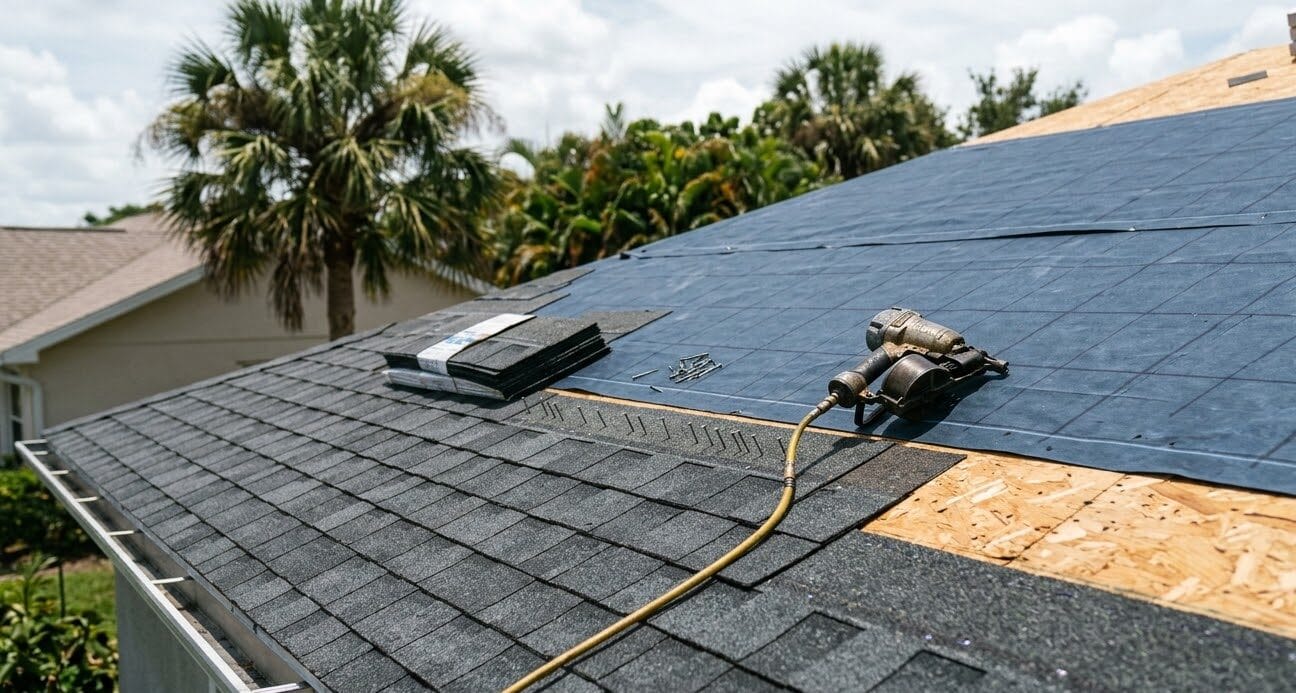
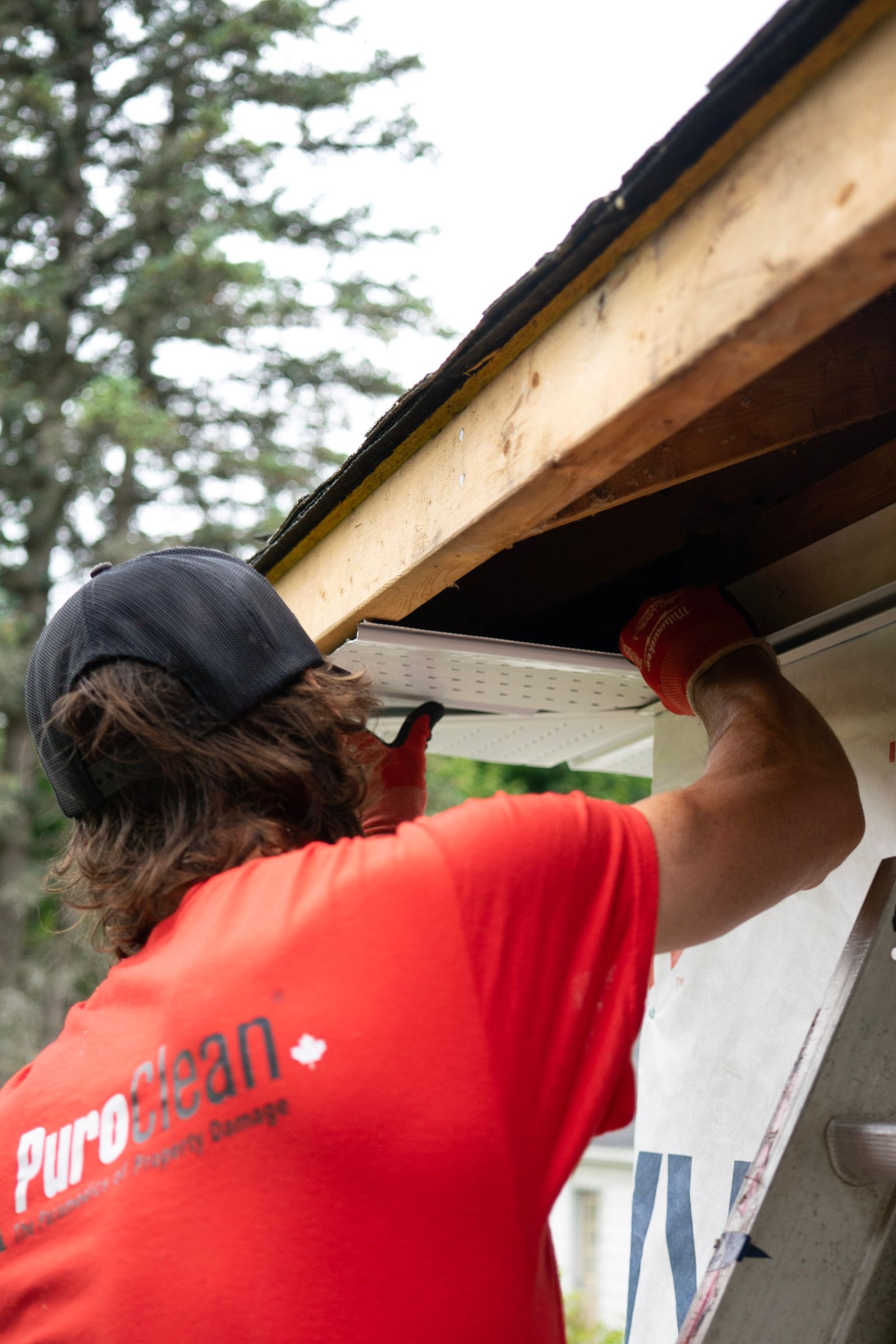
Gutters do not hang in space. They hang off the fascia board, which in most Florida homes is dimensional lumber wrapped in aluminum coil. That wrap looks permanent and hides everything behind it, which is why fascia rot is usually discovered during a roof replacement rather than by the homeowner.
The water path that causes it is short. Rain leaves the shingle edge, and if the metal edge detail does not carry it past the back wall of the gutter, it runs down the fascia behind the gutter instead of into it. That surface stays wet, the wrap holds the moisture against the wood, and the board goes soft while looking perfectly fine from the ground. Then the hanger screws lose their bite, the gutter starts to pitch wrong, and it overflows in exactly the place the homeowner assumes is a capacity problem.
Florida code is stricter than the national baseline on the edge detail for this reason. Drip edge is required on all new and replacement roofs, and the Florida Building Code calls for a 3-inch lap where the International Residential Code asks for 2. Edge metal must be mechanically fastened at 4 inches on center where the design wind speed Vasd is 110 mph or higher, or where mean roof height exceeds 33 feet. Those are the numbers your roofer is working to, and they are the numbers a gutter installer can undo.
The practical rule: gutter installation should never involve cutting, bending back or removing drip edge to make a gutter fit. If a crew has to modify the roof edge to hang a gutter, the gutter is wrong for the edge, not the other way around. When soft fascia turns up, it gets replaced before the new gutter goes on, which is work that belongs with roof repair rather than with the gutter crew.
Florida Has No Leaf Season, It Has a Leaf Year
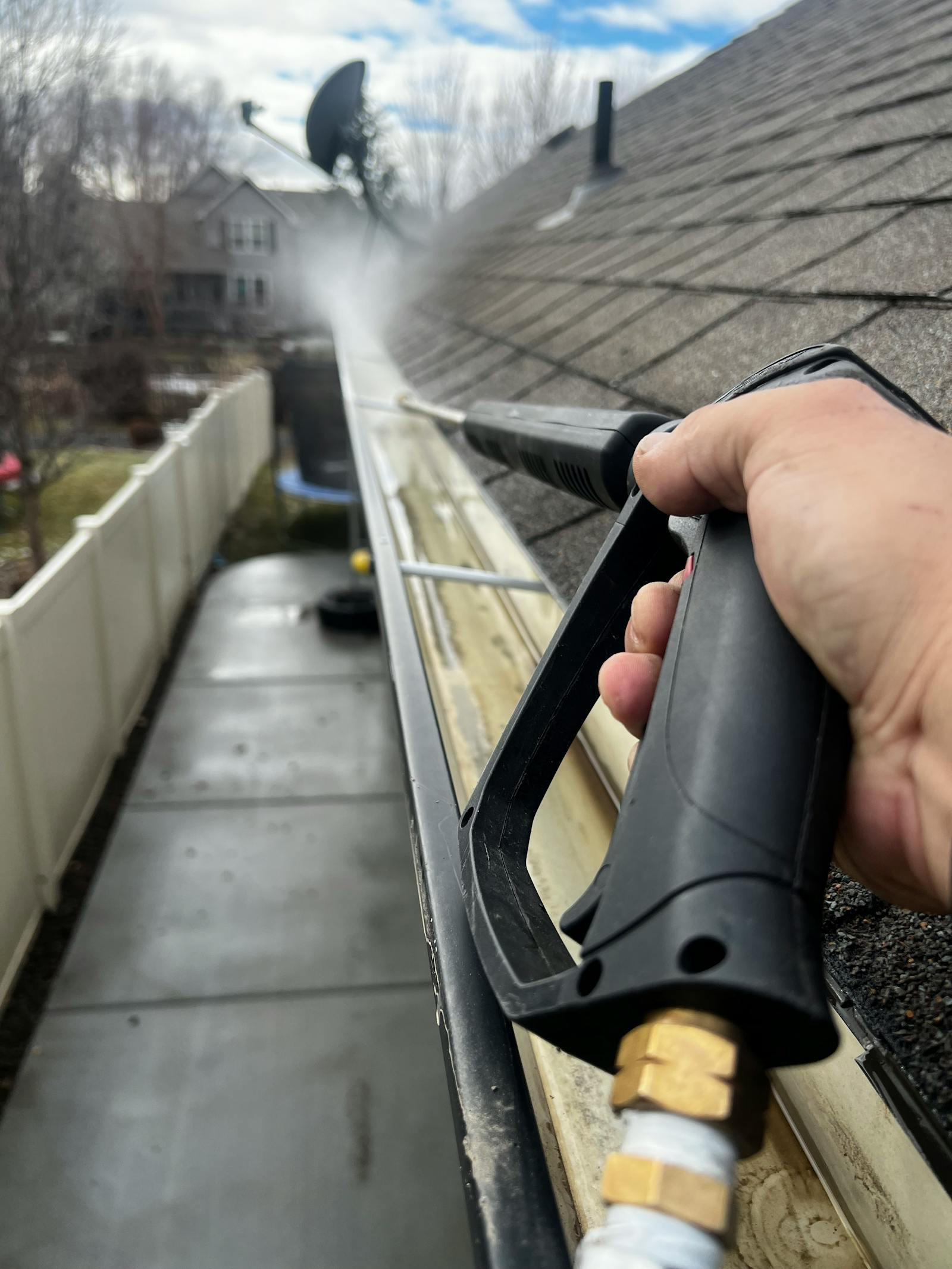
Gutter maintenance advice written for the rest of the country assumes a cleanout in late fall after the deciduous trees drop. That model does not apply here. Live oaks shed leaves gradually and heavily in spring rather than autumn, slash and longleaf pines drop needles continuously, Spanish moss comes down in every wind event, and oak pollen catkins arrive in a dense mat in late winter. Add lovebug flights in roughly May and again around September, and the debris load is spread across the calendar instead of concentrated in one weekend of work.
This changes what a gutter guard is worth. In a leaf-season climate, a guard saves you one job a year. In Florida it is managing a continuous load, and the failure mode is different too: pine needles thread through most screen products, and pollen mats and shingle granules build a sludge layer that a coarse guard passes straight through. Fine mesh handles needles and pollen far better than perforated aluminum, and it is the specification worth paying for if your house sits under pines.
There is a second reason cleanouts matter more here than elsewhere. A gutter packed with wet organic debris is dead weight hanging on the fascia through hurricane season, and standing water in a blocked gutter is a mosquito habitat about six feet from your windows. Two cleanouts a year, one before the wet season starts in June and one after it ends in October, covers most Central Florida homes. Homes under heavy pine canopy need more. Our teams handle both the recurring work through gutter cleaning and the permanent fix through gutter protection.
What Gutters Protect in a State With No Basements
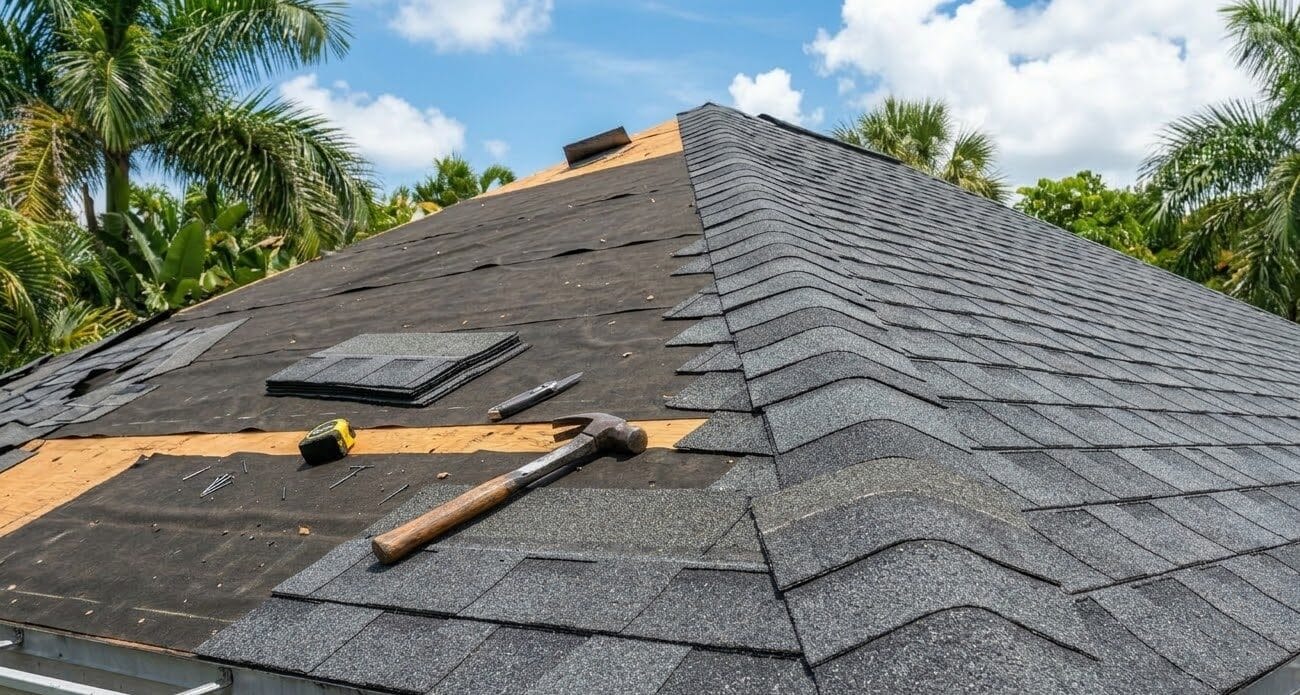
Most gutter marketing is written around basement flooding and frost heave, neither of which exists in Central Florida. It is a fair question what gutters are actually doing on a slab-on-grade house in sand. The answer is four specific things, and they are all cheaper to prevent than to repair.
- Slab edge erosion: Roof runoff falling off an unguttered eave cuts a trench in sandy soil at the drip line and undermines the grade that slopes water away from the monolithic slab edge. Once the grade reverses, water sits against the slab after every storm.
- Splash-back on the wall: Water hitting bare ground at speed throws soil and organic matter two to three feet up the stucco or siding. That is the origin of the dark band along the bottom of walls on unguttered houses, and on stucco it eventually works into hairline cracks.
- Moisture at the foundation perimeter: Persistently wet soil against the slab is a conducive condition for subterranean termites and keeps the wall base damp in a climate that already runs high humidity. Pest control companies flag it routinely.
- The entry and lanai: A concentrated sheet of water off a valley over a doorway or a pool deck is a slip and nuisance problem long before it is a structural one, and it is the complaint that actually makes homeowners call.
What gutters are not doing is keeping water out of the house through the roof. That is the roof's job, and no gutter compensates for a failing roof system. If water is showing up inside, the gutter is not the investigation, the leak detection and repair process is.
Gutters and Hurricane Season
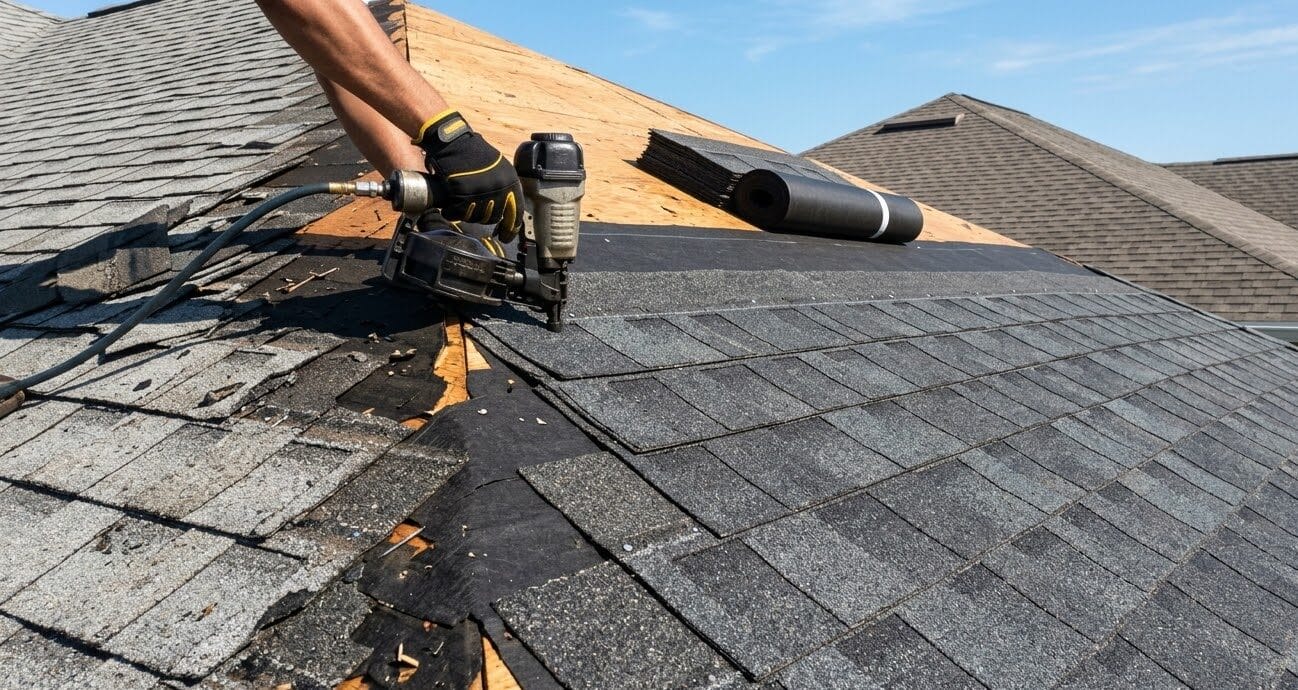
Every June somebody on a neighborhood forum suggests taking the gutters down before a storm. Do not. A correctly fastened gutter is not a meaningful hazard, and removing it exposes the fascia and the roof edge you spent money getting right. What deserves attention is whether the gutter was fastened correctly in the first place, and whether it is clear.
A blocked gutter in a tropical system fills and stays full. At roughly 8.3 pounds per gallon and 2.0 gallons per linear foot in a 6-inch profile, a 40-foot run full of water is carrying well over 600 pounds of static load on the fascia at the same moment the wind is applying lateral and uplift force to it. That combination, not the gutter itself, is what tears fascia off houses. A clear gutter drains as fast as the downspouts allow and never reaches that state.
Two practical items before the season. Make sure downspout extensions and any underground drain lines are clear, because a downspout that cannot discharge backs the whole run up regardless of how clean the trough is. And check hanger spacing on any gutter installed by a previous owner, since that is the one spec you cannot fix after the storm. The broader pre-season walkthrough is covered in our post-storm roof inspection checklist, which works just as well run in reverse in May.
What This Costs in 2026
Seamless aluminum runs roughly $6 to $12 per linear foot installed, and the spread inside that range is almost entirely gauge, hanger schedule and downspout count. Builder-grade .027 systems sit at the $6 to $11 end. Upgrading to .032 with a tighter fastener schedule moves you up the range and is the upgrade worth taking. A typical single-story home quoted with .032 aluminum, hangers, and removal of the existing gutters lands in the low thousands as a complete job.
Put that next to what it is protecting. Fascia replacement on a couple of elevations, with the soffit disturbance that comes with it, runs into the same money and arrives with a roof project attached. Stucco repair and repainting a splash-damaged wall costs more than the gutters that would have prevented it. The gutter is one of the few line items on a house where the cheap version and the correct version differ by a few hundred dollars and a decade of service life.
One sequencing note that saves real money: if a roof replacement is anywhere in the next couple of years, do the gutters after the roof, not before. New gutters get damaged and often removed during a tear-off, and the edge metal work happens with the roof. Homeowners who install gutters six months before a re-roof pay for the same gutters twice. If the roof is the near-term project, that conversation belongs with total roof replacement first.
How to Read a Gutter Quote in Sixty Seconds
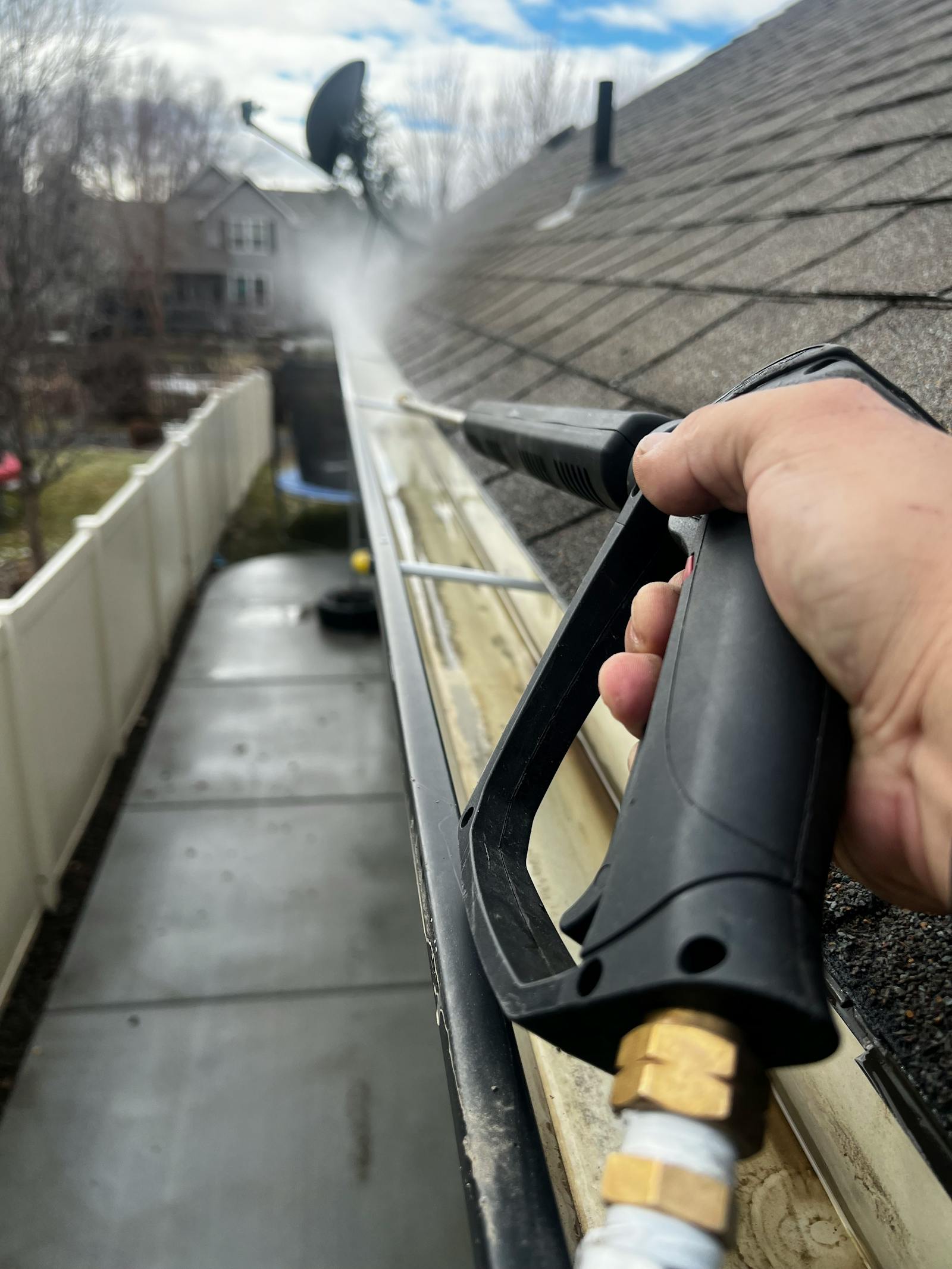
Most residential gutter quotes in Florida are one line and a color. Here is what a real one contains, and every item is something you can ask for by name.
- Profile and size: K-style or half-round, 5-inch or 6-inch, stated per elevation rather than for the whole house. The long run over the lanai may need a different answer than the garage side.
- Aluminum thickness: .027 or .032, in writing. If the quote does not say, assume .027.
- Hanger type and spacing: Hidden hangers with a stated on-center dimension and corrosion-resistant fasteners. Sixteen to eighteen inches is the Florida standard; anything at 24 inches or wider needs a reason.
- Downspout size and count: 2 by 3 or 3 by 4, and how many, and where they discharge. A 6-inch gutter paired with 2 by 3 downspouts is a mismatched system.
- Outlet size: The opening cut into the trough, which should match the downspout rather than being whatever the punch on the truck makes.
- Corners: Hand-mitered or box miter, and what the warranty on the seal is.
- Roof edge: Written confirmation that existing drip edge will not be cut, bent back or removed, and what happens if soft fascia is found.
- Finish: The paint warranty on the coil, which is a real differentiator under Florida UV and rarely mentioned.
A contractor who can answer all eight without checking is doing this properly. One who answers three of them is selling aluminum by the foot. Verify the license number on any document you receive, ours is CCC1335878, and confirm it is active before work starts.
The Short Version

Florida gutters are an intensity problem, not a volume problem. Tampa's 52.6 inches arrive with 30.3 of them inside four months, mostly in short high-rate bursts, which is why a system sized by national habit overflows here.
Six-inch K-style holds about 2.0 gallons per linear foot against 1.2 for 5-inch, roughly 67 percent more, and it is the right default for most Central Florida homes with long runs or concentrated valley flow. Pair it with 3 by 4 downspouts at roughly 1,200 square feet each, not 2 by 3 at 600, or the upgrade does nothing.
Seamless removes the 10-foot joints and is worth having, but it does not remove the corners, caps and outlets where most leaks actually start. Thickness and fastener schedule beat the word seamless: .032 aluminum on hidden hangers at 16 to 18 inches on center is the Florida specification, against the 24 to 36 inches that is normal elsewhere.
And the thing the gutter is really protecting is the fascia behind it and the grade below it. Keep the drip edge intact, keep the trough clear through a wet season that never really has an off month, and the system does its job. If you want the sizing run against your actual roof planes rather than a rule of thumb, call our team at (352) 605-0696 and we will measure it. We also install and replace complete systems through gutter installation, and the commercial equivalent of this problem is covered separately in box gutter solutions for commercial roofs.
FAQ
Frequently Asked Questions
Do I need 5-inch or 6-inch gutters in Florida?
+
Are seamless gutters actually better than sectional?
+
What downspout size should go with 6-inch gutters?
+
Does the Florida Building Code require gutters on a house?
+
How far apart should gutter hangers be in Florida?
+
Should I take my gutters down before a hurricane?
+
Related Articles
More guides for Florida homeowners
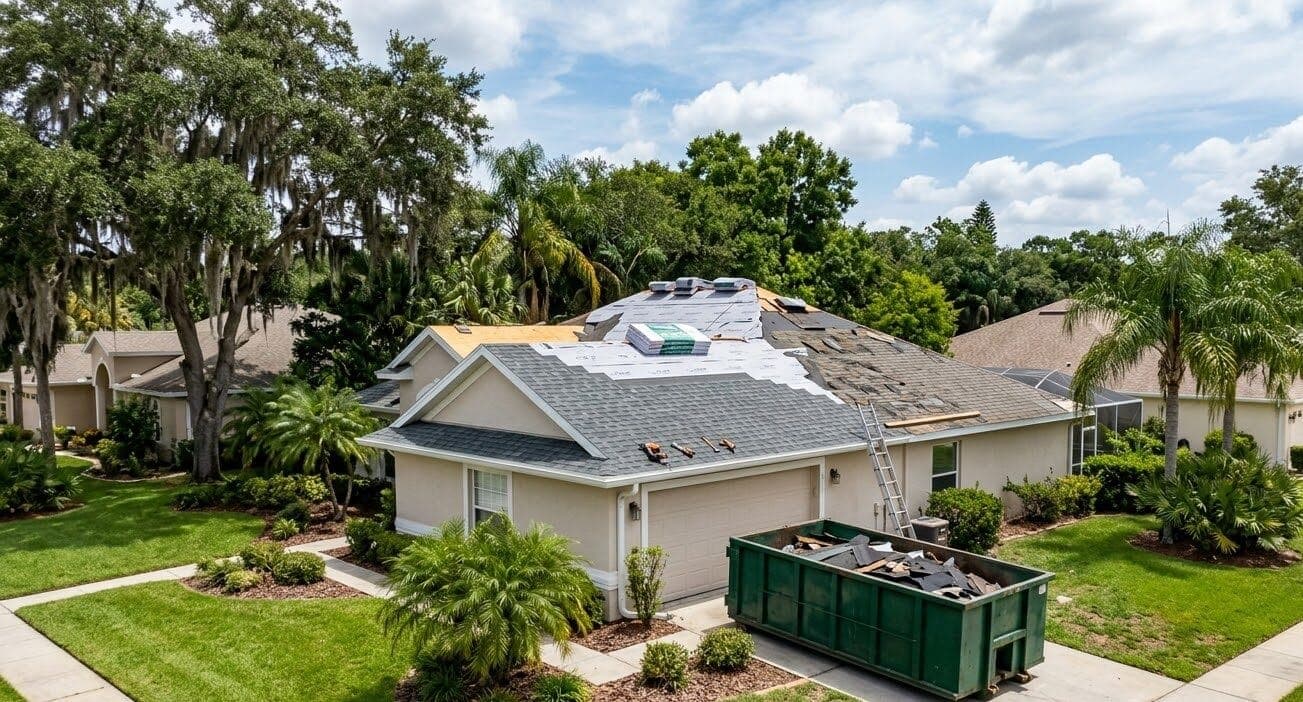
Best Shingles for Florida: Impact-Rated Class 4 Guide
The best shingle for a Florida home is usually a Class H architectural shingle installed as a full system. Here is how 3-tab, architectural and Class 4 impact-resistant shingles compare on cost, wind, insurance and lifespan.
Read Article
Metal Roof Cost in Florida 2026: Per-Sqft Guide
Metal roofs in Florida run about $8 to $23 per square foot installed, depending on the system. Here is what standing seam, stone coated steel and exposed fastener panels cost, what a typical home pays and how to compare quotes.
Read Article
Roofing Warranties in Florida: What Voids Them
A new Florida roof usually carries two warranties: one from the manufacturer for the product and one from the contractor for the installation. Here is what each covers, what quietly voids them and how to keep your coverage.
Read ArticleReady When You Are
Get your free roof inspection today.
No-pressure, written estimate. Same-week scheduling across Hernando County. Call us now or request a visit online.