Blog
Emergency Roof Tarp in Florida: When to DIY vs Call a Pro (Stop Leaks Before Mold in 24 Hours)
Call (352) 605-0696The storm passes at nine at night, you find water on the hallway ceiling at ten, and by eleven you are on your phone deciding whether to buy a tarp in the morning or call somebody now. That decision has a real deadline attached to it, and the deadline is not set by your insurer or your roofer. It is set by mold, which begins colonizing wet building materials within 24 to 48 hours. Everything in this guide works backward from that window: what a tarp does, when doing it yourself is defensible, when it is genuinely dangerous, what the work costs in Florida in 2026, and how much of it your policy pays for before anyone signs anything.
The First 24 Hours Set the Size of the Claim
A roof opening is not the expensive part of storm damage. Water that keeps arriving through the opening is. The EPA's remediation guidance is built around a simple threshold: dry water-damaged materials within 24 to 48 hours to prevent mold growth, and keep indoor humidity between 30 and 60 percent. Past that window, you are no longer managing a roof problem. You are managing a roof problem plus a drywall problem plus an insulation problem plus, potentially, a remediation protocol.
Drywall is the reason the window is that short. The paper facing is organic material and the gypsum core holds moisture in a stable state, which is close to ideal conditions for colonization. Research out of the University of Florida's building construction program found visible growth on drywall held at 80 percent relative humidity and 75 degrees in as little as 24 to 48 hours after wetting. In August in Hernando County, 80 percent humidity is not a laboratory condition. It is Tuesday.
So the honest framing is this. A tarp is not a repair and nobody should pretend it is one. A tarp is a clock management tool. It buys the days between the storm and the crew, and the value of those days is the difference between replacing shingles and replacing shingles plus ceilings, insulation, and contents.
What a Tarp Actually Does, and What It Does Not
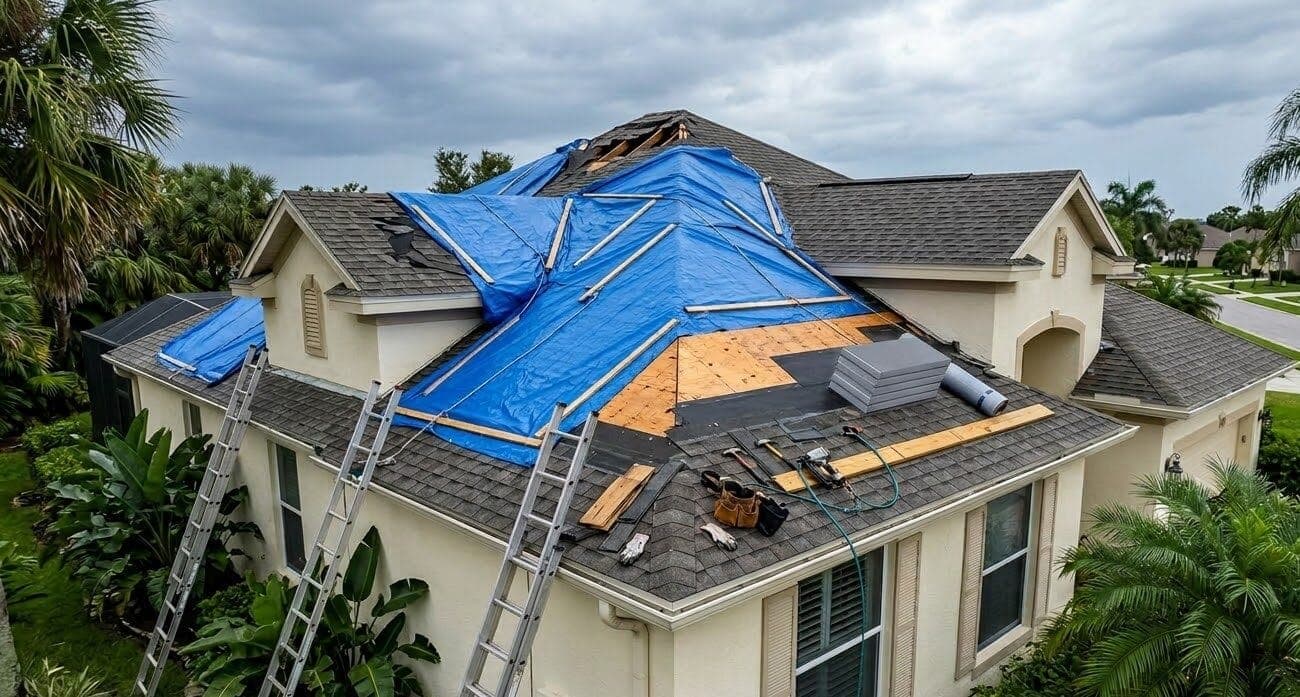
A correctly installed emergency tarp does three things. It sheds water away from the opening rather than over it. It stays attached through the next thunderstorm, which in Florida is usually tomorrow. And it does not create new holes that outlive it.
That third item is where most well-intentioned tarp jobs go wrong. A tarp screwed flat through the field of a shingle roof puts dozens of new penetrations into an intact deck, and every one of them is a leak path once the tarp comes off. Proper practice runs the tarp up and over the ridge so water cannot get under the upslope edge, wraps the edges around furring strips so fasteners land in wood rather than pinching plastic, and anchors outside the damaged zone.
What a tarp does not do: stop water already inside the assembly, dry anything, protect a deck that has lost structural integrity, or survive a hurricane. It is a bridge to a repair. Treat it as one and it works. Treat it as a solution and it becomes the reason a $4,000 repair became a $19,000 one.
The Honest DIY Case: Four Conditions That All Have to Be True
Plenty of roofing companies will tell you never to touch your own roof. That is not honest advice, it is marketing. There are real situations where a homeowner tarping a roof at seven in the morning is the correct call, and every one of them shares the same four conditions.
- The roof is walkable and dry. Low slope, asphalt shingle, no moss, no algae, and the surface has had time to dry. Wet shingles and wet tile are both far more slippery than they look, and a roof that felt fine at noon is a different surface at seven in the morning with dew on it.
- The damaged area is small, visible, and reachable from the edge or from a stable position. If you have to cross the ridge and work on the far slope out of sight of your ladder, the job has left the DIY category.
- The deck is sound. Missing shingles over solid plywood is a tarp job. A soft spot, a visible sag, or daylight through the sheathing is not. Standing on a compromised deck is how a roof problem becomes a hospital problem.
- Weather and daylight are on your side. No lightning within earshot, wind under roughly 15 miles per hour, and at least two hours of daylight left. Tarping in wind is the single most common way homeowners get pulled off a roof, because a 20 by 25 foot tarp is a sail before it is a cover.
Four out of four means a competent homeowner with a helper, a stabilized ladder and furring strips can put a defensible tarp on a roof. Three out of four means call somebody. This is not a scoring system where you get partial credit.
The Situations Where DIY Is Simply the Wrong Answer
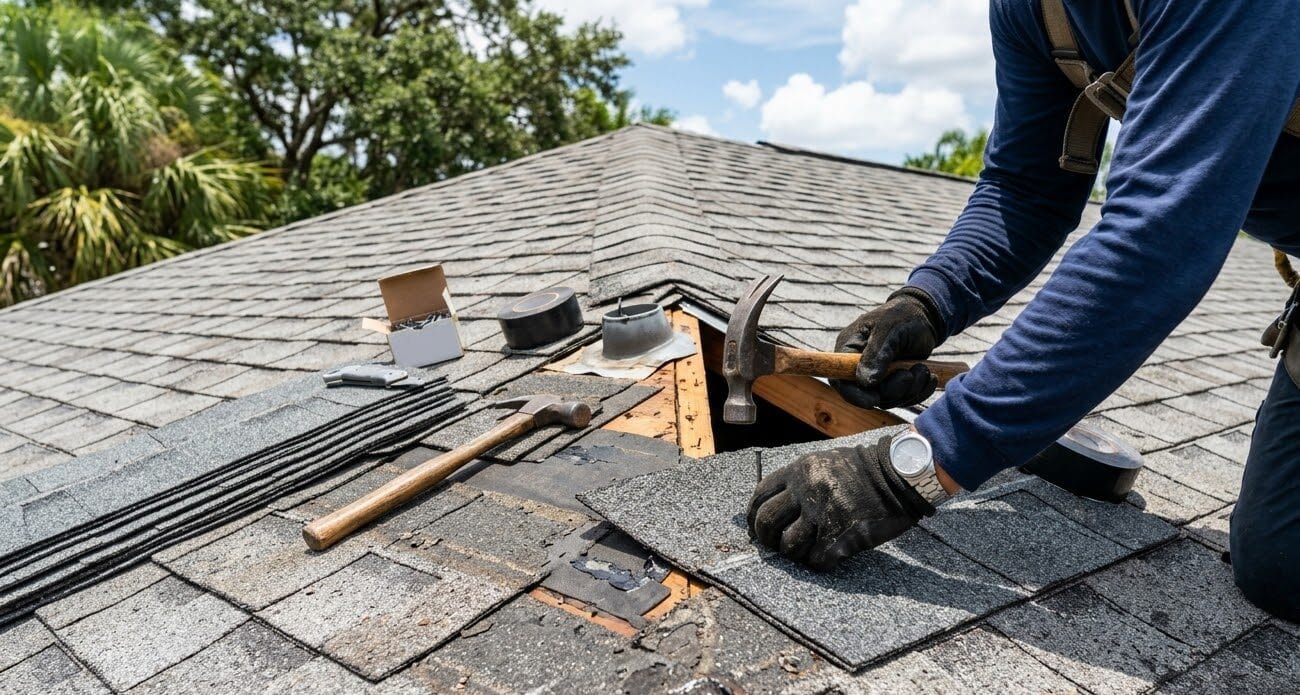
- Tile roofs. Concrete and clay tile break under foot traffic in ways that are not obvious until it rains. Walking a tile roof to install a tarp routinely creates more leak paths than the storm did.
- Metal roofs. Slick, hot, and unforgiving, with fastener patterns that a tarp screw will not respect. A tarp on standing seam also has almost nothing to grab.
- Steep pitch or two stories. Above roughly a 6 in 12 pitch, or on a second story, the fall consequence changes category entirely and so does the ladder work required to get up there with material.
- Large openings. Anything past about 200 square feet needs multiple panels with proper overlap, which is a two-person professional job in practice, not a bigger version of a small one.
- Anything structural. Tree strike, sagging deck, cracked truss, or visible framing damage. That is shoring work, not covering work, and the tarp comes after an assessment rather than before it.
- Active lightning or wind. No exceptions and no negotiation. Interior containment with buckets and plastic is the correct move until the weather passes.
The Ladder Math Nobody Runs Before Climbing
The risk in tarping is not the tarp. It is the ladder, and the numbers are not close. The World Health Organization counts more than 164,000 emergency room treated injuries and roughly 300 deaths a year in the United States from ladder falls. CDC data from occupational settings found 113 work-related ladder fall fatalities in a single year alongside an estimated 34,000 nonfatal ladder fall injuries treated in emergency departments, and among construction workers treated for fall injuries, an estimated 81 percent of those falls involved a ladder.
Those are people who climb for a living, with training and equipment. The relevant comparison for a homeowner is not whether the tarp is hard. It is whether saving several hundred dollars is worth taking on a risk category that injures six figures worth of people annually, at night, in wet conditions, carrying an awkward load, after a stressful day. Sometimes the answer is genuinely yes. It should at least be an answer you arrived at on purpose.
What Professional Roof Tarping Costs in Florida in 2026
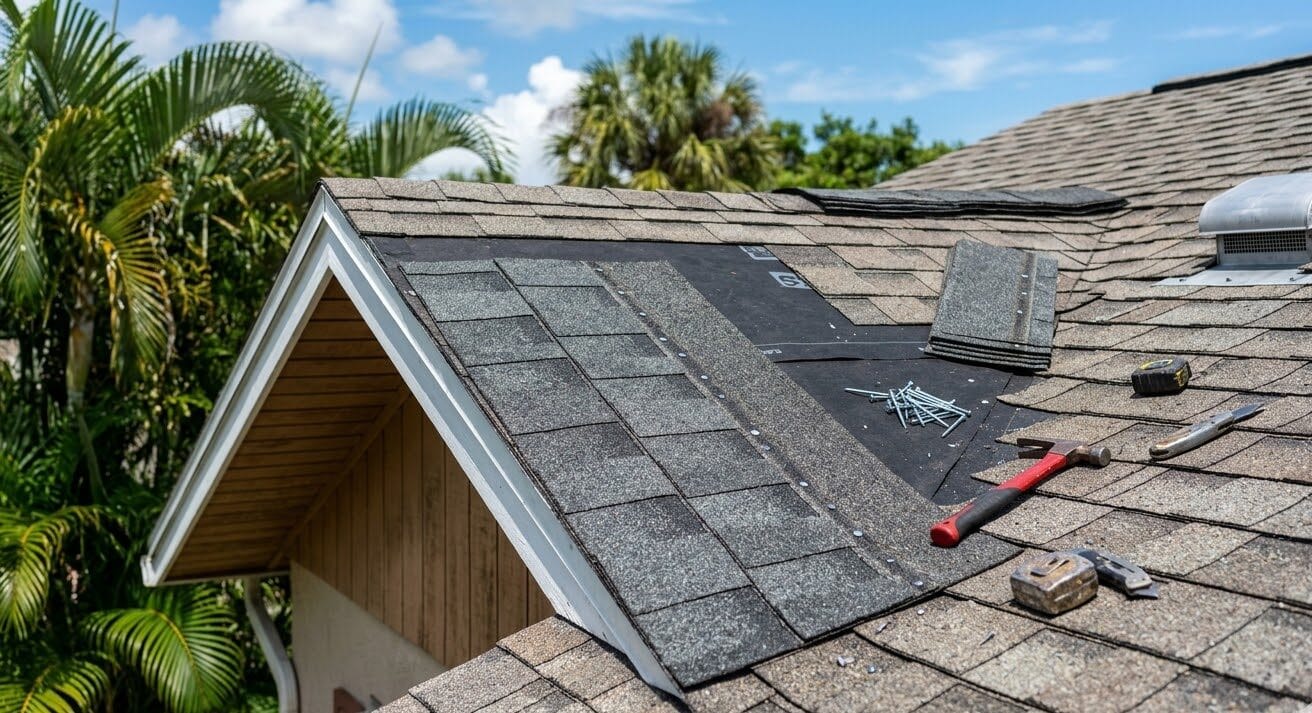
Pricing for emergency tarping is quoted by area, and 2026 market data puts standard tarp installation at roughly $0.70 to $2.00 per square foot, with true emergency response work at $1.00 to $2.80 per square foot. For most single-family homes that lands the total between about $400 and $1,500 depending on the size of the covered area, the pitch, the height and whether the call is after hours.
The material itself is a small part of that. Tarp material runs about $0.10 to $0.40 per square foot, with small tarps up to 10 by 20 feet costing $4 to $25 and full-roof tarps reaching around $250. Heavy-duty material can cost up to three times as much as standard 5 to 6 mil tarp. So when a DIY tarp costs $60 in material and a professional tarp costs $900, the $840 difference is not plastic. It is labor, a second person, ladders and staging, fastening that does not wreck the deck, liability coverage, and somebody who will come back when it lifts.
One number to hold onto: a properly installed tarp protects for up to about 90 days. That is the design life, not a suggestion, and Florida sun degrades polyethylene faster than the average. A tarp still on a roof in month five is not protection, it is a second leak waiting for a schedule. If a permanent fix is more than a season away, that is a conversation to have with your emergency roof repair contractor up front rather than in November.
What Your Policy Pays For Emergency Measures
Here is the part most homeowners get wrong in both directions. They either assume nothing is covered until the adjuster shows up, and so they let the roof stay open, or they assume everything is covered and authorize open-ended emergency work.
Florida homeowners policies generally cover reasonable costs you incur for necessary measures taken solely to protect covered property from further damage after a covered peril. Most forms cap that at the greater of $3,000 or 1 percent of your Coverage A limit unless you request approval to exceed it, and some forms carry a separate, higher allowance in the range of 2 percent of Coverage A specifically for installing a tarp or shrink wrap. On a home with $400,000 of Coverage A, 1 percent is $4,000, which comfortably covers any normal tarp job with room to spare.
Two practical rules follow from that. First, mitigation is not optional generosity on your part; every policy carries a duty to protect the property from further damage, and failing to do it can reduce what gets paid on the interior. Second, if the emergency work is going to exceed the cap, put the request to exceed it in writing before the work passes the threshold, not after.
There is also a limit worth knowing if a restoration company asks you to sign over benefits at the door. Under Florida Statute 627.7152, when a property owner acts under urgent or emergency circumstances and executes an assignment agreement to protect or mitigate further damage, the assignee may not receive an assignment of post-loss benefits exceeding the greater of $3,000 or 1 percent of the Coverage A limit. Read what you are signing at eleven at night, or get help reading it through insurance claims assistance.
The Claim Clock Runs While the Tarp Sits There
A tarp solves the water problem and solves nothing about the paperwork. Under Florida Statute 627.70132, a claim or reopened claim is barred unless notice was given to the insurer within one year after the date of loss, and a supplemental claim is barred unless notice was given within 18 months of the date of loss. Those deadlines were shortened from two years, and the tarp is exactly the thing that makes people forget them, because once the ceiling stops dripping the urgency evaporates.
Report the loss the same week you tarp it. The full sequence of deadlines and what date of loss actually means is laid out in Florida hurricane claim deadlines.
FEMA Operation Blue Roof: Free, But Not for Every Roof
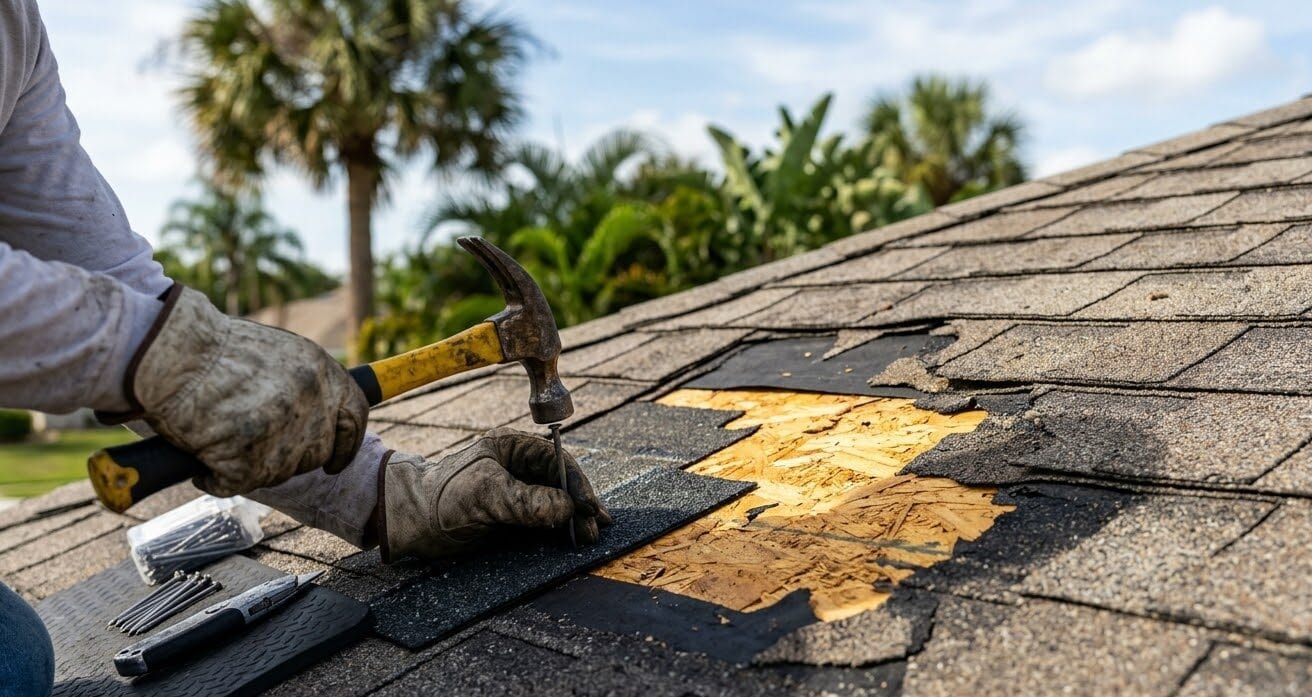
After a presidential disaster declaration, the US Army Corps of Engineers runs Operation Blue Roof in designated counties, installing reinforced sheeting at no cost to the homeowner. Registration is at BlueRoof.gov or 888-ROOF-BLU, with proof of residency required.
The eligibility rules matter more than the program itself, because a lot of Florida homes are excluded. The program covers primary residences and permanently occupied rental properties with less than 50 percent structural damage. Vacation rentals are excluded. So are homes with flat, metal, clay, slate or asbestos tile roofs, which in this market is a meaningful share of housing stock. And it only operates in counties covered by a declaration, which means the average summer thunderstorm that opens your roof is not a Blue Roof event.
Read that as good news with a boundary. If you qualify and a declaration is active, take it. If you do not, the decision goes back to DIY or hire, and waiting to find out costs you days from the 24 to 48 hour window.
Documentation That Turns a Tarp Into a Paid Line Item
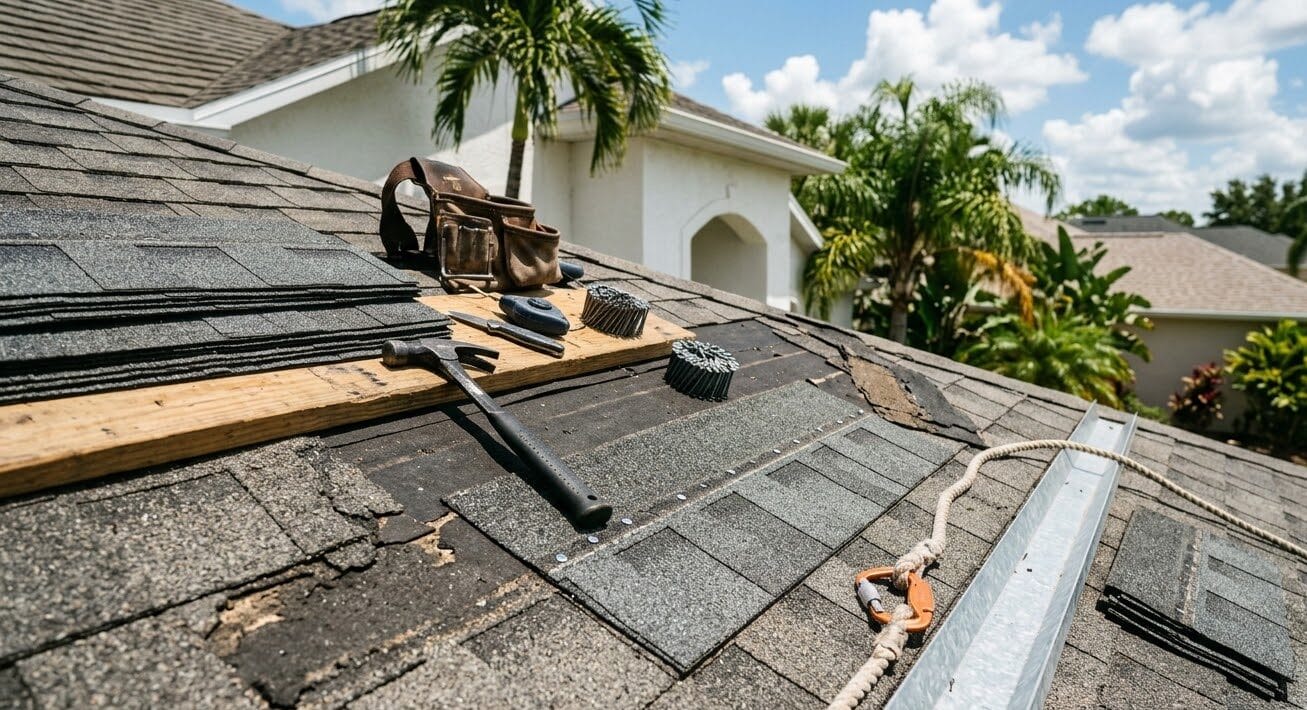
- Photograph before you cover. The tarp hides the evidence the adjuster needs. Wide shots showing the whole slope, close shots showing the opening, and at least one frame that establishes the location on the house.
- Photograph the interior on the same day. Ceiling stains, wet insulation, damaged contents. Interior damage is a separate line item from the roof and it needs its own record.
- Keep every receipt. Tarp, furring strips, screws, and the invoice if you hired the work out. Mitigation costs are reimbursable, but only the ones you can prove.
- Write down dates and times. When the damage happened, when you noticed it, when you covered it. A dated log is worth more than a memory nine months later.
- Get the damage documented by a roofer before cleanup. A written assessment separates storm damage from age, which is the argument most Florida claims actually turn on. Start with a documented roof inspection, and use the checklist in post-storm roof inspection checks so nothing gets missed.
What Happens After the Tarp
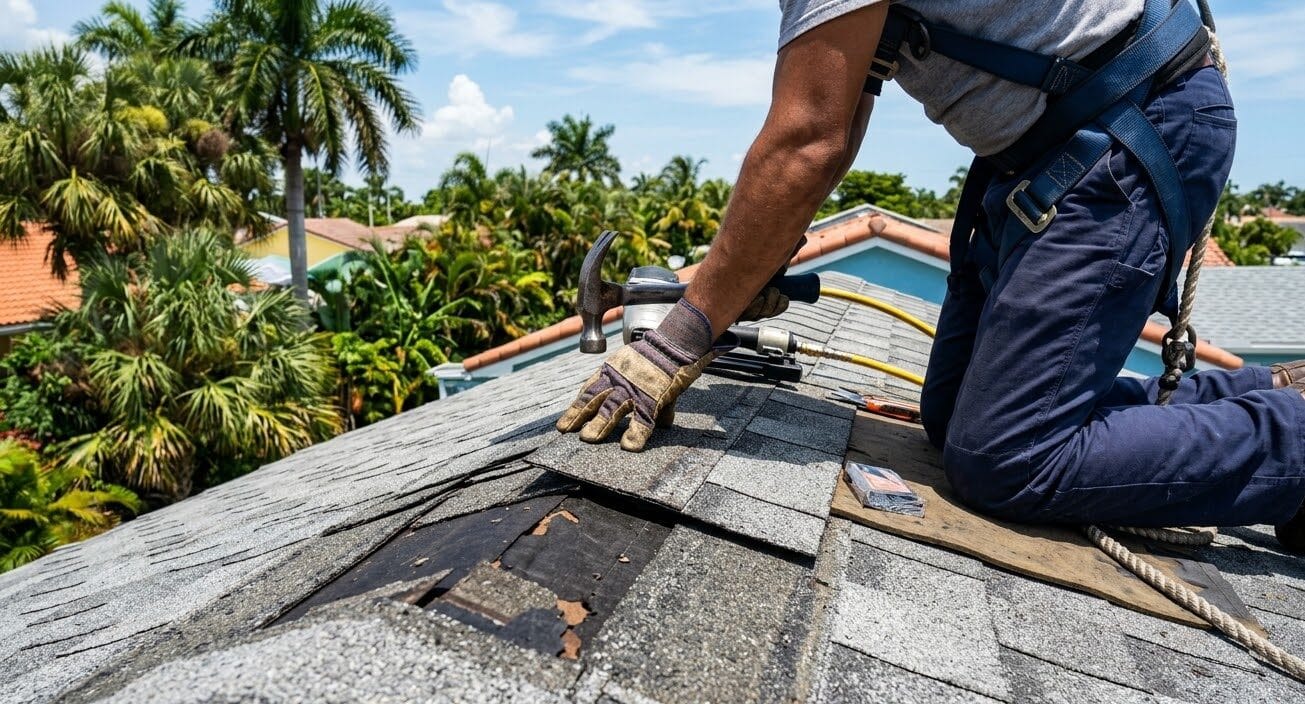
The tarp is day one of a sequence that should be short. Report the claim in the same week. Get a written scope from a licensed contractor. Let the adjuster see the damage with the documentation already in hand. Schedule the permanent repair inside the 90 day protection life of the tarp rather than at the edge of it.
Where that sequence breaks is almost always at the same point: the homeowner waits for the insurer before scheduling anything, and the insurer's timeline is not built around the tarp's. If the water intrusion is ongoing, a leak detection and repair visit finds the actual entry point, which is frequently not directly above the ceiling stain. If the storm did broader damage, storm damage restoration handles the roof and the interior as one scope rather than two disconnected ones.
Protech Roofing holds license CCC1335878 and works the Central Florida corridor from a Brooksville hub, including Spring Hill and the surrounding Hernando County communities, with same-day emergency response available at emergency roof repair in Brooksville. If a storm opened your roof tonight, the call to make is (352) 605-0696, and the thing to do while you wait is photograph everything and move what is under the leak.
FAQ
Frequently Asked Questions
How long can I leave a tarp on my roof in Florida?
+
Will my insurance pay for a roof tarp?
+
Is it cheaper to tarp my own roof?
+
Can I tarp a tile or metal roof myself?
+
How fast does mold start after a roof leak?
+
Related Articles
More guides for Florida homeowners
How Long a Roof Replacement Takes in Florida: 2026 Guide
A Florida shingle re-roof takes one to three days of physical work and about two to four weeks from contract to closed permit. Here is what happens each day, how metal and tile change the schedule and what causes delays.
Read Article
Best Shingles for Florida: Impact-Rated Class 4 Guide
The best shingle for a Florida home is usually a Class H architectural shingle installed as a full system. Here is how 3-tab, architectural and Class 4 impact-resistant shingles compare on cost, wind, insurance and lifespan.
Read Article
Metal Roof Cost in Florida 2026: Per-Sqft Guide
Metal roofs in Florida run about $8 to $23 per square foot installed, depending on the system. Here is what standing seam, stone coated steel and exposed fastener panels cost, what a typical home pays and how to compare quotes.
Read ArticleReady When You Are
Get your free roof inspection today.
No-pressure, written estimate. Same-week scheduling across Hernando County. Call us now or request a visit online.